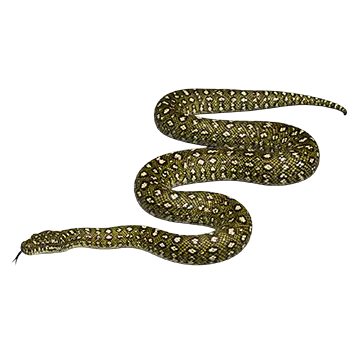

The Diamond Python occupies a position no other python holds: it is the southernmost member of the family, ranging along the cool, wet coastal forests and sandstone country of southeastern New South Wales. That geography is the single most important fact governing its nutrition. Unlike tropical relatives that maintain elevated body temperatures year round and digest quickly, Morelia spilota spilota operates at lower preferred body temperatures, tolerates activity in genuinely cool conditions, and experiences a long annual period during which it eats little or nothing at all. Feeding this subspecies on a tropical python schedule is one of the most common and most damaging husbandry errors in the hobby.
In the wild, the Diamond Python is a sit-and-wait ambush predator that positions itself along mammal runways, at the base of trees, and in low vegetation, sometimes holding a single ambush post for days. Its natural diet is broad and skewed toward small to medium endotherms: rats, mice, antechinus, ringtail possums, roosting and ground-foraging birds, and occasionally lizards, particularly in juveniles. This variety matters. The species has a documented history of a wasting and neurological condition informally called Diamond Python Syndrome, and while its causes remain incompletely understood, dietary monotony has long been listed among the suspected contributing factors alongside excessive constant heat and restricted genetics.
Caloric restraint is the defining nutritional principle for this animal. A Diamond Python grows slowly, matures late at roughly three to five years, and carries a modest metabolic engine relative to its length. Adults sustain themselves comfortably on far less food than a Coastal Carpet Python or a Ball Python of similar mass, and keepers accustomed to those species routinely overfeed Diamonds without realizing it. Obesity in this subspecies presents as fat deposits along the flanks and at the base of the tail, a rounded rather than gently triangular cross-section, and skin that stretches visibly between scales. The downstream consequences include hepatic lipidosis, reduced fertility, and shortened lifespan.
Digestion in a Diamond Python is entirely temperature dependent, which links nutrition inseparably to thermal management. A meal consumed when the snake has no access to a functional basking site will sit in the gut, ferment, and either be regurgitated or cause serious illness. Water is equally central and frequently underestimated: a well hydrated snake digests efficiently, passes urates cleanly, and sheds in a single piece, while a chronically dry animal accumulates thick urates and develops stuck sheds around the eyes and tail tip. Constant access to clean standing water is not an accessory to the diet, it is part of it.