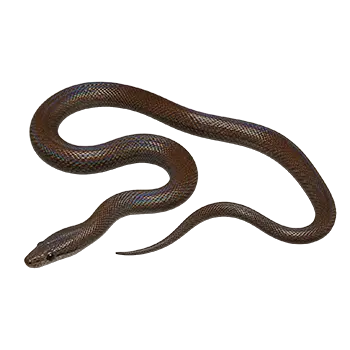

Selecting the right enclosure for a Colombian Rainbow Boa is the single most consequential housing decision a keeper will make, as the enclosure defines the boundaries within which every other environmental parameter — temperature, humidity, ventilation, and spatial complexity — must be established and maintained. An adult Epicrates maurus measuring five to seven feet requires an enclosure with a minimum footprint of four feet long by two feet deep, with a height of at least eighteen to twenty-four inches. This floor space provides sufficient room for the snake to stretch, thermoregulate by moving between warm and cool zones, and engage in the exploratory behavior that characterizes this naturally active species. Larger enclosures are always preferable when space permits, and a six-foot-long enclosure provides a meaningfully better quality of life for a large adult.
PVC and molded plastic enclosures have become the dominant choice among serious Colombian Rainbow Boa keepers, and their advantages over glass terrariums are substantial for this humidity-dependent species. PVC panels are non-porous, resist moisture absorption, and maintain humidity far more efficiently than glass tanks with screen lids. The sealed construction of a well-built PVC enclosure — with front-opening sliding or hinged doors and minimal ventilation gaps — creates a stable microclimate that reduces the keeper's workload in maintaining the sixty-five to eighty-five percent relative humidity range that this species demands. Leading PVC enclosure manufacturers produce models specifically sized for medium-bodied boids, with integrated channels for radiant heat panels, cord ports for thermostats and hygrometers, and stackable designs that accommodate multi-animal collections.
Glass aquariums remain a common starting point for new keepers, but they present significant drawbacks for Colombian Rainbow Boas. The screen lids that accompany standard glass tanks hemorrhage humidity, forcing the keeper into a constant cycle of misting and moisture replacement that rarely achieves stable conditions. Covering the screen with aluminum foil, plastic wrap, or acrylic sheeting improves humidity retention but creates a patchwork solution that lacks the reliability of a purpose-built PVC enclosure. Glass tanks also expose the snake on four sides, which can be stressful for a species that is semi-fossorial and crepuscular by nature. If a glass aquarium must be used — as is often the case for keepers housing neonates temporarily — covering three sides with an opaque background material reduces visual stress and improves the snake's sense of security.
Neonates and small juveniles should be started in appropriately scaled enclosures rather than placed directly into an adult-sized setup. A Colombian Rainbow Boa neonate measuring fourteen to eighteen inches does well in a six- to twelve-quart plastic tub with ventilation holes, a secure lid, a small water dish, a hide, and damp substrate. The confined space makes the young snake feel secure, simplifies the keeper's ability to monitor feeding and defecation, and prevents the animal from becoming lost or overwhelmed in an excessively large habitat. As the snake grows, it can be transitioned through progressively larger tubs or intermediate enclosures until it reaches the size that warrants its permanent adult enclosure.