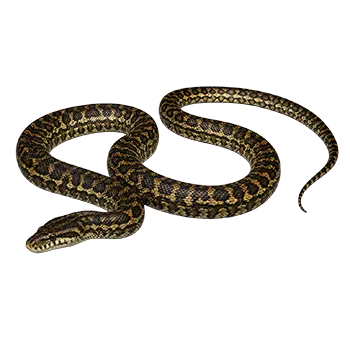

Enrichment for captive snakes is a concept that has gained significant traction in herpetological husbandry over the past two decades, driven by accumulating evidence that reptiles are far more cognitively capable and behaviorally complex than was historically assumed. The Coastal Carpet Python is an especially strong candidate for enrichment programming because of its high activity level, pronounced exploratory drive, and semi-arboreal lifestyle. In the wild, Morelia spilota mcdowelli navigates a three-dimensional environment that changes with the seasons — shifting foliage densities, varying prey availability, fluctuating temperatures and humidity — and a static captive enclosure that never changes is a poor substitute for this dynamic habitat.
The term enrichment, when applied to snakes, does not mean toys in the mammalian sense. Snakes do not play with objects the way a dog fetches a ball or a cat bats a feather toy. Instead, snake enrichment focuses on environmental complexity, novelty, sensory stimulation, and opportunities to perform species-typical behaviors such as climbing, exploring, hiding, foraging, and thermoregulating across a range of microhabitats. The goal is to create an environment that presents the snake with choices and challenges, encouraging physical activity and cognitive engagement rather than the passive immobility that characterizes many impoverished captive setups.
Research conducted on several python species, including Morelia spilota, has demonstrated measurable behavioral and physiological responses to enrichment. Snakes housed in enriched environments exhibit greater exploratory movement, more frequent use of elevated perches, more complete utilization of the available enclosure space, and lower baseline stress indicators as measured by fecal corticosterone levels. These findings align with decades of enrichment research in zoo settings and underscore the practical importance of providing captive snakes with more than the bare minimum of a hide box and a water bowl.
A well-designed enrichment program for a Coastal Carpet Python does not require expensive commercial products or constant keeper intervention. Many of the most effective enrichment strategies involve rearranging existing furnishings, introducing novel scent stimuli, varying feeding presentation, and providing climbing structures that challenge the snake's physical coordination. The investment is primarily one of thought and creativity rather than money, and the payoff — a more active, physically fit, and behaviorally engaged animal — is substantial and immediately visible.