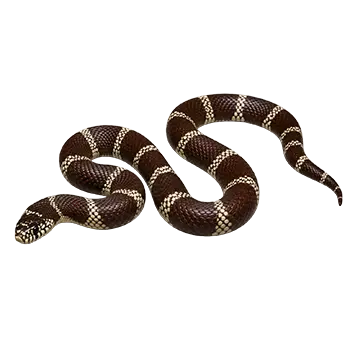

Enrichment for captive snakes is a concept that has gained significant traction in herpetological husbandry over the past two decades, driven by a growing body of behavioral research demonstrating that reptiles are far more cognitively engaged with their environments than was historically assumed. The California Kingsnake is an ideal candidate for enrichment programming because it is among the most active and exploratory colubrid species commonly kept in captivity. In the wild, Lampropeltis californiae navigates complex terrain — rocky outcrops, rodent burrows, fallen timber, leaf litter, and dense vegetation — while hunting a remarkably diverse array of prey. A barren enclosure with a water bowl and a single hide fails to replicate any of this environmental complexity and produces a snake that spends the vast majority of its time motionless and withdrawn.
The purpose of enrichment is not to entertain the keeper but to stimulate the snake's natural behavioral drives: exploration, foraging, thermoregulatory shuttling, burrowing, climbing, and scent investigation. A well-enriched California Kingsnake exhibits noticeably different behavior patterns compared to one housed in a minimalist setup. Enriched snakes are more active during their peak activity periods, display a broader range of locomotor behaviors, show stronger and more consistent feeding responses, and demonstrate reduced stress indicators such as persistent hiding, defensive musking, and refusal to feed. These behavioral outcomes are not subjective impressions — they have been documented in controlled studies across multiple colubrid and python species.
Enrichment should be thought of as an ongoing practice rather than a static arrangement. The most effective enrichment programs involve periodic changes to the enclosure layout, introduction of novel objects and scent stimuli, and variation in feeding presentation. A California Kingsnake that has thoroughly mapped every surface and passage in its enclosure over the course of several weeks has extracted the enrichment value from that configuration. Rearranging hides, repositioning branches, and introducing new textural elements refreshes the environment and reignites the snake's exploratory drive. This does not mean the enclosure should be overhauled constantly — frequency matters, and too-frequent changes can be stressful — but a monthly or bimonthly rotation of elements strikes an effective balance between novelty and stability.
Keepers should evaluate enrichment success by observing behavioral outcomes rather than anthropomorphizing the snake's experience. A snake that emerges from its hide to explore new objects, tongue-flicks surfaces and scent trails actively, and uses climbing structures and tunnels is demonstrating positive engagement. A snake that retreats to its hide and remains there for extended periods after an enclosure change may be stressed rather than enriched, indicating that the change was too dramatic or introduced an element the snake perceives as threatening. Gradual, incremental enrichment additions produce more reliable positive responses than wholesale enclosure redesigns.