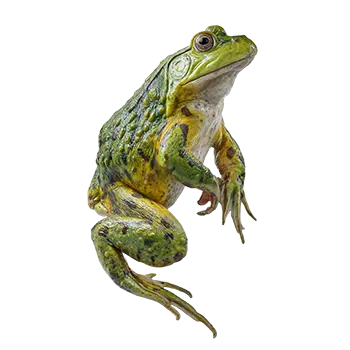

Why Enrichment Matters

Enrichment for an African Bullfrog does not look like enrichment for a dog or a parrot, and that difference leads many keepers to skip it entirely. The assumption is that because the species is sedentary, spending long stretches motionless and partially buried, it does not need or benefit from environmental stimulation. That assumption is incorrect. In the wild, Pyxicephalus adspersus navigates a complex sensory landscape of shifting soil moisture, passing prey vibrations, changing light cycles, and seasonal weather patterns. A captive enclosure that never changes deprives the animal of the inputs its nervous system evolved to process.

The behavioral consequences of an unstimulating environment accumulate slowly but are recognizable once you know what to look for. A chronically under-stimulated bullfrog may become a reluctant feeder, showing less interest in prey items over time even when body condition and temperature are normal. It may remain buried for unnaturally long periods, emerging only briefly before retreating. Some animals develop repetitive pacing or glass-surfing behaviors, which in amphibians are often misread as normal activity rather than signs of frustration or stress.

Enrichment does not need to be complicated or expensive. The core idea is to introduce controlled, safe novelty into the frog's environment so that it has reasons to investigate, react, and exercise the decision-making faculties it would use in nature. Small changes, offered on a rotating basis, keep the animal mentally engaged without overwhelming it. The goal is a frog that is alert, responsive, and behaviorally flexible, not one that has habituated to a static box.

It is worth noting that enrichment also benefits the keeper. An African Bullfrog that is actively hunting, burrowing in new areas, and responding to its environment is far more interesting and rewarding to observe than one that sits motionless in the same corner indefinitely. Enrichment transforms the keeping experience from passive husbandry into active engagement with a genuinely fascinating animal.

Feeding Enrichment

Feeding is the single most powerful enrichment tool available for African Bullfrogs because it taps directly into the species' dominant behavioral drive. In the wild, these frogs are ambush predators that detect, track, and strike at moving prey, a sequence that engages vision, vibration sensing, and explosive muscular coordination. In captivity, simply dropping pre-killed or sluggish insects in front of the frog collapses that entire behavioral chain into a reflexive gulp. Restoring some of the hunting sequence is the foundation of feeding enrichment.

The simplest method is to offer live prey that moves unpredictably within the enclosure. Crickets that hop across the substrate, roaches that scuttle along the glass, or earthworms that burrow into damp substrate all force the frog to orient, track, and time its strike. This is fundamentally different from tong-feeding, which delivers food directly and eliminates the hunting component. Tong-feeding has its place, particularly during supplementation or when monitoring intake precisely, but it should not be the exclusive delivery method.

Varying the location and timing of feedings adds another layer of unpredictability. Rather than always feeding at the same spot and the same hour, rotate between different areas of the enclosure and shift feeding time by an hour or two. The frog begins to patrol its environment rather than simply waiting at a conditioned feeding station. This mirrors the natural experience where prey arrival is stochastic, not scheduled.

For keepers comfortable with it, using feeding tongs to mimic prey movement, dragging an insect slowly across the substrate before releasing it near the frog, triggers a particularly strong hunting response. The frog will orient toward the movement, adjust its body angle, and deliver a lunging strike that exercises muscles rarely used in a passive feeding arrangement. This kind of targeted feeding enrichment can be done once or twice a week as a supplement to normal prey delivery.

Environmental Variety

Rearranging the enclosure layout on a periodic basis is one of the most effective and cost-free enrichment strategies available. Moving hides, shifting the position of the water dish, adding or rotating decor items, and altering the terrain contour of the substrate all force the frog to re-map its environment. African Bullfrogs demonstrate clear spatial awareness and will investigate changes in their territory, often spending several hours exploring a modified layout before settling into a new preferred spot.

The frequency of rearrangement should balance novelty against stress. A complete enclosure overhaul every week is excessive and counterproductive, as the frog never establishes a baseline of security. A more effective cadence is a partial change every two to three weeks, timed to coincide with a substrate refresh or routine cleaning. Move one or two items rather than everything, so the environment feels altered but not unrecognizable.

Introducing new objects on a temporary basis provides investigation opportunities without permanently cluttering the enclosure. A smooth river stone placed in a new position, a section of cork bark leaned against the glass at an unfamiliar angle, or a clump of dried leaf litter scattered on the substrate all give the frog something to explore with its forelimbs and snout. Rotate these items out after a few days and introduce something different the following week.

Substrate depth variation is an overlooked form of environmental enrichment. Rather than leveling the substrate flat, create gentle mounds and shallow depressions across the enclosure floor. The frog will select different micro-habitats based on temperature, moisture, and its current behavioral state, choosing a raised, drier area for basking and a low, damp depression for burrowing. This terrain complexity more closely replicates the uneven savanna ground the species inhabits in nature.

Sensory Stimulation

African Bullfrogs possess well-developed senses that extend beyond vision, and enrichment strategies that engage vibration detection, olfaction, and tactile exploration are often more effective than visually oriented approaches. The species relies heavily on substrate-borne vibrations to detect approaching prey and potential threats, and introducing safe vibratory stimuli can elicit alert, investigative behavior that the frog would otherwise never display in captivity.

One of the simplest vibratory enrichment techniques is to lightly tap the exterior of the enclosure glass or the substrate surface with a fingertip before introducing prey. The vibration cues the frog that something is happening in its environment and primes the feeding response. Over time, the frog associates the tap pattern with feeding, which produces a more engaged and active animal during feeding sessions. This is classical conditioning applied as enrichment, and it works reliably with this species.

Moisture variation across the substrate creates sensory gradients that encourage movement and decision-making. Rather than misting the entire enclosure uniformly, direct the spray to create one damp zone and leave another area drier. The frog will move between zones based on its hydration state and thermoregulatory needs, exercising agency over its microclimate. This kind of passive enrichment operates continuously without requiring the keeper's active involvement once set up.

Ambient sound can serve as low-level sensory input, though its effects are subtle. Some keepers report that playing recorded rain sounds or low-frequency ambient noise during evening hours, when the frog is naturally active, seems to increase surface activity and exploratory behavior. The evidence is anecdotal rather than experimental, but given that wild bullfrogs are acoustically active animals that respond strongly to rain and conspecific calls, the underlying logic is sound. Keep volume low and avoid sudden, sharp noises, which are more likely to startle than stimulate.

Burrowing and Digging Opportunities

Burrowing is not an optional behavior for African Bullfrogs; it is a core component of their behavioral repertoire that serves thermoregulation, moisture management, stress relief, and predatory concealment. An enclosure that does not support meaningful burrowing is fundamentally incomplete, regardless of how well it meets temperature and humidity targets. Enrichment in this category focuses on making the burrowing experience more varied and engaging rather than simply providing enough substrate depth.

Substrate composition directly influences digging quality. A loose, uniform coconut fiber bed allows the frog to push into the substrate easily but offers little structural resistance or variety. Adding a proportion of organic topsoil creates a denser, more cohesive medium that the frog must work harder to displace, which provides physical exercise and a more realistic digging experience. Some keepers incorporate a small amount of sphagnum moss into the mix, which creates pockets of higher moisture within the substrate column that the frog can discover and exploit.

Providing a designated deep-dig zone within the enclosure gives the frog a specific area where the substrate is deeper, perhaps five to six inches rather than the standard three to four. This zone, typically positioned on the cooler end of the thermal gradient, allows the frog to execute full burial behavior where it disappears entirely beneath the surface. Watching an African Bullfrog dig itself in using its powerful hind legs and pelvic spade is one of the most fascinating natural behaviors the species displays, and denying it by skimping on substrate depth is a significant welfare oversight.

Buried objects add discovery enrichment to the burrowing experience. A smooth stone, a small piece of cork bark, or a ceramic tile fragment placed beneath the substrate surface gives the frog something to encounter and investigate as it digs. These objects should be inert, free of sharp edges, and light enough that the frog can push past them without injury. Rotate their positions during substrate changes so the frog encounters them in new locations each time.

Water-Based Enrichment

The water feature in an African Bullfrog enclosure is typically treated as a static utility, a dish of clean water that the frog soaks in and defecates in. But with modest modifications, the water area can become an active enrichment zone that encourages natural soaking behavior, exploration, and even feeding.

Varying the water depth slightly between changes introduces a low-level environmental shift that the frog registers and responds to. One day the dish might be filled to just above the frog's ventral patch; the next change might bring the level slightly higher, encouraging the frog to settle into a different posture. This is a subtle enrichment, but for a species that spends considerable time in its water feature, small variations prevent habituation to a completely static experience.

Placing prey items in or near the water creates an aquatic feeding opportunity that closely mirrors natural behavior. In the wild, African Bullfrogs frequently hunt at the edges of temporary pools, striking at insects, smaller frogs, and fish that venture too close. Dropping an earthworm into the shallow water dish or releasing a cricket near the water's edge prompts the frog to strike in or toward water, activating a different motor pattern than dry-land feeding. This should be done sparingly to avoid fouling the water, but as an occasional enrichment activity, it is highly effective.

For keepers with a paludarium-style setup that includes a dedicated water section, adding a small, gentle water flow from a low-powered pump creates surface movement that some bullfrogs investigate with interest. The flow should be barely perceptible, producing subtle ripples rather than a current, and the pump must be fully guarded so the frog cannot contact the intake or impeller. Moving water also stays cleaner than still water, providing a secondary maintenance benefit alongside its enrichment value.

Temperature variation in the water dish is another avenue. Offering slightly warmer water after a substrate misting, or slightly cooler water on a warm day, gives the frog a thermal choice within its soaking behavior. The temperature difference should be modest, no more than a few degrees from the ambient range, to avoid shocking the animal. The point is subtle variety, not dramatic change.

What to Avoid

Not every product marketed as reptile or amphibian enrichment is appropriate for African Bullfrogs, and some common enrichment practices used with other species can be actively harmful here. Understanding what to avoid is as important as knowing what to offer.

Exercise balls, wheels, and any product that requires the animal to move continuously inside a confined space are entirely inappropriate. These products are designed for small mammals and have no application to amphibians. An African Bullfrog placed in such a device would be unable to thermoregulate, would quickly dehydrate, and would experience significant stress. The same applies to supervised outdoor excursions, which expose the frog to uncontrolled temperatures, direct sun, pesticides, parasites, and escape risk.

Mirrors and reflective surfaces are sometimes suggested as visual enrichment for reptiles but are counterproductive for African Bullfrogs. Males of this species are aggressively territorial, and a persistent mirror reflection triggers a stress response that the frog cannot resolve by displacing the perceived intruder. Chronic exposure to its own reflection can elevate cortisol levels, suppress appetite, and provoke repeated lunging at the glass, risking snout abrasion and jaw injury.

Small, ingestible decorative items, including glass beads, colored gravel, small figurines, and novelty terrarium ornaments, pose a direct impaction hazard. The bullfrog's feeding strike is fast and indiscriminate, and any object small enough to fit in the frog's gape and positioned near a prey item is at risk of being swallowed. All enrichment objects placed inside the enclosure must be too large to ingest and free of paint, coatings, or adhesives that could leach into the humid environment.

Finally, handling should not be confused with enrichment. While brief, occasional handling for health checks or enclosure maintenance is a normal part of keeping, routine handling for the keeper's entertainment provides no benefit to the frog. African Bullfrogs absorb substances through their skin, and human hand oils, soap residue, and lotions are all potential irritants. Handle only when necessary, with clean, wet hands, and recognize that the frog's tolerance of handling is not the same as enjoyment of it.

Always consult a qualified professional before making any health-related decisions. This content is provided for informational reference only and should not replace professional guidance specific to your animal.