
Nutritional Needs

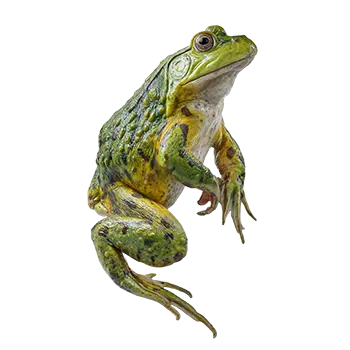
The African Bullfrog, Pyxicephalus adspersus, is a voracious opportunistic carnivore that will attempt to eat virtually anything it can overpower and swallow. In the wild, adults consume insects, smaller frogs, lizards, rodents, and even small birds. This broad palate means a captive diet must be built around variety, but it also means keepers must exercise restraint, because the species is exceptionally prone to obesity when food is too available and too calorie-dense.

Calcium metabolism is the nutritional concern that underpins nearly every feeding decision. Like most captive amphibians, African Bullfrogs are at chronic risk for metabolic bone disease if the calcium-to-phosphorus ratio in their diet is not actively managed. Feeder insects are naturally phosphorus-heavy, and vertebrate prey like mice carry their own imbalance when offered too frequently. Supplementation through dusting and gut-loading is not a suggestion but a structural requirement of keeping this species healthy over its long lifespan.

Because of their size, adult males in particular require substantial prey items, yet portion control remains essential. An overfed bullfrog deposits fat in its coelomic cavity, stressing organs and shortening its life. The animal's willingness to eat is not a reliable indicator of its need. A keeper who feeds on demand will almost certainly produce an obese frog within a year or two. Structured feeding schedules, tied to age and body condition, are far more protective than appetite-led approaches.

Hydration intersects with nutrition in this species more than many keepers realize. African Bullfrogs absorb water through their ventral skin patch, and they obtain additional moisture from prey. A shallow, clean water dish large enough for the frog to sit in is a non-negotiable element of the habitat, and the cleanliness of that water directly affects nutrient absorption and waste elimination.

What to Look For

When sourcing feeder insects for an African Bullfrog, the first consideration is scale. This is a large, powerful amphibian, and prey items should be proportionate to the frog's gape without being so large that they risk injury to the animal's jaw or esophagus. A practical guideline is that prey should be no wider than the distance between the frog's eyes, though adults can comfortably take surprisingly large items. For juveniles and subadults, erring on the smaller side with more frequent offerings is safer than pushing prey size.

Supplier quality has a direct impact on nutritional outcomes. Feeder insects should come from established breeders who maintain clean, well-fed colonies. Healthy crickets and roaches are active, uniformly sized, and free of mold, mites, or ammonia odor. Dead-on-arrival insects or batches with a high mortality rate upon delivery indicate poor colony management and typically mean the surviving insects are nutritionally depleted before they ever reach a gut-load.

Gut-load acceptance is one of the most underrated qualities to evaluate when choosing a feeder species. The best feeders are those that readily consume a nutrient-dense diet in the 24 to 48 hours before being offered, effectively transforming the insect into a mineral and vitamin delivery vehicle. Species that are picky eaters themselves, or that die quickly in holding containers, undermine the entire supplementation chain.

Finally, consider storage logistics. African Bullfrogs eat larger and fewer prey items than most small reptiles, so you are not burning through feeders at the same pace. Insects that are hardy in a simple keeper setup, such as dubia roaches, allow you to maintain a ready supply without the die-off and odor problems associated with short-lived species like crickets.

Staple Feeder Insects

Dubia roaches and large crickets serve as the two primary staple insects for African Bullfrogs, and most experienced keepers lean toward roaches for their superior hardiness and nutritional profile. Dubia roaches are meaty, carry a favorable protein-to-fat ratio, gut-load exceptionally well, and are easy to maintain in a simple plastic tub with egg crate and heat. They cannot climb smooth surfaces, are silent, and produce virtually no odor when kept clean. For a species as long-lived as the African Bullfrog, the convenience and consistency of dubia roaches translate directly into better long-term nutrition.

Crickets remain a valid staple and offer one meaningful advantage: movement. Their erratic hopping strongly triggers the bullfrog's sit-and-wait predatory instinct, which provides behavioral enrichment alongside nutrition. The trade-offs are well known. Crickets are noisy, escape-prone, short-lived, and fouling. They must be gut-loaded promptly after purchase because commercially shipped crickets are typically nutritionally hollow. If crickets are your primary feeder, plan to use them within 48 hours of gut-loading for the best results.

Discoid roaches are a useful alternative in jurisdictions where dubia roaches are restricted. They offer a similar nutritional profile and are slightly more tolerant of lower temperatures, though they are also somewhat faster and can climb rough surfaces, making escape prevention a consideration. Black soldier fly larvae are another emerging staple option, notable for their naturally high calcium content, which reduces though does not eliminate the need for dusting.

Regardless of which staple you settle on, the principle is the same: choose a feeder you can reliably keep healthy and well-nourished between feeding days. The best insect in theory is worthless if it arrives at the frog's mouth starved and dehydrated.

Variety and Occasional Feeders

Dietary variety is more important for African Bullfrogs than for many smaller insectivores because the species naturally exploits a wide prey base. Rotating through several feeder types prevents nutritional gaps and keeps the frog engaged with feeding, reducing the risk of food fixation on a single prey item.

Nightcrawlers and red wigglers are excellent supplemental feeders. Earthworms are soft-bodied, easy to digest, naturally high in moisture, and well accepted by most bullfrogs. They are particularly useful for juveniles and for animals recovering from illness or dehydration. The main caution is sourcing: worms should come from a bait supplier or reptile vendor, never from garden soil treated with fertilizers or pesticides. Rinse them before offering to remove any residual substrate.

Hornworms and silkworms provide a hydrating, nutrient-rich change of pace. Hornworms are especially moisture-dense and can help rehydrate a frog that has been reluctant to soak. Both are soft-bodied and gentle on digestion. Hornworms grow quickly, so purchase them at a size appropriate for your frog and use them promptly before they outpace the animal's gape.

For adult African Bullfrogs, appropriately sized pinky or fuzzy mice can be offered occasionally, roughly once a month or less. Vertebrate prey provides a complete nutritional package including calcium from bone, but it is extremely calorie-dense. Routine mouse feeding is one of the fastest routes to a dangerously obese bullfrog. Treat rodent prey as a periodic supplement, not a convenience staple, and never offer live rodents, which can injure the frog and raise welfare concerns.

Supplements

Supplementation for African Bullfrogs follows the same core framework used across captive amphibians, but the stakes are amplified by the species' size and longevity. A frog that may live 25 years or more will accumulate the consequences of even minor nutritional shortfalls, making a disciplined supplementation routine essential from the outset.

The foundation is a high-quality, phosphorus-free calcium powder. Prey items should be lightly dusted with plain calcium at most feedings for juveniles and at every other feeding for adults. The dusting should coat the insect without caking it so heavily that the frog rejects it. A simple method is to place a few insects in a plastic bag with a small pinch of powder and shake gently until they are lightly coated.

Calcium with vitamin D3 should be rotated in at a lower frequency, typically once or twice a week for growing juveniles and once a week or less for adults. D3 is necessary for calcium absorption, but because it is fat-soluble, excess accumulates in tissue and can cause toxicity. If the enclosure includes a low-level UVB source, the frog synthesizes some D3 on its own, and the supplementation frequency can be reduced accordingly. Keepers who do not provide UVB should be more diligent with D3 rotation.

A broad-spectrum reptile or amphibian multivitamin rounds out the regimen, offered roughly once every one to two weeks. This covers trace minerals and fat-soluble vitamins that gut-loading alone may not fully deliver. As with D3, moderation is the guiding principle. Over-supplementation with vitamin A in particular can cause toxicity in amphibians. Follow the product's dosage guidance, and when in doubt, err on the side of less.

Gut-loading is the other half of the supplementation equation and should never be treated as optional. Feeding your insects a calcium-rich, vegetable-based diet for 24 to 48 hours before offering them builds nutrition into the prey from the inside out. Commercial gut-load formulas work well, as do fresh items like dark leafy greens, squash, and carrot. The goal is a well-nourished insect that delivers minerals systemically, not just on its surface.

Foods to Avoid

Wild-caught insects and invertebrates should never be offered to a captive African Bullfrog. Pesticide exposure is the primary concern, but parasites carried by wild insects are an equally serious risk. Even in areas perceived as chemical-free, the parasite load on wild-caught prey can introduce pathogens that a captive animal's immune system is not equipped to handle. All feeder insects should be captive-bred from a reputable source.

Fireflies and other bioluminescent insects are acutely toxic to amphibians and must be avoided absolutely. The lucibufagins present in firefly tissue are cardiotoxic, and ingestion of even a single firefly can be fatal to a frog. This extends to any insect you cannot positively identify. If there is any doubt about what an insect is, it does not belong in the enclosure.

Processed human foods, pet foods designed for mammals, and plant matter have no place in an African Bullfrog's diet. The species is an obligate carnivore in practice, and its digestive system is not adapted to process grains, fruits, or vegetable matter directly. The only role for produce is inside feeder insects as part of the gut-loading process.

Live feeder fish, particularly goldfish, are sometimes offered to large bullfrogs but are best avoided. Goldfish contain thiaminase, an enzyme that degrades vitamin B1 and can cause deficiency over time. Other common feeder fish carry similar risks or are raised in conditions that make parasite transmission likely. If you wish to offer aquatic prey, purpose-bred guppies or mosquitofish from a clean source are safer, though even these should remain an occasional item rather than a dietary fixture. The caloric density of vertebrate prey means that overuse of fish or mice will drive obesity faster than any insect-based diet.

Feeding Schedule

Juvenile African Bullfrogs grow at an extraordinary rate, and their feeding schedule should support that growth without tipping into excess. Frogs under six months of age benefit from daily feedings of appropriately sized insects, offered in quantities the animal will consume within ten to fifteen minutes. At this stage, prey should be dusted with calcium at every feeding and with D3 and multivitamin on their respective rotation days. Monitoring growth rate and body condition weekly helps catch both underfeeding and the early signs of overfeeding.

As the frog matures past the six-month mark and approaches subadult size, feeding frequency should taper to every other day. Portion sizes increase as prey items scale up, but the total caloric load per week should be managed to promote lean growth rather than rapid fat deposition. This is the stage where many keepers accidentally establish overfeeding habits, because the frog's appetite remains aggressive even as its metabolic needs per unit of body weight decline.

Adult African Bullfrogs, particularly males, should be fed two to three times per week at most. A typical adult feeding might consist of several large dubia roaches, a few nightcrawlers, or a combination of staple and variety feeders. Rodent prey, if offered at all, replaces an insect feeding rather than supplementing it, and should appear no more frequently than once a month. The frog's body condition is the best guide: a healthy adult carries a rounded but not distended body, with the limbs clearly visible and no excessive fat rolls around the shoulders or flanks.

Seasonal appetite fluctuations are normal and should be respected rather than overridden. African Bullfrogs may reduce food intake during cooler months or during transitions in photoperiod, and a brief voluntary fast is not cause for alarm in an otherwise healthy, well-conditioned animal. Forced feeding or dramatically increasing prey offerings to coax a temporarily uninterested frog back to the table is counterproductive. If appetite loss persists beyond two to three weeks or is accompanied by lethargy, weight loss, or changes in skin condition, a veterinary evaluation is warranted.

Always consult a qualified professional before making any health-related decisions. This content is provided for informational reference only and should not replace professional guidance specific to your animal.