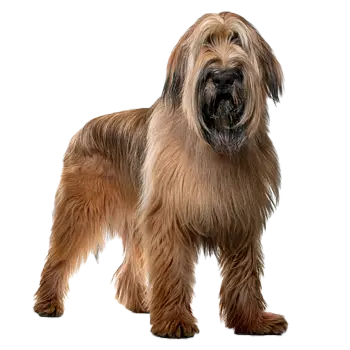

Collars, Harnesses & Leashes

Choosing the right collar for a Briard requires balancing functionality with coat preservation. Traditional flat collars work for holding identification tags and registration, but they can mat and break the coat around the neck with constant wear. Many Briard owners opt for rolled leather or rounded nylon collars that sit against the neck with minimal surface area, reducing friction and tangling in the long hair. The collar should be snug enough that two fingers fit between the collar and the neck but not so loose that it can slip over the ears.

Harnesses are the preferred walking and training tool for most Briard owners. A front-clip harness distributes leash pressure across the chest rather than the throat, which is both safer and more effective for controlling a strong, 80-plus-pound dog that may pull on leash. Back-clip harnesses are comfortable for well-trained Briards but offer less steering control for dogs still learning leash manners. Look for harnesses with padded straps wide enough to prevent digging into the coat and skin.

Leash selection depends on the situation. A six-foot leather or biothane leash is the standard for everyday walks, offering durability and a comfortable grip. Leather leashes develop a pleasant flexibility with use and provide better tactile feedback for reading the dog's movement. Retractable leashes are generally not recommended for Briards — the thin cord can tangle in the coat, and the inconsistent length teaches the dog that pulling extends the available range, reinforcing the exact behavior most owners want to discourage.

For training purposes, a long line of 15 to 30 feet provides controlled off-leash practice in open areas. Long lines let the Briard practice recall, explore at a distance, and build off-leash reliability without the risk of losing control. Use a lightweight biothane long line rather than nylon webbing, which absorbs water, collects dirt, and creates friction burns if it runs through your hands.

Grooming Tools

Grooming is not optional for the Briard — it is a core responsibility of ownership. The breed's long, slightly wavy double coat requires thorough brushing at least two to three times per week to prevent matting, and daily attention during seasonal coat changes. The essential grooming toolkit for a Briard includes a pin brush, a slicker brush, a long-toothed metal comb, a dematting tool, and a quality pair of thinning shears.

The pin brush handles the bulk of routine coat maintenance, working through the outer coat without pulling or breaking hair. Follow the pin brush with a slicker brush to address the finer undercoat, working in sections from the skin outward. Finishing with a metal comb through each section confirms that all tangles have been addressed — if the comb catches, that area needs additional brushing before moving on.

Dematting tools are necessary for the inevitable mats that form behind the ears, in the armpits, between the hind legs, and along the belly. A dematting rake with rotating teeth or a mat splitter allows you to work through tangles without cutting away large sections of coat. Patience matters more than force — working a mat apart gradually preserves coat volume and prevents skin irritation from aggressive pulling.

Bathing should occur every four to six weeks or as needed when the coat becomes dirty. The Briard's coat requires thorough soaking, generous shampoo application, complete rinsing — residual shampoo causes itching and flaking — and a conditioning step to maintain coat texture and manageability. Drying is the most time-consuming part of the process; a high-velocity dryer is a worthwhile investment for Briard owners, as it cuts drying time dramatically compared to towel drying and helps straighten the coat while removing loose undercoat.

Bowls & Feeders

Bowl selection for a Briard should account for the breed's size, deep chest, facial hair, and eating habits. Elevated feeding stations that raise food and water bowls to chest height reduce neck strain and may help with digestion, though research on whether elevation reduces bloat risk specifically remains inconclusive. Regardless of bloat considerations, most large dogs eat more comfortably from raised bowls, and the improved posture is easier on aging joints.

Stainless steel bowls are the best all-purpose choice. They resist bacterial buildup, don't absorb odors, won't crack or chip, and are easy to sanitize in the dishwasher. Ceramic bowls are acceptable if they are lead-free and uncracked, as hairline fractures harbor bacteria. Avoid plastic bowls entirely — they scratch easily, trap bacteria in surface abrasions, and can cause contact dermatitis or acne on the chin and muzzle in sensitive dogs.

The Briard's long facial hair creates a practical challenge at mealtime. Beards and mustaches get soaked during drinking and coated during eating, leading to dripping water trails through the house and food debris trapped in facial hair. Deep, narrow-diameter water bowls or no-splash bowl designs help contain mess, and some owners use snoods or beard wraps during meals to keep facial hair clean. Wiping the beard with a dry towel after each meal prevents moisture from lingering and causing skin irritation or odor.

Slow-feeder bowls with ridges, mazes, or raised patterns inside the bowl force the dog to work around obstacles to access food, naturally slowing consumption. For a deep-chested breed at elevated bloat risk, anything that reduces the speed of eating is beneficial. Slow feeders also add a mild enrichment component to mealtime, turning a routine task into a brief problem-solving exercise.

Travel Gear

Traveling with a Briard requires planning around the dog's size and coat. For car travel, a crash-tested travel crate sized for a large breed is the safest option. The crate should be secured in the cargo area of an SUV or wagon — most sedans cannot accommodate a crate large enough for an adult Briard. If a crate won't fit your vehicle, a crash-tested seat belt harness designed for large dogs provides a reasonable alternative, keeping the dog restrained during sudden stops.

Cargo area liners and seat covers protect your vehicle's interior from the considerable hair, dirt, and drool a Briard produces during travel. Waterproof, quilted covers with non-slip backing prevent the cover from bunching under the dog's movement and protect upholstery from claw scratches and coat oils. A dedicated set of travel towels for wiping down the dog before loading helps keep the vehicle cleaner and reduces post-trip cleaning time.

For air travel, the Briard's size means it will fly in cargo on most airlines, which requires an airline-approved hard-sided crate meeting specific dimensional and ventilation requirements. Air travel with a large dog involves significant advance preparation including veterinary health certificates, airline breed policies, temperature embargoes, and crate conditioning to ensure the dog is comfortable in the enclosure for extended periods. Research individual airline requirements thoroughly before booking, as policies vary widely and change frequently.

Portable travel bowls, a supply of the dog's regular food, any medications, vaccination records, and a basic first-aid kit round out the travel essentials. Collapsible silicone bowls pack flat and weigh nothing, making them ideal for road trips, hiking, and hotel stays. Keeping a dedicated travel bag packed with these items means you can load up and go without scrambling to assemble supplies each time.

Safety & ID

Every Briard should carry identification at all times in the form of both a collar tag and a microchip. Collar tags provide instant visual identification that anyone can read without special equipment, making them the fastest route to reuniting a lost dog with its owner. Include your phone number, the dog's name, and any critical medical information on the tag. Engraved stainless steel or brass tags are more durable than printed or painted options that wear illegible over time.

Microchipping provides a permanent, tamper-proof backup identification that survives even if the collar is lost or removed. The microchip is a tiny transponder injected under the skin between the shoulder blades, and it can be scanned by any veterinary office or animal shelter. Registration of the chip in the manufacturer's database — and keeping your contact information current — is what makes the chip functional. An unregistered chip is essentially useless, so verify your registration annually.

Reflective and LED accessories improve visibility during early morning, evening, and nighttime walks. The Briard's dark tawny or black coat makes it particularly difficult for drivers to see in low-light conditions. A reflective collar strip, a clip-on LED light, or a reflective harness vest ensures the dog remains visible to traffic. These accessories are inexpensive and can prevent a dangerous situation on roads without sidewalks or in poorly lit neighborhoods.

For Briards that spend time off-leash in unfenced areas, a GPS collar attachment or tracking device provides real-time location data if the dog wanders out of visual range. These devices are covered in greater detail on the tech page, but from a safety perspective, the peace of mind they provide is significant for owners of a large, fast dog with strong protective instincts that could pursue a perceived threat well beyond earshot.

Seasonal Gear

The Briard's heavy coat provides substantial natural protection against cold weather, but extreme conditions or prolonged outdoor exposure may still warrant additional gear. A waterproof outer layer — a rain jacket or slicker — keeps the coat from becoming saturated during wet weather walks. A soaked Briard coat takes hours to dry fully and creates an unpleasant damp-dog environment indoors. A well-fitted rain coat prevents waterlogging and dramatically reduces post-walk drying time.

Paw protection is important year-round but especially critical in winter and summer extremes. Winter road salt and ice-melting chemicals irritate and crack paw pads, while hot summer pavement can cause burns. Paw wax or balm applied before walks creates a protective barrier, and dog boots provide the most complete protection if your Briard will tolerate them. Introducing boots gradually with positive reinforcement during puppyhood makes acceptance much easier than forcing them on an adult dog for the first time.

Summer gear for Briards focuses on cooling. Evaporative cooling vests, dampened with water and placed on the dog's body, lower surface temperature through evaporation and are effective during warm-weather walks and outdoor activities. Cooling mats — gel-filled or pressure-activated — provide a cool resting surface indoors or in shaded outdoor areas. These products are genuinely useful for a breed that carries a heavy insulating coat through months when insulation is the last thing needed.

Seasonal shedding intensifies the need for grooming tools during spring and fall coat transitions. A deshedding rake or undercoat-specific tool helps remove the dense undercoat that loosens during seasonal changes, reducing the volume of hair deposited on floors, furniture, and clothing. Daily brushing during peak shedding periods, while time-consuming, prevents the loose undercoat from matting into the remaining coat and creating larger grooming problems.

Always consult a qualified professional before making any health-related decisions. This content is provided for informational reference only and should not replace professional guidance specific to your animal.