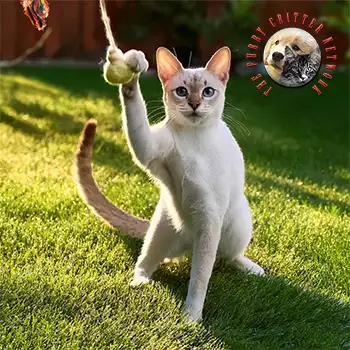

Play Style & Drive

The Singapura is often described as a perpetual kitten — a cat that retains intense playfulness well into adulthood and even old age. These cats possess an extraordinary combination of intelligence, speed, and curiosity that drives them to investigate and interact with virtually everything in their environment. Understanding the Singapura's play style is the first step in selecting toys that will genuinely engage them rather than gathering dust under the couch.

Singapuras are ambush predators at heart. They love to stalk, pounce, and chase, and they're extraordinarily quick despite their small size. Their light weight allows them to make acrobatic leaps and mid-air direction changes that heavier cats simply can't manage. Toys that simulate prey movement — darting, fluttering, and unpredictable motion — trigger the strongest play responses.

These cats are also remarkably persistent problem-solvers. Where many cats lose interest in a puzzle after a few failed attempts, Singapuras tend to become more determined. They'll work at a challenging toy for extended periods, experimenting with different approaches until they succeed. This intellectual tenacity means they need toys that offer genuine challenge, not just motion.

Social play is deeply important to Singapuras. They prefer interactive play sessions with their owners over solitary toy engagement, though they certainly need self-directed play options for when humans aren't available. The ideal toy collection includes both types — interactive toys for bonding time and autonomous toys for independent entertainment.

Interactive & Puzzle Toys

Puzzle feeders and treat-dispensing toys are among the most valuable enrichment tools for a Singapura. These combine the cat's food motivation with its problem-solving drive, providing mental stimulation that physical play alone cannot match. Start with simpler designs that reward the cat quickly, then progress to more complex multi-step puzzles as the cat masters each level.

Slider puzzles, ball-track feeders, and lift-and-reveal boards all work well with this breed. The key is matching difficulty to the individual cat's experience level. A puzzle that's too easy will bore a Singapura within days, while one that's impossibly difficult can lead to frustration. The sweet spot is a challenge that requires effort but yields consistent rewards with persistence.

Interactive wand toys are the cornerstone of human-directed play for Singapuras. Feather wands, string chasers, and ribbon toys allow you to simulate prey behavior — the erratic darting of a mouse, the fluttering of a bird, the slow creeping of an insect. Vary your technique during play sessions, alternating between fast chases and slow, twitching movements that build anticipation before the pounce.

Electronic interactive toys that respond to the cat's touch or movement can supplement human play sessions. Motion-activated toys, rotating feather attachments, and laser-pattern projectors provide engagement when you're busy. However, these should complement rather than replace direct interactive play, as the social bonding component of human-directed play is irreplaceable for this people-oriented breed.

Chew Toys & Durability

While cats are not typically heavy chewers in the way dogs are, Singapuras do enjoy gnawing and biting during play. Their small jaws and teeth mean they don't destroy toys as quickly as larger breeds, but they can still dismantle poorly constructed toys over time, creating potential choking hazards from loose parts, detached eyes, or shredded fabric.

Look for toys with reinforced stitching and securely attached components. Avoid toys with small glued-on elements — button eyes, plastic noses, or decorative beads — that can be chewed off and swallowed. The safest chew-play toys are made from single materials or have minimal separate parts. Knotted fabric toys, twisted rope mice, and solid rubber or silicone toys hold up well under sustained chewing.

Catnip-infused chew toys provide added appeal for cats that respond to catnip. Not all cats are sensitive to catnip — the response is genetic and affects roughly 60 to 70 percent of cats — but for those that are, a catnip toy combines chewing satisfaction with the euphoric rolling and rubbing behavior that catnip triggers. Silvervine and valerian root are alternative attractants that affect some cats who don't respond to catnip.

Rotate chew toys regularly to maintain novelty. A toy that's been available continuously for weeks loses its appeal, but putting it away for a few days and then reintroducing it can rekindle interest. Keep three or four chew toys in active rotation while storing others out of sight. This simple strategy extends the useful life of your toy collection and keeps the cat engaged without constant purchases.

Chase & Aerial Toys

The Singapura's exceptional agility and love of high-speed pursuit make chase toys essential components of any enrichment program. These cats can change direction instantaneously and leap to impressive heights relative to their body size, so toys that move quickly and unpredictably in three dimensions generate the most enthusiastic response.

Spring-mounted toys that wobble and bounce when batted provide self-directed chase entertainment. The unpredictable motion keeps the cat engaged through multiple play cycles, as the toy never moves exactly the same way twice. Floor-mounted springs with feathers or fabric attachments are particularly effective because they remain upright and responsive no matter how vigorously the cat attacks.

Ball-track toys with enclosed channels allow the cat to bat and chase balls along a defined path. Multi-level track designs add complexity and maintain interest longer than simple circular tracks. Some Singapuras figure out how to knock balls out of even well-designed tracks, so enclosed channel designs tend to hold up better than open-groove models with this clever breed.

Flying and dangling toys that exploit the Singapura's vertical tendencies round out the chase category. Toys suspended from doorframe mounts, elastic cords attached to cat tree perches, or feather toys hung at varying heights encourage jumping, reaching, and aerial interception. These aerial challenges provide intense exercise in short bursts and satisfy the cat's instinct to hunt birds and flying insects.

Comfort & Companion Toys

Despite their high energy, Singapuras have a deeply affectionate, cuddly side. Many develop attachments to specific soft toys that serve as comfort objects — carried around the house, kneaded during relaxation time, or tucked into their sleeping spots. Providing appropriate comfort toys satisfies this nurturing instinct and gives the cat a source of security during quiet hours or when owners are away.

Small, lightweight plush toys sized proportionally to the Singapura work best. A toy roughly the size of a mouse or small bird feels natural to carry and cuddle. Oversized plush toys that a larger cat might wrestle with are often ignored by Singapuras in favor of smaller items they can easily grip and transport. Look for soft, pliable toys without hard internal components that could be uncomfortable during kneading.

Heartbeat-simulating toys can be especially comforting for Singapuras, particularly newly adopted kittens or cats experiencing transitions like a move or the loss of a companion animal. The rhythmic pulse mimics the presence of another living being and can reduce anxiety-driven behaviors such as excessive vocalization or destructive scratching.

Washability is important for comfort toys that see daily use. These items end up in food bowls, litter box adjacency, and under furniture, accumulating dirt and bacteria. Machine-washable toys or those with removable, launderable covers stay hygienic through extended use. Having a duplicate of a favored comfort toy is wise insurance — if the original is lost or destroyed, the transition to a replacement is smoother with an identical backup.

DIY & Budget Options

Some of the most effective Singapura toys cost nothing at all. Paper bags with the handles removed become rustling exploration tunnels. Wadded-up balls of paper or aluminum foil skitter across hard floors in a way that triggers instant chase responses. Cardboard boxes with holes cut in the sides become forts, hiding spots, and ambush stations. The Singapura's intelligence and imagination can transform the simplest household items into hours of entertainment.

Empty toilet paper and paper towel tubes serve as both puzzle feeders and batting toys. Fold the ends closed with a few treats inside, and the cat must figure out how to extract them. Cut small holes in the sides of a tube, fill it with kibble, and let the cat roll it around to release food piece by piece. These disposable puzzles can be made fresh daily for zero cost.

Simple homemade wand toys using a dowel rod, string, and a fabric or feather attachment tied to the end provide the same interactive play experience as commercial versions. Change out the attachment regularly to maintain novelty — a strip of fleece one week, a bundle of feathers the next, a crinkly piece of cellophane after that. The key is the movement you create, not the expense of the toy.

Safety remains paramount with DIY toys. Remove all staples, tape, rubber bands, and sharp edges. Never leave string, yarn, or ribbon toys unattended, as cats can swallow linear materials that cause dangerous intestinal blockages. Discard homemade toys at the first sign of significant wear, and always supervise play with any toy that includes small parts or long, thin components.

Always consult a qualified professional before making any health-related decisions. This content is provided for informational reference only and should not replace professional guidance specific to your animal.