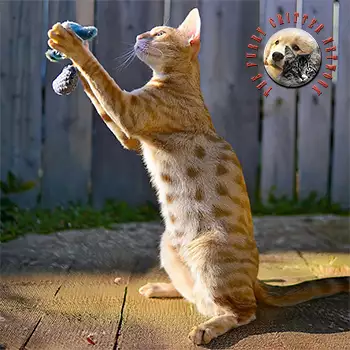

Understanding the Savannah's play style is essential before investing in any toys, because this breed plays differently than most domestic cats. Savannahs retain strong predatory instincts from their serval heritage, and their play sessions closely mimic real hunting sequences: stalking, chasing, pouncing, and capturing. They are not cats that will lazily bat at a dangling feather for thirty seconds and walk away. Play sessions are intense, physical, and often sustained for far longer than typical domestic cats.
The Savannah's intelligence adds another layer to their play requirements. They quickly lose interest in toys that offer no challenge or variability. A mouse toy that moves in a predictable pattern will entertain a Savannah for a day or two before being ignored entirely. Toys that incorporate unpredictable movement, problem-solving elements, or multi-step challenges hold attention far longer. Rotating toys in and out of availability every few days also helps maintain novelty.
Many Savannahs are fascinated by water, a trait inherited from the serval's hunting habits in wetland environments. Incorporating water-based play such as floating toys in a shallow basin or interactive water fountains can provide enrichment that most cat owners never consider. This affinity for water also means that standard toys left near water bowls or sinks may end up submerged, so choose toys that can handle occasional submersion.
Social play is important for Savannahs, and they often prefer interactive play with their owners over solitary toy engagement. Dedicate at least two focused play sessions per day of fifteen to thirty minutes each. These sessions serve as physical exercise, mental stimulation, and bonding time. A Savannah that does not receive adequate interactive play will often redirect that energy into destructive behavior, counter surfing, or attention-seeking antics.