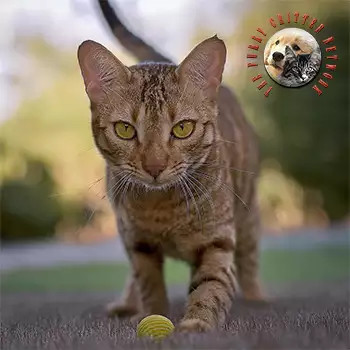

Play Style & Drive

Ocicats possess one of the highest play drives among domestic cat breeds. Their ancestry — a mix of Abyssinian, Siamese, and American Shorthair — produced a cat with intense curiosity, athletic ability, and a strong prey drive that demands regular outlets. Understanding your Ocicat's play style is the foundation for choosing toys and enrichment activities that actually hold their interest rather than collecting dust under the couch.

This breed tends to favor active, predatory play that mimics the hunt-stalk-pounce-kill sequence. They are not passive observers — an Ocicat wants to chase, catch, wrestle, and carry their prey. Toys that move unpredictably, change direction, or can be captured and carried away in the mouth tend to generate the most engagement. Static toys that just sit on the floor rarely sustain an Ocicat's attention for long.

Ocicats are also notable for their willingness to play fetch, learn tricks, and engage in structured interactive games with their owners. This dog-like trainability means that play sessions can be more elaborate and cooperative than with most cat breeds. Many Ocicats will retrieve thrown toys, respond to commands, and even walk on leash, opening up play possibilities that extend well beyond typical cat toy territory.

Plan for at least two dedicated interactive play sessions per day, each lasting fifteen to twenty minutes. These sessions are not optional for an Ocicat — they are essential for managing energy, preventing behavioral issues, and maintaining the bond between cat and owner. An under-stimulated Ocicat will find its own entertainment, and that often means shredded curtains, knocked-over objects, or excessive vocalization demanding attention.

Interactive & Puzzle Toys

Puzzle feeders and interactive toys are particularly well-suited to the Ocicat's intelligence and problem-solving ability. These toys require the cat to manipulate components — sliding panels, rotating discs, lifting cups — to access hidden treats or kibble. Start with simpler designs and progress to more complex puzzles as your cat masters each level. An Ocicat that solves a puzzle too quickly will lose interest, so having multiple puzzles of varying difficulty on rotation is a smart strategy.

Track-style toys with balls that roll inside enclosed channels provide self-directed play when you are not available for interactive sessions. Look for multi-level track designs that allow the ball to be batted between different tiers, as these hold attention longer than single-track versions. Some Ocicats will play with track toys for extended periods, while others treat them as warm-up activities before demanding human-led play.

Motion-activated toys that start moving when bumped or detected by a sensor can provide bursts of stimulation throughout the day. These are useful for Ocicats that are left alone during work hours, though they should supplement rather than replace direct interactive play. Battery-powered toys that mimic erratic prey movement — darting, stopping, changing direction — tap into the Ocicat's predatory instincts effectively.

Rotate your puzzle and interactive toy collection regularly. Even the most engaging toy becomes predictable after repeated exposure, and Ocicats are smart enough to lose interest once they have fully decoded the challenge. Keeping a box of toys in a closet and swapping out the active selection every week or two preserves novelty and keeps your cat's problem-solving skills sharp.

Wand Toys & Prey Simulation

Wand toys — flexible rods with feathers, fabric strips, or small toys dangling from a string — are the gold standard for interactive play with Ocicats. These toys allow you to simulate realistic prey behavior: the flutter of a bird, the scurry of a mouse, the unpredictable dart of an insect. The key to effective wand play is moving the lure away from the cat, not toward it. Real prey runs from predators, and mimicking that flight response triggers your Ocicat's full hunting sequence.

Vary your technique during wand play sessions. Drag the lure along the floor and behind furniture to simulate ground prey, then lift it into the air with quick, erratic movements to mimic a bird. Let the lure pause and twitch to create moments of tension, then burst into rapid movement. The stop-start rhythm is what builds anticipation and makes the pounce rewarding. A predictable back-and-forth swing will bore an Ocicat quickly.

Always end a wand play session with a successful catch, followed by a small treat or a meal. This completes the hunt-catch-eat cycle that is hardwired into your cat's behavior. Ending play abruptly without allowing a capture can leave your Ocicat frustrated and overstimulated, which may lead to redirected aggression or restless behavior afterward.

Store wand toys out of reach when not in active use. Unsupervised play with string-type toys poses a serious ingestion risk, as cats can swallow string, ribbon, or feather components, potentially causing intestinal blockages that require emergency surgery. Inspect wand toys regularly for wear and replace any components that are fraying or coming loose.

Fetch & Active Toys

The Ocicat's willingness to play fetch is one of the breed's most distinctive traits, and it is worth cultivating this behavior with the right toys. Small, lightweight balls — crinkle balls, foam balls, or soft fabric balls — work best for fetch because they are easy for the cat to carry in its mouth. Ping pong balls are popular but can be difficult for some cats to grip. Experiment with different sizes and textures to find what your Ocicat prefers to retrieve.

Teaching fetch to an Ocicat usually requires less effort than with other breeds, but the process still benefits from patience and consistency. Start by tossing a toy a short distance when your cat is already engaged and attentive. When the cat picks it up, encourage it back toward you with an excited tone or by showing a treat. Most Ocicats will naturally start bringing the toy back within a few sessions once they understand the game.

Kicker toys — elongated plush toys designed for cats to grab with their front paws and kick with their hind legs — provide an outlet for the wrestling and bunny-kick component of predatory behavior. Look for kicker toys that are at least eight to ten inches long and stuffed firmly enough to withstand vigorous kicking. Many Ocicats will engage in intense bouts of kicking, biting, and rolling with these toys, which provides excellent exercise and a satisfying predatory outlet.

Spring toys, bouncy balls, and rolling toys that move unpredictably across hard floors trigger chase behavior and can keep an Ocicat entertained during solo play. These low-tech options are surprisingly effective and durable. A simple coiled spring toy can provide days of batting, pouncing, and chasing entertainment for a fraction of the cost of electronic alternatives.

Comfort & Companion Toys

While Ocicats are primarily action-oriented players, they also appreciate comfort toys during quieter moments. Soft plush toys, particularly those infused with catnip or silvervine, can provide solo comfort and a target for gentle kneading behavior. Some Ocicats develop attachments to specific toys and will carry them around the house, deposit them in their sleeping spots, or present them to their owners as gifts.

Catnip sensitivity is genetic, and roughly thirty to fifty percent of cats do not respond to catnip at all. If your Ocicat falls into this group, silvervine and valerian root are alternative attractants that stimulate different receptors and may produce a response where catnip does not. Toys stuffed with a blend of multiple attractants cover the widest range of potential responses.

Heated or microwavable comfort toys can be soothing for Ocicats during cooler weather or for cats that are recovering from veterinary procedures. These products typically contain rice or grain filling that retains warmth after heating and can provide a comforting heat source that mimics the warmth of another body. They are particularly useful for single-cat households where the Ocicat does not have a feline companion to curl up with.

Avoid toys with small, detachable parts such as button eyes, ribbon bows, or glued-on plastic components. Ocicats are vigorous players who will dismantle poorly constructed toys quickly, and small swallowed parts pose choking and obstruction hazards. Opt for toys with embroidered features rather than sewn-on accessories, and regularly inspect all toys for damage.

DIY & Budget Options

Some of the most engaging toys for Ocicats cost nothing at all. A paper grocery bag with the handles removed becomes an irresistible crinkly cave for hiding, pouncing, and ambushing. Cardboard boxes of various sizes can be arranged into tunnels, forts, and hiding spots. Cut cat-sized holes in the sides of large boxes to create multi-entrance dens that satisfy the Ocicat's love of enclosed spaces and surprise attacks.

Wadded-up aluminum foil balls, wine corks, and crumpled paper balls make excellent fetch and batting toys. Their irregular shapes create unpredictable rolling patterns on hard floors that trigger chase behavior. These disposable toys can be refreshed constantly at zero cost, which is particularly convenient because novelty is one of the most important factors in maintaining an Ocicat's interest.

Toilet paper tubes stuffed with treats and folded closed at the ends create simple puzzle toys that require the cat to tear open the tube to access the reward. You can increase the difficulty by nesting tubes inside each other or placing them inside a box with holes cut in the lid. This kind of layered puzzle appeals directly to the Ocicat's problem-solving drive and costs nothing beyond the treats inside.

A piece of string dragged along the floor remains one of the most effective cat toys ever invented, but it should only be used during supervised play. Never leave string, yarn, ribbon, or rubber bands accessible to your Ocicat when you are not watching. The risk of linear foreign body ingestion — where swallowed string becomes tangled in the intestines — is a genuine veterinary emergency. Use string-type toys actively and store them securely afterward.

Always consult a qualified professional before making any health-related decisions. This content is provided for informational reference only and should not replace professional guidance specific to your animal.