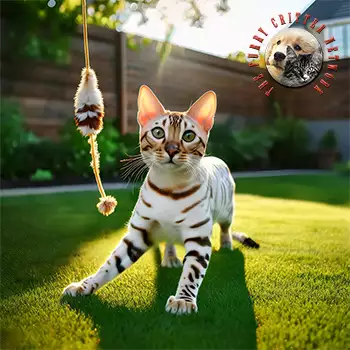

Bengals possess an exceptionally strong prey drive inherited from their Asian Leopard Cat ancestry, and their play style reflects this wild heritage. They stalk, pounce, leap, and chase with an intensity that surpasses most domestic breeds. Understanding this play style is essential for selecting toys that will actually hold a Bengal's interest rather than being ignored after the first five minutes.
The Bengal play cycle closely mirrors a natural hunting sequence: detect, stalk, chase, pounce, catch, and consume. Toys and play sessions that replicate this full cycle are far more satisfying than those that only engage one element. A wand toy that moves erratically, pauses, and then darts away simulates prey behavior and allows the Bengal to work through the entire hunting sequence. Ending a play session with a treat or a meal satisfies the "consume" phase and provides psychological closure.
Bengals are also remarkably intelligent and will quickly lose interest in predictable toys. A toy that moves in the same pattern every time or makes the same sound without variation will be abandoned within days. Rotating toys regularly and introducing novel stimuli keeps a Bengal engaged. Many Bengal owners maintain a toy rotation system, keeping a selection of toys hidden and swapping them out weekly to maintain the novelty factor.
It is worth noting that Bengals often enjoy water play, which is unusual among domestic cats. Floating toys in a shallow water dish, dripping faucets, and pet water fountains with moving streams can all serve as enrichment. Some Bengals will even play fetch, returning small toys to their owner for repeated throwing, which combines physical exercise with interactive bonding.