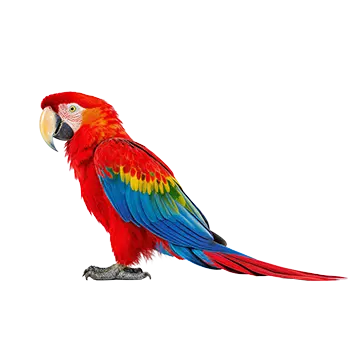

The Scarlet Macaw is one of the largest parrot species commonly kept in captivity, with a total body length that can exceed thirty-six inches from head to tail tip and a wingspan approaching forty-five inches when fully extended. These dimensions make adequate housing a serious logistical consideration that goes well beyond simply purchasing the largest cage a room can accommodate. A Scarlet Macaw confined to a cage that merely fits its body without allowing free movement will develop physical atrophy, behavioral disorders, and feather-destructive habits that are difficult to reverse once established.
The absolute minimum cage dimensions for a single Scarlet Macaw are forty inches wide, thirty inches deep, and sixty inches tall, though these figures represent a baseline rather than a target. A cage of this size provides enough room for the bird to extend its wings partially and move between perches, but it does not allow genuine flight or the kind of vigorous climbing and acrobatic play that keeps a macaw physically and psychologically healthy. Owners who can afford the space should consider enclosures that are at least sixty inches wide and deep, which allow short flights between perches and far more naturalistic movement patterns.
Height is important but often overemphasized relative to width and depth. Parrots do not fly vertically under normal circumstances. They fly horizontally, and their climbing and swinging behaviors use horizontal and diagonal space far more than vertical space alone. A cage that is very tall but narrow forces the bird into a limited vertical column of movement that does not engage its natural locomotor repertoire. Width and depth should be prioritized over height beyond the minimum needed for comfortable perch placement at multiple levels.
For households where the macaw spends significant time outside its cage under supervision, the cage functions primarily as a sleeping enclosure and a safe retreat rather than a full-time living space. In this context, a somewhat smaller cage may be acceptable provided that the bird has regular access to a spacious playstand or bird room during waking hours. However, even a bird with extensive out-of-cage time needs a cage large enough to stretch, flap, and move comfortably, since there will inevitably be days when supervised out-of-cage time is limited by the owner's schedule, travel, or household circumstances.