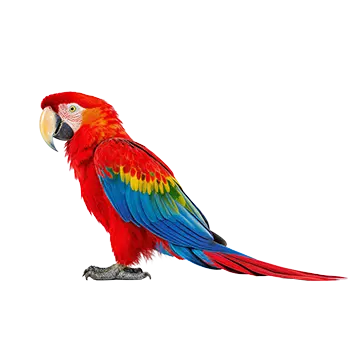

The dishes that hold a Scarlet Macaw's food and water are among the most frequently handled and functionally critical accessories in the bird's daily environment. Dish selection affects hygiene, feeding behavior, waste levels, and even the bird's willingness to eat and drink. Despite their apparent simplicity, choosing the right dishes and maintaining them properly is a decision that compounds over thousands of daily uses across the bird's multi-decade lifespan.
Stainless steel is the preferred material for macaw food and water dishes. It is non-porous, resists bacterial biofilm formation, does not absorb stains or odors, withstands the high temperatures of dishwasher sterilization, and is impervious to the beak damage that cracks and chips ceramic, plastic, and melamine alternatives. A Scarlet Macaw's powerful beak can shatter a ceramic dish and chip fragments of plastic or melamine into food and water, creating an ingestion hazard. Stainless steel eliminates these risks entirely and maintains its structural integrity indefinitely.
Dish mounting systems determine how securely the dish stays in position during the bird's feeding activity. Scarlet Macaws are vigorous, messy eaters that routinely flip, pull, and fling unsecured dishes. Locking crock holders that bolt or clamp to the cage bars and require a deliberate release action to remove provide the necessary security. Some cage manufacturers offer integrated dish holders that accept specific dish sizes, and aftermarket universal locking brackets are available for cages without built-in holders. The locking mechanism must be robust enough that the bird cannot defeat it, since a macaw that learns to dump its food dish will repeat the behavior for entertainment.
Multiple dish stations allow separation of food types and ensure continuous water access. A minimum of three dishes is recommended: one for pellets, one for fresh foods, and one for water. Some owners add a fourth dish for supplements, sprouted seeds, or training treats. Positioning dishes at different cage locations encourages the bird to move between feeding stations, adding a small but meaningful amount of physical activity to the eating routine. Water dishes should be placed away from food dishes and perches to minimize contamination from food debris and droppings.