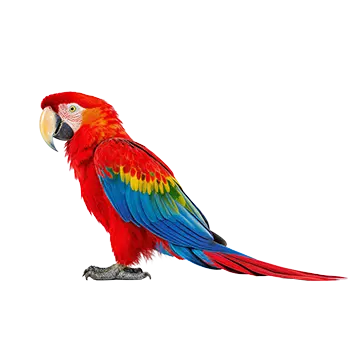

Play Style and Behavioral Drives

Understanding how a Scarlet Macaw plays is essential before investing in toys and enrichment products. These birds are powerful destroyers by nature — in the wild, they spend hours tearing apart bark, cracking through hard nut shells, and stripping vegetation. This destructive drive is not misbehavior; it is a fundamental biological need. Any toy purchased for a Scarlet Macaw should be viewed as consumable rather than permanent, and the speed at which a toy is demolished is actually a measure of its success, not its failure.

Scarlet Macaws are also highly intelligent problem solvers with cognitive abilities comparable to a young child. They crave novelty and mental challenge, becoming bored with toys they have already figured out. A toy that captivates a macaw for a week may be completely ignored the following week once the bird has exhausted its possibilities. This means toy rotation is not optional — it is a core management strategy. Maintaining a reserve of toys and cycling them in and out of the cage every few days keeps the environment fresh without constant new purchases.

Social play is another dominant behavioral drive. Scarlet Macaws in the wild play with flock mates, engaging in aerial chases, foot wrestling, and mutual preening. In captivity, the human caregiver often fills the role of flock mate, making interactive play sessions as important as in-cage toy selection. Setting aside dedicated time each day for hands-on play — teaching tricks, playing peek-a-boo, or simply engaging in roughhousing that the bird initiates — addresses social enrichment needs that no toy can fulfill alone.

Finally, consider that Scarlet Macaws are intensely oral creatures. They explore their world primarily through their beaks, and virtually everything they interact with will be tasted, chewed, and tested for destructibility. This means every toy and material in the bird's environment must be evaluated for safety as though the bird will ingest it — because it very well might. Non-toxic materials, vegetable-tanned leather, food-grade dyes, and untreated natural materials should be the default standard.

Foraging and Puzzle Toys

Foraging toys are the single most important enrichment category for captive Scarlet Macaws. In the wild, these birds spend the majority of their waking hours searching for, manipulating, and extracting food. In captivity, food appears in a bowl every morning, eliminating hours of natural mental engagement. Foraging toys restore that challenge by requiring the bird to work for its food, dramatically reducing boredom-driven behaviors like feather plucking, excessive screaming, and cage aggression.

The complexity of foraging toys should match your bird's experience level and be gradually increased over time. For beginners, start with simple concepts — food wrapped in paper, treats visible through a clear acrylic container with a removable lid, or seeds sprinkled through crumpled paper at the bottom of a foraging tray. As the bird masters these, progress to multi-step puzzles that require unscrewing bolts, pulling chains, lifting covers, or manipulating sliding panels to access rewards.

Acrylic foraging devices designed for large parrots offer the advantage of transparency, which helps a novice forager understand that food is inside and motivates problem-solving behavior. Stainless steel foraging canisters with adjustable openings are more durable and can be calibrated to the bird's skill level by changing the hole size or adding internal baffles. Natural foraging opportunities — hiding food inside pine cones, stuffing treats into bundles of palm leaves, or threading nuts onto thick leather strips tied in knots — provide organic challenges without commercial product costs.

Rotate foraging methods regularly to prevent habituation. A macaw that has learned to open a particular puzzle will do so in seconds, converting an enrichment activity back into a simple food delivery system. Combining different foraging challenges in the same session — some easy wins mixed with harder problems — mimics the variable reinforcement schedules that keep wild foraging behavior robust and persistent.

Chew Toys and Destructibles

Chew toys for Scarlet Macaws must be built to withstand — or more accurately, to be satisfyingly destroyed by — one of the most powerful beaks in the parrot world. Lightweight balsa wood and popsicle-stick toys marketed for cockatiels or small parrots will be reduced to splinters in minutes, providing zero enrichment value. Look for chew toys constructed from dense hardwoods, thick leather, coconut shell, and heavy-duty vegetable-tanned rawhide specifically designed for macaws and cockatoos.

Wood is the most universally accepted chew material. Safe hardwood options include mahogany pods, java wood chunks, yucca pieces, and sections of untreated maple or birch. Softwood options like pine and balsa have their place as quick-destruction items that provide instant gratification, but they should supplement rather than replace hardwood options that provide longer-lasting engagement. Always verify that wood components are untreated, unpainted, and free of chemical preservatives — pressure-treated lumber and dyed craft wood are toxic.

Leather components in chew toys should be vegetable-tanned only, never chrome-tanned, as chromium is toxic to birds. Thick leather strips, knots, and laces add textural variety and can be woven through wood blocks to create multi-material toys with different chewing experiences in a single item. Natural fiber ropes made from sisal, jute, hemp, or untreated cotton are excellent additions, though they require regular inspection — frayed fibers can wrap around toes, and ingested rope fibers can cause crop impaction.

Expect to go through chew toys regularly and budget accordingly. A well-engaged Scarlet Macaw can demolish a large wooden toy in a day or two. Rather than viewing this as wasteful, consider it evidence that the bird is directing its destructive energy appropriately rather than toward cage bars, perches, or its own feathers. Buying components in bulk — untreated wood blocks, leather strips, stainless steel hardware — and assembling your own toys can reduce costs significantly while allowing you to customize designs to your bird's preferences.

Foot Toys and Manipulatives

Foot toys are small objects designed to be held in one foot and manipulated with the beak — a behavior that comes naturally to macaws and provides excellent fine-motor enrichment. These toys take advantage of the macaw's zygodactyl foot structure, which allows a powerful pincer grip ideal for grasping and rotating objects. Simple foot toys include hardwood blocks, whiffle balls, stacked wooden rings, and knotted leather pieces sized appropriately for a macaw's grip.

The best foot toys offer multiple interaction possibilities. A wooden spool threaded with leather and beads can be chewed, unthreaded, tossed, and retrieved. Stainless steel puzzle rings that can be separated and reassembled challenge problem-solving abilities. Acrylic pacifier-shaped toys with embedded noise-making elements combine tactile manipulation with auditory feedback. The key is that the toy rewards interaction — something changes, opens, moves, or makes a sound when the bird engages with it.

Macaws are notorious for tossing foot toys off their perches and play stands, then watching expectantly for their human to retrieve them. While this can feel like a game of avian fetch designed purely to train the owner, it is actually valuable social play behavior. Providing a collection of foot toys in a shallow tray on the play stand allows the bird to select, manipulate, and discard items at will. Placing a basket or catchment area below the primary play zone simplifies the inevitable retrieval process.

Safety considerations for foot toys center on size and material. The toy must be large enough that no component can be swallowed whole but small enough to be comfortably gripped in one foot. Avoid toys with small metal bells that can be bitten open, jingle-type bells with internal clappers that can be extracted and swallowed, or any component held together with glue rather than mechanical fastening. All metal parts should be stainless steel — zinc, lead, and copper components are toxic and have no place in any bird toy.

Swings, Boings, and Physical Play Equipment

Physical play equipment encourages movement, balance, and exercise — all critical for a bird that may spend the majority of its life in an enclosure. Swings are a perennial favorite among macaws, providing the gentle motion that many birds find soothing along with the core muscle engagement required to maintain balance. Macaw-sized swings should be constructed from thick hardwood or stainless steel with natural rope or chain hangers rated for the bird's weight, which can exceed two and a half pounds.

Boing-style spiral perches made from thick cotton or synthetic rope wrapped around a wire core offer a unique bouncing, swaying perch experience that many macaws become obsessed with. The spring action provides proprioceptive feedback that engages balance systems and encourages active play. When selecting a boing, ensure the diameter is appropriate for macaw feet and that the internal wire is completely encased with no exposed ends. Mount boings vertically from the cage ceiling or horizontally between attachment points, depending on the bird's preference.

Play stands and play gyms provide essential out-of-cage activity centers. A well-designed macaw play stand features multiple perching levels, attachment points for hanging toys, integrated food and water cups, and a solid base heavy enough that the bird's movements do not tip it over. Wheeled play stands offer the convenience of portability, allowing you to move the bird's activity center between rooms so it can participate in household life throughout the day.

Ladders and climbing structures made from natural wood or stainless steel encourage vertical movement that strengthens leg muscles and provides variety in the bird's physical routine. Rope ladders add an instability element that increases the physical challenge. Some keepers install overhead track systems or ceiling-mounted perch networks that allow supervised free-flight between stations — these represent the highest level of physical enrichment but require careful bird-proofing of the entire room, including window coverings, fan guards, and blocked access to electrical cords and toxic houseplants.

DIY Enrichment and Budget Options

Commercial macaw toys can be expensive, and given the rate at which a Scarlet Macaw destroys them, building a portion of your enrichment supply from inexpensive or free materials is both practical and creative. Cardboard is one of the best free enrichment materials available — toilet paper rolls stuffed with treats and folded closed, small shipping boxes filled with crumpled paper and hidden food items, and egg cartons with nuts placed in each compartment all provide excellent foraging and destruction opportunities at zero cost.

Untreated wood scraps from woodworking projects can be repurposed into chew toys, provided the wood species is bird-safe and has not been treated, stained, or finished. Drill holes through wood blocks and string them on stainless steel wire or vegetable-tanned leather strips with knots between each piece. Pine cones collected from pesticide-free areas make wonderful foraging toys when stuffed with nut butter or seeds and briefly baked to sterilize them. Coconut shells cut in half provide chewing material and can be filled with treats for foraging.

Paper-based enrichment is vastly underutilized. Wrapping food items in progressively more layers of plain newsprint or butcher paper creates graduated foraging challenges. Weaving strips of paper through cage bars creates a destruction activity that keeps a macaw occupied for extended periods. Phone books — increasingly rare but still available — can be hung in the cage and provide hours of page-ripping satisfaction. Ensure all paper products are printed with soy-based inks and are free of glossy coatings or chemical treatments.

Environmental enrichment extends beyond physical toys. Playing nature sounds or music during the day provides auditory stimulation. Placing the cage near a window with a bird feeder visible outside offers visual engagement. Training sessions using positive reinforcement — teaching the bird to identify colors, stack rings, or perform simple tasks — provide intensive cognitive enrichment that strengthens the human-bird bond while exercising the macaw's considerable intelligence. Even simple changes like rearranging perches, switching toy locations, or introducing a new food item in an unfamiliar presentation count as meaningful enrichment.

Always consult a qualified professional before making any health-related decisions. This content is provided for informational reference only and should not replace professional guidance specific to your animal.