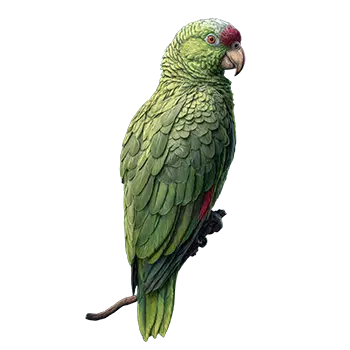

Companion parrot care has historically been a domain of direct observation and manual intervention, but modern technology now offers tools that can meaningfully improve outcomes for both the bird and the owner. The Lilac-Crowned Amazon is a long-lived species whose health depends on environmental consistency, early detection of subtle behavioral changes, and preventive care rather than reactive treatment. Technology that monitors, records, and alerts fills the gaps that human attention inevitably leaves, particularly during working hours when the bird is unsupervised.
The case for technology in parrot care is grounded in a fundamental challenge: parrots are prey animals that actively conceal signs of illness and discomfort as an evolved survival strategy. By the time a Lilac-Crowned Amazon shows obvious symptoms of disease, the underlying condition may be significantly advanced. Subtle shifts in weight, activity level, vocalization patterns, and food consumption are the earliest detectable indicators, and these shifts are precisely the type of data that digital tools can capture more consistently and precisely than the human eye.
Technology also addresses the environmental monitoring challenge. Temperature swings, humidity drops, and air quality degradation can occur while the owner is asleep or away, and the bird experiences the consequences without any human awareness until damage has been done. A parrot that spends eight hours in excessively dry air every night while the household furnace runs will develop respiratory and feather problems over time, and the owner may never connect the nocturnal environmental conditions to the clinical signs that emerge weeks later. Continuous environmental sensors close this information gap.
The integration of smart home technology with pet care represents a practical convergence rather than a luxury indulgence. Many of the devices that serve parrot care, including smart plugs, thermostats, humidity controllers, and cameras, are standard smart home components that happen to solve avian-specific problems when deployed thoughtfully. Owners who already have smart home infrastructure can incorporate bird care monitoring with minimal additional investment, and those building from scratch will find that most of the hardware serves dual purposes within the household.