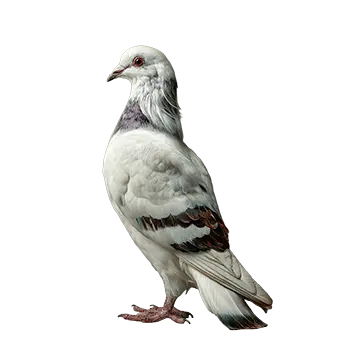

Understanding Pigeon Enrichment

Enrichment for pigeons operates on fundamentally different principles than enrichment for parrots, the bird group most commonly associated with toys and puzzles in the pet trade. Parrots are arboreal manipulators that use their feet and beaks to disassemble objects, solve mechanical puzzles, and interact with complex devices. Pigeons are ground-dwelling foragers whose natural behavioral repertoire centers on walking, pecking, preening, bathing, and social interaction. Effective enrichment for a Jacobin Pigeon means providing opportunities for these natural behaviors in varied and stimulating ways, not hanging a bell from the ceiling of the loft.

The Jacobin's restricted peripheral vision adds another layer to enrichment planning. Because the breed's hood feathers partially obstruct the visual field, Jacobins navigate their environment more cautiously than unhooded breeds and may be startled by objects that appear suddenly in their limited line of sight. Enrichment items should be introduced gradually, placed where the bird can approach and investigate on its own terms, and positioned at ground level or on low platforms rather than suspended overhead where the bird cannot easily see or reach them.

Social interaction is arguably the most important form of enrichment for any pigeon. Pigeons are deeply social animals that pair-bond for life, preen one another, coo in conversation, and synchronize their daily routines with their flock mates. A solitary Jacobin kept without companions will show signs of stress and boredom regardless of how many physical enrichment items are provided. Whenever possible, Jacobins should be kept in pairs or small groups so that the social dimension of their behavioral needs is met naturally.

Environmental variety matters more than any single product. Rearranging perches, introducing a new substrate to explore, rotating the location of feeding stations, or offering a bath at an unexpected time of day all provide cognitive stimulation that keeps the bird engaged with its surroundings. The goal is not to overwhelm the bird with novelty but to create an environment that offers enough variation to prevent the repetitive monotony that leads to feather-picking, lethargy, and other behavioral problems.

Foraging Enrichment

Foraging is the behavior most amenable to enrichment in pigeons, and it aligns perfectly with their natural activity budget. Wild rock doves spend a large portion of their waking hours walking and pecking at the ground in search of seeds, and captive pigeons retain this strong foraging drive. Simply scattering grain across the loft floor rather than offering it in a bowl transforms mealtime from a brief event into an extended activity that engages the bird's attention and movement for much longer.

Foraging trays filled with a substrate that conceals grain take this concept further. A shallow tray filled with clean river pebbles, dried leaves, or shredded paper with grain mixed throughout forces the bird to peck and push aside the substrate to uncover each seed. The physical effort involved is minimal, but the cognitive engagement of searching and discovering is substantial. For Jacobins, ensure that the substrate material does not snag or tangle in the hood feathers, which rules out fibrous materials like long strands of raffia or shredded fabric.

Grass and herb trays provide both foraging opportunity and nutritional supplementation. Growing shallow trays of wheatgrass, barley grass, or mixed herbs like oregano and thyme gives pigeons a living substrate to explore, peck at, and consume. The act of pulling at grass stems and investigating the root zone mimics the foraging behavior of wild pigeons in agricultural fields. These trays can be grown in standard nursery flats and rotated into the loft or aviary on a schedule, with fresh trays replacing consumed ones every few days.

Scatter feeding outdoors in an aviary setting provides the richest foraging experience because the natural ground surface offers its own complexity. Seeds that fall between pebbles, into grass tufts, or onto soil require different pecking strategies to retrieve, and the bird encounters incidental items like small insects, grit particles, and plant fragments that add variety to the foraging experience. For Jacobins housed in aviaries with natural-earth floors, outdoor scatter feeding combines exercise, foraging enrichment, and environmental exploration into a single activity.

Bathing & Water Enrichment

Bathing is one of the most enthusiastically pursued activities in a pigeon's behavioral repertoire, and providing regular bathing opportunities is among the simplest and most effective forms of enrichment available. Pigeons bathe by standing in shallow water, dipping their breast and wings, and flicking water over their backs with vigorous wing motions. The behavior is visibly pleasurable, and pigeons that have been denied bathing for several days will bathe with particular intensity when a pan is finally offered.

Bath pan selection should account for the Jacobin's hood. Standard round or rectangular pans work well, but the water depth should be kept to approximately two inches. Deeper water can soak the hood feathers excessively, and waterlogged hood feathers are slow to dry, heavy, and prone to tangling and matting. In cold weather, wet hood feathers also create a chilling risk because the dense feather mass traps moisture against the skin of the head and neck. Some Jacobin keepers offer baths only on warm, sunny days when the birds can dry naturally and quickly.

Adding a small amount of apple cider vinegar or a few drops of avian bathing solution to the bath water can enhance its feather-cleaning properties without harming the bird. Products marketed as pigeon bath salts typically contain mild surfactants and conditioning agents that help break down feather dust and oil, leaving the plumage cleaner and more supple. These products are optional but can be particularly useful for show birds that need to be in peak feather condition.

Misting offers an alternative to pan bathing that some Jacobin keepers prefer for hood management. A fine mist from a clean spray bottle, directed at the bird's body rather than its face, dampens the feathers enough to trigger preening behavior without saturating the hood. On warm days, misting the aviary environment creates a light humidity that simulates rain and stimulates natural preening and feather-maintenance behaviors across the entire flock. Automatic misting systems on timers can provide this stimulation consistently without requiring the keeper's presence.

Environmental Stimulation

Visual enrichment is often overlooked for pigeons, but these birds are highly visual animals with excellent color vision that extends into the ultraviolet range. Placing the loft or cage where the bird can observe outdoor activity, whether passing birds, moving foliage, or human foot traffic, provides a constantly changing visual landscape that holds a pigeon's attention. For indoor birds, positioning the cage near a window with a view of a garden or bird feeder gives the pigeon something to watch throughout the day.

Auditory stimulation also contributes to environmental richness. Pigeons respond to the sounds of other birds, gentle music, and household ambient noise. A radio or music player set to a low volume in the loft provides background sound that prevents the monotonous silence of an isolated enclosure. Some keepers report that their pigeons appear most relaxed and engaged when listening to classical or soft instrumental music, though individual preferences vary. Abrupt loud noises should be avoided, as they can startle the birds and trigger panic flights that risk injury in enclosed spaces.

Textural variety on the loft or cage floor gives pigeons different surfaces to walk on and explore. Rotating between pine shavings, clean sand, smooth river stones, and bare flooring on different sections of the enclosure floor creates a patchwork of textures that encourages the bird to move from zone to zone. Sand areas double as dust-bathing stations, which pigeons use to work fine particles through their feathers to absorb excess oil and deter parasites. Providing a dedicated dust-bath tray filled with clean builder's sand or chinchilla dust offers this important behavior even in lofts with solid flooring.

Access to sunlight, whether direct or filtered, is a form of environmental enrichment that affects mood, feather condition, and vitamin D synthesis. Pigeons kept exclusively under artificial lighting miss the full-spectrum light they need for normal calcium metabolism and feather coloring. Even thirty minutes of direct sunlight per day, provided through an open window, a sunlit aviary section, or a supervised outdoor session, benefits the bird's physical and psychological health. UV-transmitting glass or polycarbonate roofing materials allow ultraviolet wavelengths to reach the birds even when they cannot be outdoors.

Social Enrichment & Taming

For Jacobin Pigeons kept as pets or handled regularly for show conditioning, the relationship with the keeper is itself a powerful source of enrichment. Pigeons that are handled gently and consistently from a young age become remarkably tame and seek out human interaction. Daily handling sessions where the bird is held, spoken to, and offered treats build trust and provide the bird with social stimulation that goes beyond what flock mates alone can offer. The Jacobin's calm disposition makes it one of the more naturally amenable fancy breeds for this kind of relationship.

Taming a Jacobin begins with associating the keeper's presence with positive experiences, primarily food. Sitting quietly near the loft or cage while the birds eat allows them to acclimate to human proximity without feeling threatened. Over time, offering treats by hand, then gently placing a hand near the bird while it feeds, and eventually picking the bird up and holding it briefly before returning it, builds a graduated desensitization that results in a genuinely handleable bird. Patience is essential, as pigeons that are grabbed or restrained before they are ready will associate handling with fear rather than reward.

Paired pigeons engage in a rich array of social behaviors that are inherently enriching. Courtship displays, mutual preening, nest-building cooperation, and the shared responsibility of incubating eggs and rearing squabs all provide behavioral complexity that no toy or foraging device can replicate. Allowing pairs to breed, even if the eggs are replaced with wooden dummy eggs to control population, preserves the behavioral cycle that gives the birds a sense of purpose and occupation throughout the reproductive season.

Group dynamics in a flock of Jacobins also provide social enrichment. Pigeons establish a social hierarchy through ritualized displays rather than physical aggression, and observing and navigating these social relationships occupies a significant portion of each bird's cognitive resources. A mixed flock containing several pairs, along with unpaired young birds, creates a socially complex environment where birds must continuously monitor and respond to the behavior of their flock mates, which is far more stimulating than a static pair bond in isolation.

DIY Enrichment Ideas

Many of the most effective enrichment strategies for Jacobin Pigeons cost nothing and can be assembled from materials already available in most households. A cardboard box with a pigeon-sized entry hole cut in one side becomes a hiding spot and exploration zone that pigeons will enter, exit, and perch on top of with evident curiosity. Replacing the box every few days with one of a different size, shape, or color keeps the novelty fresh. The disposable nature of cardboard also means it can be discarded when soiled rather than cleaned.

A mirror placed at floor level or on a low shelf provides visual stimulation that many pigeons find engaging. Pigeons do not consistently recognize their reflection as themselves, and a mirror can trigger social responses including cooing, bowing, and tail-fanning, particularly in unpaired birds. While a mirror is not a substitute for a live companion, it can provide a form of pseudo-social interaction for a bird that is temporarily housed alone. Monitor the bird's response and remove the mirror if it causes agitation or obsessive behavior rather than casual interest.

Simple platform structures made from stacked bricks, flat stones, or wooden blocks give pigeons elevated surfaces to perch on, walk across, and claim as territory. These structures can be rearranged weekly to provide variety and encourage the birds to re-explore their environment. Building platforms at different heights creates a landscape that the birds navigate by walking and short flights, adding exercise to the enrichment value. For Jacobins, keep platform heights modest, as their limited vision makes them less confident in navigating steep vertical changes.

Seasonal foliage and branches brought into the loft offer novel textures, scents, and visual elements. Non-toxic branches from apple, willow, or maple trees can be placed on the floor or wedged into corners for the birds to investigate. Pigeons will peck at bark, leaves, and buds, and the natural branch material provides foot-exercise variety that flat artificial perches do not. Ensure that any plant material introduced has not been treated with pesticides or herbicides, and remove it once it dries out and begins to shed debris.

Products to Avoid

The pet toy market is overwhelmingly designed for parrots, and many products sold as bird toys are inappropriate or unsafe for pigeons. Hanging toys with bells, chains, and swinging components are designed for birds that climb, grip, and manipulate objects with their feet and beaks. Pigeons do not interact with objects this way, and a hanging toy in a pigeon enclosure is at best ignored and at worst a hazard if the bird's hood feathers become entangled in chains or string components.

Small parts that can be swallowed present a serious risk. Pigeons swallow food items whole, and a bird investigating a toy with small detachable beads, clips, or metal pieces may ingest a component that causes crop obstruction or heavy-metal poisoning. Any object placed in a pigeon enclosure should be solid, too large to swallow, and free of small parts that could break off with repeated pecking. The half-inch rule is a useful guideline: if a piece is smaller than half an inch in any dimension, it should not be accessible to the birds.

Scented or chemically treated products have no place in a pigeon enclosure. Scented bedding, aromatic wood shavings like cedar, and toys treated with dyes or finishes release volatile compounds that irritate the avian respiratory system, which is far more sensitive than that of mammals. Pigeons kept in environments with chronic low-level chemical exposure develop respiratory inflammation that may not produce obvious symptoms for months but progressively damages lung tissue and air sac membranes.

Rubber and soft plastic toys designed for parrots can be dangerous if a pigeon manages to tear off a piece and swallow it. Rubber fragments can cause gastrointestinal obstruction, and some rubber compounds contain zinc or other metals that leach into the digestive tract. Hard plastic items are generally safe as long as they cannot be broken into ingestible fragments, but soft, chewable plastics should be avoided. When in doubt about a product's material safety, choose natural materials like untreated wood, stone, and ceramic, which pose minimal risk even if pecked at extensively.

Always consult a qualified professional before making any health-related decisions. This content is provided for informational reference only and should not replace professional guidance specific to your animal.