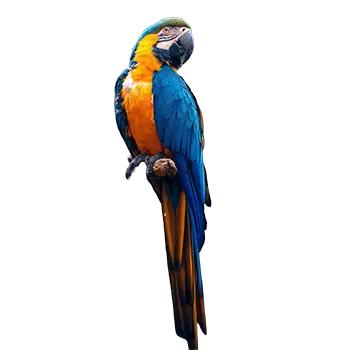

Blue and Gold Macaws are among the largest commonly kept companion parrots, with a wingspan that can exceed forty inches and a tail that adds another fifteen to twenty inches to overall body length. These dimensions make cage sizing one of the most consequential housing decisions an owner will face. The absolute minimum indoor cage for a single Blue and Gold Macaw is approximately forty inches wide, thirty inches deep, and sixty inches tall, though these figures represent a floor rather than a recommendation. Experienced macaw owners and avian welfare organizations consistently advocate for the largest enclosure the household can accommodate, with many recommending dimensions closer to sixty inches wide, forty inches deep, and seventy-two inches tall.
Width is the most critical dimension because macaws move horizontally far more than vertically. A cage that is tall but narrow forces the bird into a cramped lateral space that restricts wing stretching and comfortable movement between perches. When evaluating cages, prioritize horizontal footprint over height if compromises must be made. A cage that allows the bird to fully extend both wings simultaneously without touching the bars is the practical benchmark, though even larger is preferable.
Bar spacing is a safety-critical specification that is non-negotiable. Blue and Gold Macaws require bar spacing between one inch and one and a half inches. Bars spaced too widely create a risk of head entrapment, which can cause injury or death. Bars spaced too narrowly, such as those on cages designed for cockatiels or conures, reduce visibility and ventilation while providing an unsatisfying surface for a macaw's large feet to grip. The bar gauge must also be heavy enough to withstand a macaw's beak, which generates bite pressures that can deform lightweight wire or thin-gauge bars over time.
The cage should be positioned in a socially active area of the home where the bird can observe and participate in household activity without being in the direct path of foot traffic, kitchen fumes, or drafts. A corner placement often works well, providing the bird with a sense of security against two walls while maintaining a clear sightline into the room. The cage should never be placed in or adjacent to the kitchen, where cooking fumes, overheated nonstick coatings, and airborne grease particles pose serious respiratory hazards.