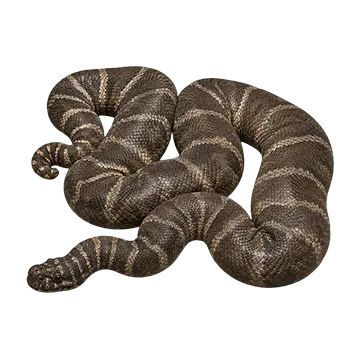

The Adult Elephant Trunk Snake

The Elephant Trunk Snake (Acrochordus javanicus) reaches sexual maturity and enters its adult phase between approximately three and five years of age, depending on sex, growth rate, and overall husbandry quality. Adult females are substantially larger than males, commonly reaching six to eight feet in total length and weighing upward of twenty to thirty pounds, while males typically plateau at four to five and a half feet and ten to fifteen pounds. This pronounced sexual dimorphism is among the most extreme found in any snake family and has direct implications for enclosure sizing, feeding strategies, and overall space requirements. An adult Elephant Trunk Snake in good condition is a thick-bodied, heavy animal whose mass belies the relatively modest length figures, owing to the dense musculature and substantial girth characteristic of the species.

Adult coloration stabilizes into the muted gray-brown to dark olive-brown palette that gives the species its common name, with the loose, deeply folded skin creating a wrinkled appearance reminiscent of an elephant's trunk or hide. The ventral surface is typically lighter, ranging from cream to pale gray, and may show irregular darker mottling. The granular, file-like texture of the dorsal scales is fully developed in adults and serves the functional purpose of gripping fish during constriction. This unique integument requires specific husbandry attention throughout the adult stage, as the skin folds create microenvironments that can harbor pathogens if water quality deteriorates.

The prime adult years represent the longest and most stable phase of the Elephant Trunk Snake's captive life. Once the rapid growth of the juvenile period decelerates and the animal reaches its mature size, husbandry requirements become relatively predictable and routine. An established adult in a well-maintained enclosure with consistent feeding and water quality will often go years without a significant health event. This stability, however, should not breed complacency. The very predictability of the adult stage can cause keepers to relax their monitoring and maintenance habits, allowing gradual declines in water quality, creeping weight gain from overfeeding, or slow-developing health conditions to progress undetected until they become serious.

Adult Elephant Trunk Snakes are not demanding animals in terms of behavioral interaction, but they do require a committed keeper who understands and accepts the species' unique needs. The fully aquatic lifestyle, the significant water volume and filtration infrastructure required, the specialized piscivorous diet, and the long-term space commitment distinguish this species from the vast majority of commonly kept snakes. Keepers who have successfully raised their animal through the neonatal and juvenile stages are well prepared for the adult phase, but those acquiring an adult from another keeper should thoroughly research the species' requirements before taking on the responsibility.

Permanent Enclosure Design

The permanent enclosure for an adult Elephant Trunk Snake should provide a minimum of seventy-five gallons of water volume for males and one hundred twenty gallons or more for large females. These figures represent functional minimums; larger enclosures are always preferable and allow for better water parameter stability, more naturalistic habitat design, and reduced maintenance frequency. Custom-built plywood enclosures lined with pond liner or fiberglass, large stock tanks, or commercial aquariums of appropriate dimensions all serve as viable housing options. The enclosure must be fully aquatic with no terrestrial haul-out area, as Elephant Trunk Snakes cannot support their body weight on land and will suffer musculoskeletal injury, skin damage, and respiratory compromise if forced out of water for extended periods.

Water depth for adults should range from ten to sixteen inches, allowing the snake to rest on the bottom while reaching the surface to breathe with minimal effort. The species naturally inhabits shallow, slow-moving rivers, swamps, and coastal estuaries, and captive enclosures should reflect these conditions. Strong water currents are contraindicated, as they force the sedentary snake to expend energy resisting flow rather than resting in its preferred stationary ambush posture. Filter outflows should be baffled or directed along the enclosure walls, and powerheads or wave-makers should never be used in an Elephant Trunk Snake enclosure.

Filtration for an adult enclosure should be rated for at least three times the actual water volume to provide adequate biological, mechanical, and chemical filtration capacity. Canister filters are the preferred option for enclosures of this size because they offer high flow rates, large media capacity, and can be positioned outside the enclosure to simplify maintenance and maximize interior space. A combination of biological media such as ceramic rings or sintered glass, mechanical media such as filter floss or foam pads, and chemical media such as activated carbon provides comprehensive water treatment. The filter should be serviced every two to four weeks by rinsing the mechanical media in a bucket of old tank water — never in chlorinated tap water, which would destroy the beneficial bacterial colonies essential for biological filtration.

Enclosure security is a non-negotiable consideration for adult Elephant Trunk Snakes. While the species' inability to move on land makes terrestrial escape essentially impossible, an unsecured lid allows the snake to push its head and upper body above the waterline, exposes the enclosure to dust, pet hair, and airborne contaminants, and poses a risk to household children or other pets that might reach into the water. A tightly fitting lid with ventilation openings too small for the snake's head to pass through, secured with clips or latches, provides safety for both the snake and the household. The lid should also minimize evaporation, which can be substantial from a large, warm water enclosure and will require frequent topping off with dechlorinated water to maintain proper water levels.

Long-Term Diet & Nutritional Balance

Adult Elephant Trunk Snakes require fewer feedings than juveniles but larger individual meals to maintain healthy body condition without promoting obesity. A feeding schedule of once every seven to fourteen days is appropriate for most adults, with the exact interval determined by the individual's body condition, metabolic rate, and activity level. Each feeding should consist of several appropriately sized fish totaling roughly five to ten percent of the snake's body weight. This proportional approach ensures that dietary intake scales with the animal's size and prevents the gradual caloric excess that leads to obesity in captive aquatic snakes.

Dietary variety remains important throughout the adult stage to provide a complete nutritional profile. A rotation of tilapia, silversides, smelt, and occasional trout or perch fillets offers a broad range of nutrients and prevents the deficiencies associated with single-species diets. Whole fish are always preferable to fillets because the bones, organs, and skin contribute essential calcium, fat-soluble vitamins, and trace minerals that muscle tissue alone does not provide. When whole fish of appropriate size are unavailable, fish fillets can be supplemented with a light dusting of reptile calcium and multivitamin powder applied to the thawed prey before offering.

The thiaminase concern that applies to neonates and juveniles remains relevant for adults and warrants continued vigilance. Goldfish, rosy red minnows, and certain other cyprinid species contain high levels of thiaminase, which enzymatically destroys thiamine (vitamin B1) during digestion and can produce severe neurological symptoms including disorientation, loss of righting reflex, and seizures if these fish are used as a dietary staple. Occasional feeding of thiaminase-containing fish is unlikely to cause problems in an otherwise well-nourished adult, but these species should never constitute more than a small fraction of the overall diet.

Body condition scoring in adult Elephant Trunk Snakes requires practice and species-specific knowledge because the naturally loose, heavily folded skin can obscure both emaciation and obesity. A healthy adult should have a gently rounded cross-sectional profile with visible but not prominent skin folds along the lateral surfaces. When the snake is gently palpated underwater, the ribs should be detectable with light pressure but not visually prominent. An emaciated adult will have deeply concave flanks with prominent vertebral and costal ridges, while an obese adult will have taut, smooth skin with the characteristic folds stretched flat and a visibly distended coelomic region. Monthly body condition assessments paired with periodic weight checks provide the data needed to fine-tune feeding frequency and portion size over the long term.

Environmental Enrichment & Behavioral Welfare

Environmental enrichment for a species as sedentary as the Elephant Trunk Snake requires a fundamentally different approach than enrichment for active, exploratory species. The goal is not to stimulate high levels of physical activity, which would be unnatural and stressful for this ambush predator, but rather to provide environmental complexity that supports the expression of natural behaviors such as hiding, resting in varied postures, selecting preferred thermal microzones, and engaging in ambush predation. Enrichment that achieves these objectives contributes meaningfully to the animal's psychological welfare even if the snake's external behavior appears largely unchanged to the casual observer.

Structural complexity within the enclosure is the primary form of enrichment for adult Elephant Trunk Snakes. Large-diameter PVC pipe sections, stacked slate or flagstone formations with gaps sized for the snake to wedge into, large driftwood pieces with hollows and crevices, and dense arrangements of tall artificial plants all create a three-dimensional environment that the snake can navigate and use as shelter. The arrangement of these elements should be varied periodically — perhaps every two to three months — to introduce novelty into the environment. Some keepers report increased exploratory behavior for several days following a furniture rearrangement, suggesting that the change provides cognitive stimulation even for this outwardly unresponsive species.

Feeding enrichment offers additional behavioral stimulation by engaging the snake's predatory instincts. Rather than simply dropping thawed fish into the water, keepers can present prey with tongs, moving the fish slowly through the water at varying distances and angles to elicit a directed strike response. This approach mimics the experience of hunting live prey without the disease and parasite risks associated with live feeder fish. Some keepers also introduce feeding at unpredictable intervals rather than on a rigid schedule, which more closely approximates the variable prey availability that wild Elephant Trunk Snakes experience and may help maintain the animal's predatory responsiveness.

Photoperiod management contributes to environmental quality and supports normal behavioral rhythms. Adult Elephant Trunk Snakes benefit from a consistent light-dark cycle of approximately twelve hours of subdued light followed by twelve hours of darkness, reflecting the equatorial day length of their native range. Bright, direct lighting causes the snake to retreat to the darkest available shelter and remain inactive, while dim ambient light or indirect room lighting allows the animal to rest comfortably in the open where it can be observed. A timer-controlled LED strip mounted above the enclosure and set to a low intensity produces a naturalistic dawn-dusk transition that is preferable to the abrupt on-off switching of overhead room lighting.

Water temperature variation, within a narrow and safe range, can serve as a subtle form of environmental enrichment. A slight seasonal fluctuation of two to three degrees — maintaining 82 to 84 degrees Fahrenheit during summer months and 79 to 81 degrees during winter — mimics the mild thermal seasonality of Southeast Asian freshwater habitats and may support normal endocrine cycling, particularly in animals maintained for breeding. These fluctuations must be gradual, occurring over weeks rather than days, and should never drop below 78 degrees or exceed 86 degrees, as temperatures outside this range compromise immune function and metabolic health.

Handling Mature Specimens Safely

Adult Elephant Trunk Snakes retain the docile temperament characteristic of the species, but their substantial size and weight introduce handling considerations that differ significantly from those applicable to neonates and juveniles. A large female Elephant Trunk Snake at six to eight feet and twenty to thirty pounds is a heavy, muscular animal that requires two-handed support at minimum and ideally the assistance of a second person for any procedure that involves removing the snake from its enclosure. The snake's body should always be supported at multiple points along its length to distribute its weight evenly, as concentrated pressure on a single point can cause internal bruising or musculoskeletal injury in a species whose body is adapted to the buoyant support of water.

The primary handling risk for adult Elephant Trunk Snakes remains desiccation rather than defensive aggression. Out of water, the snake's characteristically loose skin dries rapidly, and the animal experiences thermoregulatory disruption because evaporative cooling accelerates heat loss in ways the snake cannot compensate for on land. Extended air exposure can also cause the skin to crack and peel abnormally, creating entry points for opportunistic bacterial and fungal pathogens. Handling sessions should be limited to the minimum duration necessary for the task at hand, with the snake returned to water promptly afterward. For procedures expected to take more than a few minutes, such as a thorough physical examination, the snake should be placed in a shallow tub of enclosure-temperature water during the process.

Routine husbandry tasks that do not require physical handling should be conducted without removing the snake from its enclosure whenever possible. Water changes, filter maintenance, temperature checks, and visual health assessments can all be performed with the snake in situ, reducing stress and eliminating handling-associated risks. Many experienced keepers of adult Elephant Trunk Snakes report handling their animals only a few times per year — for annual veterinary examinations, enclosure transfers during deep cleaning, and the occasional emergency — and this minimalist approach is entirely appropriate for a species that derives no behavioral benefit from regular human interaction.

When handling is necessary, approach the snake slowly and deliberately, sliding both hands beneath its body while it rests on the substrate. Avoid gripping the snake behind the head or pinning any part of its body against a surface, as these restraint techniques, while appropriate for defensive terrestrial species, are unnecessary for the overwhelmingly placid Elephant Trunk Snake and may cause the animal to thrash in an uncharacteristic stress response. Wet hands provide better grip on the snake's rough skin and reduce friction-related irritation. After handling, observe the snake for several hours to ensure it resumes normal behavior, including resting in a typical posture, surfacing to breathe at normal intervals, and accepting food at its next scheduled feeding.

Ongoing Health Management

Health management for adult Elephant Trunk Snakes centers on consistent preventive practices rather than reactive intervention, as the species' aquatic lifestyle and sedentary behavior mean that clinical signs of illness are often subtle and easy to overlook until a condition has advanced considerably. An annual veterinary examination by a practitioner experienced with aquatic reptiles should include a full physical assessment, fecal parasite screening, and evaluation of a water sample from the enclosure. Establishing this annual baseline allows the veterinarian to detect gradual changes in body condition, skin health, or organ function that might escape notice during the keeper's routine daily observations.

Water quality is the single greatest determinant of long-term health in captive Elephant Trunk Snakes, and this principle only becomes more important as the animal ages through its adult years. The cumulative effects of chronic low-level exposure to elevated ammonia, nitrite, or nitrate are insidious, producing gradual immunosuppression, subclinical organ damage, and increased susceptibility to opportunistic infections that may not manifest as overt disease for months or years. Consistent, rigorous water quality maintenance — weekly testing, regular partial water changes, diligent filter servicing, and prompt removal of uneaten food and waste — is the foundation upon which all other health management strategies rest.

Dermatological vigilance remains essential throughout the adult stage. The deep skin folds characteristic of the species create warm, moist microenvironments that are inherently conducive to bacterial and fungal colonization, and even well-maintained enclosures can harbor opportunistic organisms that exploit any lapse in the snake's immune defenses. During routine observation, keepers should examine the skin systematically, paying particular attention to the ventral folds, the area around the cloaca, and any regions where the snake habitually rests against hard surfaces. Reddening, swelling, excessive mucus production, raised lesions, or localized loss of the granular texture all warrant closer examination and potentially veterinary consultation.

Obesity is the most prevalent chronic health condition in adult Elephant Trunk Snakes maintained in captivity and is almost entirely attributable to overfeeding relative to the animal's minimal energy expenditure. The metabolic consequences of obesity in reptiles parallel those in mammals, including hepatic lipidosis, cardiovascular strain, reduced immune competence, and impaired reproductive function. Because the species' loose skin can camouflage early fat deposition, keepers should rely on periodic weight measurements and body condition scoring rather than visual assessment alone to monitor nutritional status. An adult that gains more than five percent of its body weight between annual veterinary visits without a clear explanation such as reproductive development should have its feeding schedule and portion sizes evaluated and adjusted accordingly.

Always consult a qualified professional before making any health-related decisions. This content is provided for informational reference only and should not replace professional guidance specific to your animal.