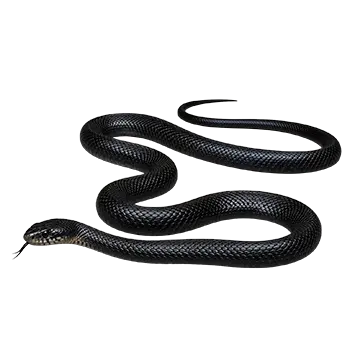

The juvenile phase of the Eastern Indigo Snake (Drymarchon couperi) spans roughly from three months of age through the second or third year, encompassing the period of most rapid proportional growth the animal will experience in its lifetime. During this window, a well-managed juvenile can grow from approximately thirty inches to four or even five feet in total length, with males tending to outpace females in both length and mass by the end of the second year. This growth is not strictly linear; juveniles often exhibit bursts of rapid elongation following successful feeding cycles, punctuated by brief plateaus that typically coincide with shed cycles or seasonal shifts in appetite.
The hallmark iridescent blue-black coloration of the Eastern Indigo Snake intensifies dramatically during the juvenile period. Hatchlings often display a somewhat muted dorsal color with faint banding or speckling that gradually gives way to the deep, uniform blue-black sheen characteristic of the species. The chin and throat markings, which may be salmon, orange, reddish-brown, or cream in hatchlings, can either become more vivid or gradually darken depending on the individual's genetics. By the end of the juvenile phase, the snake's coloration is largely established, though subtle shifts in iridescence and hue may continue for years.
Body proportions shift noticeably as the juvenile matures. Young Eastern Indigo Snakes have proportionally large heads relative to their body diameter, giving them a somewhat gangly appearance during the first year. As the body catches up in girth, the head-to-body ratio normalizes, and the sleek, muscular build that defines the adult form begins to emerge. The smooth, glossy dorsal scales become increasingly lustrous, and the overall body shape transitions from the slender profile of a neonate to the robust, cylindrical cross-section of a subadult.
Regular weight and length measurements are essential during this period. Weighing the juvenile every two weeks on a reliable digital scale and recording total length monthly provides a growth curve that can reveal early signs of nutritional deficiency, parasitic burden, or environmental stress long before they become clinically obvious. A healthy juvenile should show consistent upward trends in both weight and length, with temporary plateaus around shed events being entirely normal. Prolonged stagnation or any sustained weight loss warrants immediate investigation into feeding adequacy, enclosure temperatures, and overall health status.