
Common Garter Snakes (Thamnophis sirtalis) reach physical maturity between eighteen months and two years of age, though growth does not cease entirely at this point. Adults of this species exhibit considerable size variation depending on geographic origin, sex, and individual genetics, with most captive specimens reaching eighteen to twenty-six inches in length and occasional individuals from large-bodied lineages exceeding thirty inches. Females are consistently larger and heavier than males of the same age and lineage, a sexual dimorphism that becomes increasingly pronounced once both sexes reach maturity. A robust adult female may weigh two to three times as much as a male of comparable length, owing to her broader body cavity and thicker trunk proportions.
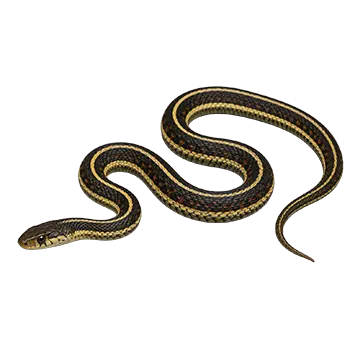
The dorsal coloration and pattern of the adult Common Garter Snake is among the most variable of any North American serpent. The base color may range from olive green to dark brown or nearly black, overlaid with three longitudinal stripes that can be yellow, greenish, bluish, or tan depending on the subspecies and locality. Between the stripes, a checkered or spotted pattern of darker and lighter scales creates a complex visual texture that serves as effective camouflage in the grassland, wetland, and forest-edge habitats the species occupies throughout its enormous geographic range. Captive-bred color morphs, including albino, melanistic, erythristic, and flame variants, have been developed through selective breeding and offer keepers an array of aesthetic options.
Musculoskeletal development in the adult Common Garter Snake reflects the species' active, pursuit-predator lifestyle. Unlike ambush-hunting species that rely on explosive short-distance strikes, garter snakes are built for sustained, agile movement through dense ground cover and shallow water. Their musculature is lean and elongated rather than bulky, and their body profile in cross-section is more oval than round. Adults are deceptively quick and capable of impressive bursts of speed when motivated by prey capture or perceived threat. This athleticism demands an enclosure that provides adequate space for natural locomotion patterns, as sedentary housing conditions contribute to muscle atrophy, obesity, and diminished overall vitality.
Skin and scale condition in a healthy adult should be smooth, glossy, and free of blemishes, lesions, or discoloration between shed cycles. The ventral scales, or scutes, should be uniform in shape and lie flat against the body without lifting, curling, or showing gaps. Any irregularity in scale condition warrants close examination, as lifted scales can indicate the presence of subcutaneous abscess, retained shed, early signs of scale rot caused by excessively damp substrate, or the beginning stages of blister disease. Maintaining the adult in clean, dry conditions with access to appropriate basking temperatures supports healthy skin turnover and minimizes dermatological problems.