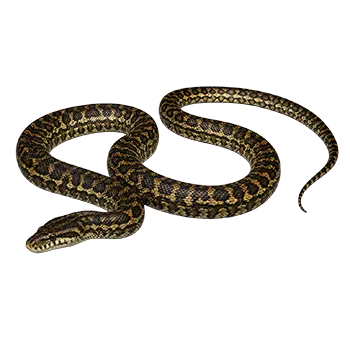

The juvenile stage in Coastal Carpet Pythons (Morelia spilota mcdowelli) spans roughly from the end of the first year through the third or fourth year of life, a period defined by sustained and sometimes dramatic physical growth. An animal that entered its first birthday at approximately three feet in length may reach five to six feet by the end of its second year and approach its full adult proportions by year three or four, depending on sex, genetics, and husbandry quality. Males tend to mature at a somewhat smaller size than females, typically topping out at six to seven feet, while females of exceptional lineage and condition may reach eight to nine feet once fully grown.
During this rapid growth phase, the juvenile sheds its skin with considerable frequency, typically every four to six weeks under optimal conditions. Each shed cycle reflects a measurable increase in length and girth, and the quality of each shed serves as a reliable barometer of overall husbandry. A clean, single-piece shed that includes intact spectacle scales and tail tip coverage indicates that humidity, hydration, and nutritional parameters are well-calibrated. Fragmented or patchy sheds that require manual removal suggest that one or more environmental factors need adjustment, most commonly relative humidity falling below 50 percent for extended periods.
The color and pattern of juvenile Coastal Carpet Pythons undergo a gradual but noticeable ontogenetic shift during this period. The high-contrast, sharply defined banding of the hatchling phase begins to soften and broaden as the animal grows, with the dark dorsal saddles becoming less distinctly bordered and the ground color often warming from pale cream to deeper gold, tan, or olive depending on locality and individual genetics. This color transition can take two to three years to fully resolve and is one of the more visually rewarding aspects of raising this subspecies from a young age.
Body composition changes significantly through the juvenile period as well. The somewhat delicate, whip-like build of the hatchling gives way to a thicker, more muscular frame with well-developed coiling strength. The head widens relative to the neck, becoming more distinctly triangular in profile, and the labial heat-sensing pits along the upper and lower jaw become more prominent. These structural changes reflect the animal's transition from a diet of small rodents to larger prey items and from a lifestyle heavily dependent on concealment to one that increasingly involves active hunting and arboreal locomotion.