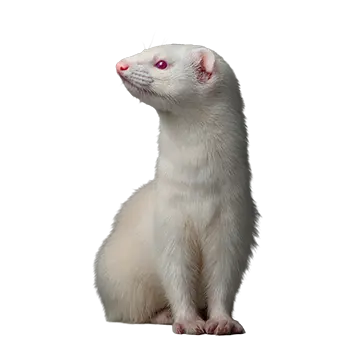

The Weaning Transition

The juvenile phase of an albino ferret's life begins with weaning, a gradual process that typically unfolds between five and eight weeks of age. During this transitional window, the kits shift from complete dependence on the jill's milk to consuming solid food independently. The process is rarely abrupt in a natural setting; instead, the kits begin sampling the jill's kibble and soft food offerings while still nursing intermittently. Keepers can encourage this transition by offering a gruel made from high-quality ferret kibble soaked in warm water or kitten milk replacer until it reaches a porridge-like consistency. This softened food bridges the gap between liquid milk and hard kibble, accommodating the kits' still-developing dentition.

By six weeks of age, most albino ferret kits are actively eating softened solids and their dependence on the jill's milk has diminished considerably. The jill herself often facilitates the weaning process by becoming less willing to lie still for prolonged nursing sessions, standing up and walking away from persistent kits. This natural maternal behavior should not be interpreted as rejection. It is a normal behavioral shift that pushes the kits toward dietary independence. If the jill is producing excessive milk after the kits have largely weaned, a slight reduction in her supplemental caloric intake can help her body adjust milk production downward gradually.

The nutritional requirements of juvenile albino ferrets are among the highest of any domestic carnivore relative to body weight. Growing kits need a diet containing at least 35 to 38 percent animal-based protein and 18 to 22 percent fat to support their rapid skeletal and muscular development. Ferret-specific kibble from reputable manufacturers is formulated to meet these requirements, but not all brands are equal. Keepers should examine ingredient lists carefully, avoiding products that list grain, corn, or vegetable protein among the first several ingredients, as ferrets are obligate carnivores with limited ability to digest plant-based nutrients. Poor-quality diets during the juvenile period can lead to stunted growth, dull coat, and long-term metabolic problems.

Fresh water should be available at all times through both a sipper bottle and a shallow, tip-resistant bowl. Juvenile ferrets are notoriously messy drinkers and may play in open water dishes, so placement within the enclosure matters. Positioning the water source away from bedding and food prevents contamination and reduces the frequency of bedding changes. Some keepers offer a small amount of raw egg or a commercially prepared raw meat supplement several times per week during the juvenile growth phase, providing additional protein and essential fatty acids that promote healthy coat development, which is particularly important for albino ferrets whose white coats readily show any signs of nutritional deficiency.

Socialization and Behavioral Development

The juvenile period, spanning roughly six weeks to six months of age, represents the most critical window for socialization in an albino ferret's life. Experiences during this phase shape the animal's temperament, confidence, and adaptability for years to come. Kits that receive consistent, gentle handling from multiple people during this window grow into adults that are comfortable being picked up, restrained for veterinary examinations, and introduced to novel environments. Conversely, ferrets that miss this socialization window often remain skittish, nippy, and difficult to manage throughout their lives, regardless of later training efforts.

Nipping and biting are among the most common behavioral challenges during the juvenile phase, and albino ferrets are no exception. Young ferrets explore their world with their mouths, and play between littermates involves a significant amount of mock biting. When directed at human handlers, this behavior requires patient, consistent correction. Scruffing, which involves gently grasping the loose skin at the back of the neck and briefly holding the kit still while issuing a firm verbal correction, mimics the disciplinary technique used by the jill and is generally the most effective approach. Flicking the nose, blowing in the face, or any form of physical punishment beyond scruffing is counterproductive and can create fear-based aggression.

Introducing the juvenile albino ferret to a variety of environments, sounds, textures, and experiences builds resilience and reduces stress responses in adulthood. Supervised exploration of different rooms in the house, exposure to normal household sounds such as vacuum cleaners, televisions, and conversation, and gentle introduction to other household pets under controlled conditions all contribute to a well-rounded temperament. Albino ferrets, because of their photosensitive eyes, may initially be more cautious in brightly lit environments. Allowing them to explore dimmer rooms first and gradually introducing them to well-lit spaces respects their visual comfort while still broadening their experiential repertoire.

Socialization with other ferrets is equally important, particularly if the juvenile will be housed in a group as an adult. Ferrets are highly social animals that thrive in pairs or small groups, and the play skills learned during juvenile interactions with siblings or age-matched companions are foundational to successful cohabitation later. When introducing a juvenile to an established adult ferret, initial sessions should be brief, closely supervised, and conducted in a neutral territory that neither animal considers its own. Some posturing, hissing, and chasing is normal during introductions, but any encounter that escalates to sustained aggressive biting or drawing blood should be interrupted immediately and reintroduced more gradually.

Litter Training and Household Manners

Litter training is one of the first structured behaviors a juvenile albino ferret should learn, and the process is most successful when initiated during the weaning period. Ferrets have a natural instinct to eliminate in corners, and this tendency can be leveraged by placing litter boxes in the corners of the enclosure where the kit has already chosen to relieve itself. The litter box should have low sides for easy access by a small juvenile and should be filled with a dust-free, paper-based litter or pelleted recycled newspaper. Clumping clay litters and cedar or pine shavings should be strictly avoided, as ferrets may ingest these materials during their habitual digging behavior, leading to intestinal blockages or respiratory irritation.

Consistency is the cornerstone of successful litter training. When the juvenile wakes from a nap or finishes eating, it will typically need to eliminate within five to ten minutes. Keepers who learn to recognize the pre-elimination posture, which involves backing into a corner with a raised tail, can gently place the kit in the litter box at the critical moment. Successful use of the box should be immediately rewarded with a small, high-value treat such as a pea-sized portion of salmon oil or a ferret-specific treat. Over time, the association between using the box and receiving a reward becomes habitual. Patience is essential, as juvenile ferrets rarely achieve perfect litter habits, and an accuracy rate of eighty to ninety percent is considered excellent for the species.

Beyond litter training, juvenile albino ferrets benefit from learning basic household boundaries during this formative period. Ferrets are notorious for their ability to squeeze into impossibly small spaces, and a thorough ferret-proofing of any area the juvenile will be allowed to explore is non-negotiable. This includes blocking gaps beneath appliances, sealing openings behind cabinetry, covering electrical outlets, securing cabinet doors, and removing rubber or foam objects that ferrets are inclined to chew and swallow. Intestinal foreign body obstruction is one of the leading causes of emergency veterinary visits in young ferrets, and prevention through environmental management is far preferable to surgical intervention.

Teaching a juvenile ferret to respond to its name and to come when called is achievable with consistent positive reinforcement. Short training sessions of three to five minutes, conducted when the ferret is alert and slightly hungry, work best. Calling the ferret's name and immediately offering a treat when it approaches begins building the association. Over several weeks of daily practice, most juvenile ferrets will reliably orient toward and approach their keeper when called. This recall response is not merely a parlor trick; it is a valuable safety behavior that allows the keeper to locate and retrieve the ferret during supervised free-roam time, potentially preventing escapes or access to dangerous areas.

Growth Patterns and Physical Development

Juvenile albino ferrets undergo a period of remarkably rapid growth between weaning and approximately four months of age. Male kits, known as hobs, typically grow larger and heavier than female kits, called jills, with adult hobs reaching weights of two to four pounds and jills settling between one and a half to two and a half pounds. During the peak growth phase, a juvenile ferret may gain several grams per day, and its skeletal frame lengthens and broadens visibly from week to week. The long, sinuous body shape that defines the mustelid family becomes increasingly apparent as the kit matures, with the characteristic low-slung profile and flexible spine allowing the ferret to navigate tight spaces with remarkable fluidity.

The juvenile coat undergoes its own transformation during this period. The soft, downy white fur of the neonatal albino kit is gradually replaced by the denser, slightly coarser guard hairs and plush undercoat of the juvenile and adult pelage. In albino ferrets, this coat remains pure white or cream-white throughout life, though it may develop a faint yellowish tinge due to natural skin oils, particularly in intact males whose sebaceous gland activity increases with approaching sexual maturity. Regular bathing is not recommended more than once every few months, as excessive bathing strips the coat of protective oils and paradoxically increases the musky odor that ferret skin produces in compensation.

Skeletal development during the juvenile phase demands adequate dietary calcium and phosphorus in the correct ratio, typically between 1.2:1 and 1.5:1 calcium to phosphorus. High-quality commercial ferret diets are formulated to provide this balance, but keepers who supplement with raw meat or homemade diets must be attentive to mineral ratios. Excessive phosphorus relative to calcium, which is common in all-meat diets lacking bone content, can lead to metabolite bone disease characterized by weakened, poorly mineralized bones prone to fractures. Conversely, excessive calcium supplementation can cause its own set of developmental orthopedic problems. The safest approach for most keepers is to rely on a well-formulated commercial diet as the nutritional foundation.

Sexual maturity arrives relatively early in domestic ferrets, with both hobs and jills capable of reproduction as young as four to six months of age. In intact albino hobs, approaching sexual maturity is often signaled by an increase in the intensity of body odor, territorial marking behavior, and a greasy feel to the coat caused by elevated sebaceous gland activity. Intact jills entering their first estrus cycle will display a swollen vulva. Because prolonged estrus in unspayed jills carries the life-threatening risk of estrogen-induced aplastic anemia, the decision regarding spaying or neutering should be discussed with a veterinarian well before the juvenile reaches sexual maturity, ideally at the three to four month veterinary visit.

Vaccination and Preventive Health Care

The juvenile vaccination schedule is one of the most important preventive health measures for young albino ferrets. Canine distemper virus is nearly one hundred percent fatal in ferrets, and vaccination is the only reliable protection. The initial distemper vaccination series typically begins at six to eight weeks of age, with booster doses administered every three to four weeks until the kit reaches fourteen to sixteen weeks of age. Only canine distemper vaccines specifically approved or commonly used for ferrets should be administered; certain canine combination vaccines contain components that can cause adverse reactions in mustelids. The veterinarian should be experienced with ferret medicine and aware of the appropriate vaccine products and protocols.

Rabies vaccination is the second essential immunization for juvenile ferrets and is legally required in many jurisdictions for domestic ferrets. The rabies vaccine is typically administered as a single dose at twelve to sixteen weeks of age, with annual boosters thereafter depending on local regulations and the specific vaccine product used. Keepers should be aware that ferrets can experience vaccine reactions ranging from mild lethargy and localized swelling to rare but serious anaphylactic responses. For this reason, many veterinarians recommend a thirty-minute observation period in the clinic following each vaccination. Pretreatment with an antihistamine may be discussed for ferrets with a history of vaccine sensitivity.

Beyond vaccination, the juvenile period is the appropriate time to establish a comprehensive preventive health care routine. An initial fecal examination screens for intestinal parasites that may have been acquired from the jill or the environment. Ear mites, caused by Otodectes cynotis, are common in young ferrets obtained from breeding facilities or pet stores, and a thorough ear examination with treatment as needed should be part of the first veterinary visit. External parasites such as fleas can be managed with ferret-safe topical preventives, though many common flea products designed for dogs or cats contain permethrin or other compounds that are dangerous to ferrets and must never be used.

Spaying and neutering decisions carry particular significance for albino ferrets and ferrets generally. Intact female ferrets that are not bred during their estrus cycle can remain in estrus indefinitely, a condition called persistent estrus. The sustained high levels of circulating estrogen suppress bone marrow function, leading to aplastic anemia, a condition that is frequently fatal without aggressive treatment. For this reason, jills that will not be used in a carefully managed breeding program should be spayed before or shortly after their first estrus. Intact hobs develop increasingly strong body odor and aggressive behavior as they mature, making neutering the practical choice for most pet owners. The surgery is routine in experienced hands, but the timing and approach should be discussed individually with a veterinarian who understands ferret endocrinology.

Preventive dental care begins during the juvenile period as well. Young ferrets should have their teeth examined at each veterinary visit for proper eruption, alignment, and early signs of tartar accumulation. While dental disease is more commonly a concern in middle-aged and older ferrets, establishing a baseline during the juvenile phase allows the veterinarian to track changes over time. Providing appropriate chew items and avoiding sugary treats supports long-term dental health. The deciduous teeth are replaced by the full set of permanent teeth by approximately nine weeks of age, and any retained baby teeth that have not shed by twelve weeks should be evaluated for possible extraction to prevent crowding and malocclusion.

Always consult a qualified professional before making any health-related decisions. This content is provided for informational reference only and should not replace professional guidance specific to your animal.