
Reproductive Biology and Sexual Maturity

The reproductive biology of the domestic ferret is distinctive among small companion mammals and carries several features that make breeding a serious undertaking requiring thorough preparation and commitment. Both male and female ferrets reach sexual maturity between four and eight months of age, though the precise timing is influenced by the photoperiod to which the animal is exposed. Ferrets are seasonally polyestrous, and their reproductive cycles are strongly triggered by increasing day length in the spring. Under natural lighting conditions in the Northern Hemisphere, jills typically come into estrus between March and August, while hobs develop testicular enlargement and increased sebaceous gland activity during the same period.

The jill's estrus cycle is unusual among mammals in that ovulation is induced by mating rather than occurring spontaneously. This means that a jill that enters estrus but is not mated will remain in estrus indefinitely, a condition known as persistent estrus. The sustained elevation of circulating estrogen that accompanies prolonged estrus causes progressive suppression of bone marrow function, leading to estrogen-induced aplastic anemia. This condition, which manifests as lethargy, pale mucous membranes, petechial hemorrhages, hind-limb weakness, and ultimately fatal pancytopenia, is one of the most important reasons why breeding ferrets requires careful planning and why unspayed jills that are not destined for breeding must be spayed, given hormonal implants, or mated with a vasectomized hob to terminate estrus safely.

In hobs, the approach of breeding season is marked by dramatic physical and behavioral changes. The testicles, which partially regress during the winter months, enlarge considerably as spermatogenesis resumes. The hob's body odor intensifies significantly due to increased activity of the subcutaneous sebaceous glands, and the coat often develops a greasy texture and a pronounced yellowish tinge, which is particularly visible on the white coat of an albino hob. Territorial marking behavior increases, with the hob dragging his abdomen across surfaces to deposit scent, and he may become more assertive or aggressive with cage mates. These changes are driven by rising testosterone levels and are normal indicators that the hob is approaching peak fertility.

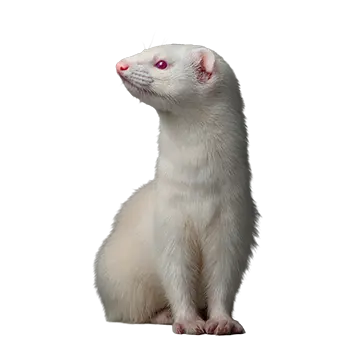
The genetics of albinism in domestic ferrets follows a well-understood autosomal recessive inheritance pattern. True albinism results from a mutation in the tyrosinase gene that eliminates melanin production entirely, producing the characteristic white coat, pink skin, and ruby-red or pink eyes. Both parents must carry at least one copy of the albino allele for any albino offspring to appear in a litter, and mating two albino ferrets together guarantees that all offspring will also be albino. Breeders who work with albino lines should be aware that while albinism itself does not cause health problems beyond photosensitivity, responsible breeding requires attention to overall genetic diversity and health screening to avoid perpetuating lines with elevated risk for the common ferret diseases such as insulinoma, adrenal disease, and cardiomyopathy.

Pre-Breeding Health Assessment and Selection

Responsible breeding of albino ferrets begins long before mating occurs, with comprehensive health screening of both the prospective jill and hob. A thorough pre-breeding veterinary examination should include a complete physical assessment, blood work encompassing a full blood count and serum chemistry panel, fasting blood glucose measurement to screen for early insulinoma, and abdominal palpation or ultrasound to evaluate adrenal gland size and screen for splenic abnormalities. Any ferret diagnosed with insulinoma, adrenal disease, cardiomyopathy, or lymphoma should be excluded from the breeding program, as these conditions carry heritable predisposition components that responsible breeders should not propagate.

Age is an important consideration in breeding selection. Jills should ideally be bred during their first or second estrus season, typically between eight months and two years of age. Jills older than three years face increased risks of pregnancy complications, reduced litter size, and higher incidence of dystocia. Hobs remain fertile for a longer span but should likewise be in excellent health and free of the common ferret diseases. Both animals should be current on vaccinations, free of external and internal parasites, and at optimal body condition, neither overweight nor underweight, before mating is attempted.

Temperament evaluation is an often-neglected aspect of breeding selection that deserves equal weight alongside physical health. Ferrets with stable, confident temperaments that tolerate handling well, show appropriate social behavior with other ferrets, and do not display excessive fear or unprovoked aggression should be prioritized in the breeding program. Temperament has a heritable component in domestic ferrets, and consistently selecting for good disposition produces offspring that are better suited for life as companion animals. Albino ferrets that are excessively reactive to light stimuli or that display unusual behavioral patterns should be evaluated carefully before inclusion in a breeding program to distinguish individual variation from potential neurological issues.

Practical preparation for a breeding program extends beyond the animals themselves. The breeder must have appropriate facilities to house the jill separately during gestation, a whelping area that meets the environmental requirements of neonatal kits, a relationship with a veterinarian experienced in mustelid reproduction, the financial resources to manage potential complications including emergency cesarean section, and a realistic plan for placing the offspring in responsible homes. Ferret litters can range from one to as many as fourteen kits, and the breeder must be prepared to care for, socialize, vaccinate, and rehome every kit produced. Breeding ferrets casually, without these preparations in place, is irresponsible and contributes to the already significant population of surrendered and abandoned ferrets in rescue organizations.

The Mating Process and Estrus Management

Recognizing the onset of estrus in the jill is the first step in timing a successful mating. The most reliable external indicator is swelling of the vulva, which becomes visibly enlarged, turgid, and pink to reddish in color within one to two weeks of estrus onset. The swelling is often dramatic, progressing from a small, barely visible structure to a prominently protruding, pea-sized or larger protrusion. Some jills also display behavioral changes during estrus, including increased restlessness, a tendency to back up to objects or the cage wall, and a posture with the hindquarters slightly elevated when pressure is applied to the lower back. On the white skin of an albino jill, the vulvar changes are particularly easy to observe, which gives the breeder a clear visual signal for timing the introduction to the hob.

The mating process in ferrets is vigorous and can appear alarming to observers unfamiliar with mustelid reproductive behavior. The hob grasps the jill by the scruff of the neck with his teeth and mounts her from behind. The jill typically goes limp during the scruff hold, a response called tonic immobility that facilitates copulation. The mating act itself can last from thirty minutes to several hours, during which the pair may rest intermittently while remaining coupled. The neck bite commonly leaves the jill with a raw, abraded, or even bleeding scruff area, which is normal and generally heals without treatment within a few days. Keepers should ensure that the mating enclosure has no obstacles or levels from which the coupled pair could fall.

Ovulation in the jill is induced by the physical stimulation of mating and typically occurs thirty to forty hours after copulation. Because ovulation is not spontaneous, a single mating is usually sufficient to induce it, though many breeders allow two to three mating sessions over consecutive days to maximize the likelihood of fertilization. Following successful mating, the vulvar swelling will begin to recede over the next two to three weeks as progesterone levels rise and estrus transitions to diestrus. If the swelling does not recede after three weeks, the mating may not have been successful in inducing ovulation, and veterinary consultation is warranted.

For jills that have entered estrus but for whom breeding is not planned during that particular cycle, the estrus must be terminated to prevent aplastic anemia. Options include mating with a vasectomized hob, which induces ovulation and a pseudopregnancy lasting approximately forty-two days, administration of human chorionic gonadotropin to induce ovulation hormonally, or placement of a deslorelin implant that suppresses the reproductive axis. Each approach has advantages and limitations, and the choice should be made in consultation with a veterinarian. Allowing a jill to remain in estrus for more than four to six weeks without intervention significantly increases the risk of life-threatening bone marrow suppression.

Gestation and Prenatal Care

The gestation period in domestic ferrets lasts approximately forty-one to forty-two days from the date of successful ovulation-inducing mating. During the first two weeks of pregnancy, external signs are minimal, and the jill's behavior and appetite may not change noticeably. Confirmation of pregnancy can be attempted through abdominal palpation by an experienced veterinarian at approximately fourteen to twenty-one days post-mating, when the individual embryonic vesicles can sometimes be felt as small, rounded structures along the uterine horns. Ultrasound examination provides a more definitive and less invasive confirmation method and can also give an approximate count of developing fetuses, though accuracy varies depending on the stage of gestation and the skill of the operator.

Nutritional support during gestation is critical for the health of both the jill and her developing kits. The jill's caloric and protein requirements increase progressively throughout pregnancy, rising most steeply during the final two weeks when fetal growth accelerates dramatically. Her diet should consist of the highest-quality ferret food available, with a protein content of at least 36 percent and fat content of at least 20 percent, offered on a free-feeding basis so she can eat as much as she needs. Supplementation with cooked egg, small portions of raw meat or organ meat, and a ferret-appropriate vitamin supplement provides additional nutritional insurance. Fresh water must be constantly available, and intake should be monitored, as dehydration during gestation can compromise placental function and fetal development.

The jill's physical activity typically decreases naturally during the second half of gestation as her body weight increases and her energy is directed toward supporting fetal growth. She should not be forced to exercise or subjected to stressful handling during this period, though gentle, routine interactions should continue to maintain her comfort with human contact, which will be important during and after delivery. Her cage or enclosure should be arranged to minimize the need for climbing, with food, water, and litter box accessible at a single level. The whelping box should be introduced into the enclosure at least one week before the expected delivery date so the jill has time to acclimate to it and begin arranging nesting material to her satisfaction.

The final days of gestation are characterized by noticeable behavioral changes in the jill. She may become increasingly restless, repeatedly entering and rearranging the nesting box, and her appetite may diminish in the twenty-four to forty-eight hours preceding delivery. Abdominal distension becomes visibly obvious in the final week, and the mammary glands enlarge and may begin to express colostrum. The keeper should have the veterinarian's emergency contact information readily available and should know the location of the nearest after-hours emergency clinic that treats ferrets, as complications such as dystocia, retained kits, or postpartum hemorrhage require immediate professional intervention.

Whelping Preparation and Delivery

Preparing for the delivery of an albino ferret litter requires attention to both the physical environment and the keeper's own readiness to support the process while minimizing interference. The whelping box should be a solid-walled enclosure approximately twelve by eighteen inches with sides four to six inches high, providing enough space for the jill to move comfortably while keeping the kits contained. A single entry point allows the jill to come and go while preventing the blind, crawling neonates from wandering out. The box should be lined with soft, clean fleece or flannel, and spare bedding should be available nearby for replacement if the birthing material becomes heavily soiled.

The environmental temperature surrounding the whelping area should be elevated to 80 to 85 degrees Fahrenheit, as the neonatal kits will be unable to thermoregulate at birth. A ceramic heat emitter controlled by a thermostat provides steady warmth without the bright light of a heat lamp, which would be uncomfortable for both the jill and particularly for the photosensitive eyes of albino neonates. A secondary thermometer at nest level allows the keeper to verify that the actual temperature within the whelping box matches the target range. The room should be quiet and free from foot traffic, other animals, and unnecessary disruption.

Delivery in ferrets typically begins with visible contractions and restless nesting behavior. The jill will often pant, stretch, and repeatedly reposition herself within the whelping box. Kits are usually delivered at intervals of several minutes to over an hour, with the jill cleaning each kit, consuming the placental membranes, and severing the umbilical cord between deliveries. A litter of six to eight kits may take several hours to deliver completely. The keeper should observe from a distance, noting the time of each delivery and watching for signs of distress. If the jill strains continuously for more than two hours without producing a kit, or if she appears exhausted and stops contracting with kits still undelivered based on the expected count, emergency veterinary assistance is required, as dystocia in ferrets can quickly become life-threatening.

Following completion of delivery, the jill should settle with her litter and begin nursing within the first few hours. The keeper can offer food and water near the whelping box but should not attempt to inspect, count, or handle the kits for at least twenty-four to forty-eight hours. During this initial bonding period, the jill is at her most protective and easily stressed, and disturbance can trigger dangerous responses including refusal to nurse or infanticide. The used bedding can be carefully removed and replaced with clean material once the jill voluntarily leaves the nest, working quickly and quietly to minimize the disruption. The post-delivery jill should be monitored for signs of postpartum complications including persistent bloody or foul-smelling discharge, fever, lethargy, refusal to eat, or rejection of the litter, any of which warrant immediate veterinary consultation.

The breeder's responsibilities extend well beyond delivery day. Each kit will need to be monitored for adequate growth through daily weighing, socialized through gentle handling beginning around ten to fourteen days of age, and provided with a gradually expanding environment as the litter develops mobility and curiosity. The entire litter must receive its initial vaccination series beginning at six to eight weeks, and each kit should be individually assessed by a veterinarian before being placed in its new home. Responsible breeders also provide new owners with comprehensive care information, dietary recommendations, vaccination records, and ongoing support, ensuring that every albino ferret kit produced has the best possible start in its new family.

Always consult a qualified professional before making any health-related decisions. This content is provided for informational reference only and should not replace professional guidance specific to your animal.