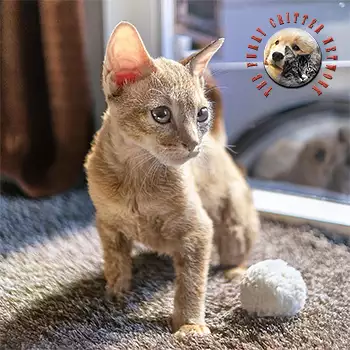

The German Rex coat is produced by an autosomal recessive mutation that alters the structure of the hair shaft, resulting in the soft, wavy fur that defines the breed. For a kitten to display the rex coat phenotype, it must inherit two copies of the recessive allele — one from each parent. A cat carrying only one copy of the rex gene will have a normal straight coat but will be a carrier capable of producing rex-coated offspring when mated to another carrier or to a homozygous rex cat. Understanding this inheritance pattern is fundamental to planning litters and predicting coat outcomes.
The German Rex mutation is genetically distinct from the Cornish Rex mutation, despite producing superficially similar curly coats. Early test crosses between German Rex and Cornish Rex cats produced straight-coated kittens in the first generation, demonstrating that the two breeds carry their rex phenotype on different loci. However, subsequent investigations and breeding data have complicated this picture, with some researchers and breed historians suggesting the two mutations may be allelic or closely linked. For practical breeding purposes, German Rex programs treat the mutation as breed-specific and maintain their lines independently of Cornish Rex bloodlines.
Genetic diversity is a significant concern for the German Rex due to the breed's small global population. The breed traces its documented history to a single foundation cat, a curly-coated feline discovered in East Germany in the late 1940s and early 1950s. Subsequent breeding programs expanded the gene pool through carefully selected outcrosses, but the population remains limited compared to mainstream breeds. Responsible breeders monitor inbreeding coefficients, utilize pedigree analysis tools, and collaborate internationally to access unrelated lines that can introduce fresh genetic material without compromising breed type.
Before undertaking any breeding, both the prospective sire and dam should undergo comprehensive health screening. At minimum, this includes cardiac evaluation by echocardiography to screen for hypertrophic cardiomyopathy, testing for feline leukemia virus and feline immunodeficiency virus, blood type determination, and a thorough physical examination. Any available DNA-based health screening panels relevant to the breed should also be utilized. Breeding cats with known hereditary health conditions or those that have not been adequately screened is inconsistent with responsible stewardship of the breed.