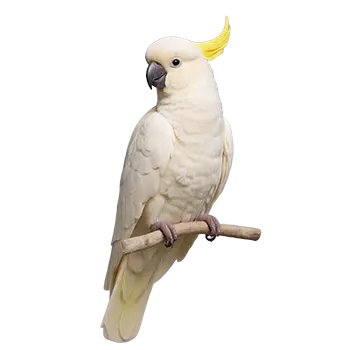

The Sulphur-Crested Cockatoo reaches full physical maturity between three and five years of age, entering an adult phase that can span several decades. This is the longest stage of the bird's life and the period during which the relationship between cockatoo and caregiver either deepens into a rewarding partnership or deteriorates under the weight of unmet needs. Understanding what an adult Sulphur-Crested Cockatoo truly requires is essential for anyone committed to providing lifelong care for one of the most complex companion animals in existence.
Physically, the adult Sulphur-Crested Cockatoo is an imposing bird. Mature individuals measure 17 to 20 inches from head to tail tip and weigh between 800 and 1,000 grams depending on sex and subspecies. The plumage is predominantly white with a striking forward-curving crest of bright sulphur-yellow feathers that the bird raises and lowers to communicate arousal, alarm, excitement, and curiosity. The undersides of the wings and tail are washed with pale yellow, visible during flight and display. The beak is a powerful, dark grey instrument capable of exerting crushing force exceeding 350 pounds per square inch, sufficient to crack macadamia nuts, shatter wooden dowels, and bend cage bars that are not adequately constructed.
Behaviorally, the adult cockatoo is a study in contrasts. These birds are capable of profound affection, playful exuberance, and remarkable problem-solving intelligence, while also being prone to dramatic emotional displays, possessiveness, jealousy, and persistent loud vocalizations. A well-adjusted adult Sulphur-Crested Cockatoo is one of the most engaging companion animals imaginable, demonstrating a range of emotional expression that few other species can match. An under-stimulated or improperly socialized adult, however, can become a formidable behavioral challenge, and the species accounts for a disproportionate share of birds surrendered to rescue organizations.
The key to successful adult care lies in accepting the Sulphur-Crested Cockatoo for what it is: a wild animal that has been domesticated in form but not in essence. Its drives for social connection, physical activity, foraging, chewing, vocalizing, and exploring are not negotiable preferences but biological imperatives. Suppressing these drives rather than channeling them is the root cause of the majority of behavioral problems seen in captive cockatoos. The caregiver's role is not to make the bird fit a convenient domestic mold but to create an environment that allows the bird to express its nature as fully as possible within the constraints of a shared home.