Sage Baluchi

Afghan Hound

Quick Facts

🐕 Breed Group
Hound Group
📏 Size Category
Large
📏 Height
Males: 27-29 inches, Females: 25-27 inches
⚖️ Weight
Males: 50-60 lbs, Females: 50-60 lbs
⏱️ Life Expectancy
12-14 years
🧣 Coat Type
Long, thick, fine, silky; shorter saddle on back
🎨 Coat Colors
Any color or combination; common colors include black, black and tan, cream, red, blue, brindle, domino
😀 Temperament
Dignified, aloof, independent, affectionate with family, strong prey drive
🏃 Exercise Needs
Moderate to high - daily walks plus sprinting opportunities in secure areas
🎓 Training Difficulty
High - independent thinker, requires patient positive methods
👶 Good with Children
Better with older children; too independent for rough play
🐾 Good with Other Pets
Good with dogs; very high prey drive toward small animals

Other Names & Breed Recognition

Sage Baluchi is a name rooted in the languages and geography of the breed's homeland, referring to the dog of the Baloch people or the hound from Balochistan. In Dari and related Persian-dialect languages, sage means dog, and Baluchi identifies the connection to the Baloch ethnic group and the vast Balochistan region that spans modern-day southwestern Pakistan, southeastern Iran, and southern Afghanistan. This name places the breed firmly in one of its most important ancestral landscapes, the arid steppe and desert terrain where sighthounds were essential companions to nomadic and semi-nomadic peoples who depended on them for hunting game across open ground.

The breed is far more widely known today as the Afghan Hound, the name used by the American Kennel Club, The Kennel Club of the United Kingdom, and most other English-language registries. The FCI registers the breed under Standard Number 228, recognizing Afghanistan as the country of origin and using the name Afghan Hound internationally. But Sage Baluchi is only one of a remarkable number of alternate names this breed has accumulated over its long history. Others include Balkh Hound, referencing the ancient northern Afghan province of Balkh; Barakzai Hound, after the Barakzai Pashtun tribal dynasty; Kabul Hound, identifying the mountain-type dogs from the Afghan capital region; Galanday Hound and Shalgar Hound from other regional traditions; Kuchi Hound, associated with the nomadic Kuchi people; and Tazi or Sag-e Tazi, a general term for sighthounds used across Central Asia. The breed has also been called the Eastern Greyhound and Persian Greyhound by British observers who encountered these dogs during the colonial period.

This proliferation of names reflects both the breed's deep antiquity and its widespread distribution across a vast geographic area where different cultures, languages, and tribal groups each developed their own terminology for dogs they had known for generations. The modern Afghan Hound descends from two primary foundation strains imported to Britain in the 1920s. The Bell-Murray strain, brought to Scotland from Balochistan in 1920, represents the desert or steppe type with lighter coats and a sleeker build suited to hot, open terrain. This is the strain most directly associated with the Sage Baluchi name. The second strain, known as Ghazni after Mrs. Mary Amps's kennel in Kabul, represented the heavily coated mountain type. These two distinct types were eventually merged into a single breed standard written in 1948.

Sage Baluchi Organizations & Standards

The breed known in its homeland as the Sage Baluchi is governed by breed standards maintained across all major international kennel organizations, each recognizing the same dog under the primary name Afghan Hound. The Afghan Hound Club of America, founded in 1937, serves as the AKC parent club and bears primary responsibility for the breed standard in the United States. The AKC first recognized the breed in 1926, classifying it within the Hound Group. The standard describes a dog of dignified bearing and aristocratic appearance, combining speed, power, and agility in a form specifically adapted to the demanding terrain of its homeland. The club hosts an annual National Specialty and participates in the CHIC health testing program administered through OFA.

The Federation Cynologique Internationale registers the breed under Standard Number 228, placing it in Group 10 for Sighthounds, Section 1 for Long-haired or Fringed Sighthounds, with Afghanistan recognized as the country of origin. The FCI standard provides detailed physical requirements and emphasizes the breed's functional heritage as a coursing hound capable of pursuing diverse game across mountain, desert, and steppe terrain. The breed standard's description of the ideal Afghan Hound reflects both the mountain type and the desert type that contributed to the modern breed, requiring a dog that balances elegance with genuine athletic capacity.

The United Kennel Club recognized the breed in 1948, classifying it within the Sighthound and Pariah Group. The UKC standard places particular emphasis on the breed's working origins, noting that Afghan Hounds hunted prey ranging from hare to snow leopard across extremely challenging terrain. The Kennel Club of the United Kingdom recognizes the breed within its Hound Group, and the breed has maintained a significant presence in British breeding and showing circles since the 1920s. The Canadian Kennel Club also recognizes the breed in its Hounds Group.

Health testing recommendations established by the Afghan Hound Club of America through the CHIC program require hip evaluation through OFA or PennHIP, an eye examination registered through CERF or OFA, and a thyroid evaluation. These three tests address the breed's primary documented health concerns and provide breeders with standardized data for informed breeding decisions. The club has also initiated research into chylothorax, a condition that affects Afghan Hounds at a higher rate than most other breeds, working with the University of Missouri and the AKC Canine Health Foundation to investigate the genetic basis of this serious thoracic condition.

Kennel Club Recognition

  • American Kennel Club (AKC): Recognized in 1926, Hound Group
  • United Kennel Club (UKC): Recognized, Sighthound and Pariah Group
  • Canadian Kennel Club (CKC): Recognized, Hounds Group
  • FCI: Recognized, Group 10 (Sighthounds)
  • The Kennel Club (UK): Recognized, Hound Group

Sage Baluchi Physical Description

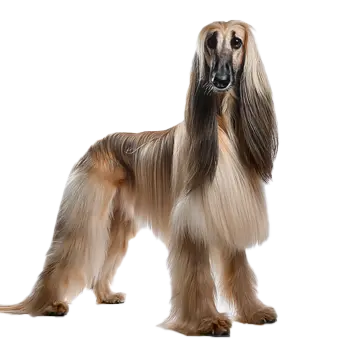
The Sage Baluchi is a large sighthound whose physical structure reflects thousands of years of adaptation to some of the most demanding hunting terrain on earth. Males stand 27 to 29 inches at the withers, with females slightly smaller at 25 to 27 inches. Weight ranges from approximately 50 to 60 pounds, though the breed should always appear lean and athletic rather than heavy. The overall silhouette is one of height and elegance, with a long, refined head carried proudly on a muscular neck, a level topline, prominent hipbones, and a deep chest that provides the lung capacity needed for sustained high-speed pursuit.

The head is long and narrow, with a skull that is neither too broad nor too domed, and a muzzle that is slightly convex along its dorsal line. The stop is minimal, creating a smooth transition from forehead to muzzle. The nose is typically black, though liver-colored noses appear in dogs with lighter coats. The eyes are almond-shaped, dark, and set with a slightly oblique angle that gives the face the breed's characteristic faraway, almost melancholy expression. This expression is often described as looking through rather than at the observer, conveying the dignified detachment that defines the breed's demeanor. The ears are set low and far back on the skull, hanging flat against the head and covered with long, silky hair that blends into the coat of the neck.

One of the breed's most immediately recognizable features is the long, silky topknot of hair on the crown of the head. This crowning feature, combined with the flowing coat along the body and legs, gives the breed its unmistakable appearance. The coat is thick, fine, and silky in texture, growing longest on the ribs, forequarters, hindquarters, and legs. A distinctive shorter-haired area along the back forms what is called the saddle, where the hair lies close and smooth in contrast to the longer coat elsewhere. This saddle pattern is a hallmark of breed type and is present to some degree in all properly coated individuals.

The body is built for the combination of speed, endurance, and agility required to hunt across rugged ground. The chest is deep, reaching approximately to the elbow, but not excessively broad. The ribs are well sprung, and the loin is strong and slightly arched. The hipbones are prominent and set wide, a structural feature that provides the power and flexibility needed for the breed's distinctive gait and its ability to navigate rocky, uneven terrain at speed. The hindquarters are powerful, with well-bent stifles and long second thighs that generate the driving force behind the breed's gallop.

The feet are large, strong, and covered with thick hair, a functional adaptation that served as natural shock absorption on the rocky mountain terrain of Afghanistan. The tail is set low, carried in a ring or curve at the tip, and sparsely feathered compared to the rest of the body. This distinctive tail carriage is considered essential to breed type. Movement at the trot is smooth, springy, and covers ground with minimal apparent effort. The breed possesses the typical double-suspension gallop of sighthounds, capable of reaching speeds up to 40 miles per hour with explosive acceleration and the agility to make sharp directional changes at speed.

Any color or combination of colors is acceptable under the breed standard, though white markings on the head are discouraged. Common colorations include black, black and tan, red, cream, blue, brindle, and domino patterns. The coat color does not affect judging, and the breed exhibits one of the wider color ranges among sighthound breeds.

Affectionate With Family
The Sage Baluchi bonds selectively and deeply with its chosen people, showing genuine devotion through quiet proximity and calm companionship rather than exuberant displays.
Good With Young Children
Tolerant rather than enthusiastic with children, this independent breed may withdraw from rough or noisy play and is best suited to families with older, respectful children.
Good With Other Dogs
Generally compatible with other dogs, especially fellow sighthounds, though the breed's independent nature means it engages socially on its own terms.
Shedding Level
Sheds minimally despite the profuse coat. The fine, silky hair tends to come out during grooming sessions rather than depositing loosely around the home.
Coat Grooming Frequency
One of the most grooming-intensive breeds in existence. The long, silky coat requires multiple thorough brushing sessions weekly and regular bathing to prevent painful matting.
Drooling Level
This is a clean, dry-mouthed breed that produces virtually no drool.
Coat Type
The long, thick, fine, silky coat covers most of the body with a distinctive shorter saddle area along the back. A silky topknot crowns the head.
Openness To Strangers
Reserved and observational with unfamiliar people, the breed assesses strangers on its own timeline and approaches when it is ready, not when beckoned.
Playfulness Level
Possesses a surprising clownish streak that emerges during play, contrasting with the breed's usual composed dignity. Play tends to occur in short, spirited bursts.
Watchdog/Protective Nature
Not a natural watchdog or protector. The breed is quiet, rarely barks, and lacks strong territorial instinct despite its imposing size.
Adaptability Level
Calm indoors and adaptable to household routines, but requires ample space, secure fencing for running, and is not suited to apartment life.
Trainability Level
Highly intelligent but independently minded, the breed evaluates commands before deciding whether to comply. Training requires patience, creativity, and realistic expectations.

Sage Baluchi History & Development

The name Sage Baluchi carries a specificity that the more familiar Afghan Hound designation does not. While Afghan Hound identifies the breed with an entire nation, Sage Baluchi pinpoints a particular region and people. Balochistan is a vast territory extending across the southern portions of Afghanistan and Pakistan and into southeastern Iran, historically home to the Baloch people, who maintained a seminomadic pastoral culture in which hunting dogs played an essential functional role. The sighthounds kept by these communities were not ornamental companions but working animals integral to subsistence and cultural life.

The dogs from this region formed one of the two primary foundation strains of the modern breed. In 1920, Major and Mrs. G. Bell-Murray, along with Miss Jean C. Manson, brought a group of sighthounds from Balochistan to Scotland. These Bell-Murray dogs represented what became known as the desert or steppe type, characterized by lighter, less profuse coats and sleeker builds adapted to the hot, arid terrain of lower elevations. They were functional hunting dogs, built for speed across open ground rather than for the cold-weather endurance required in the Afghan mountains.

The second foundational strain arrived several years later. Mrs. Mary Amps, who had moved to Kabul following the Third Anglo-Afghan War in 1919, established a kennel there and shipped dogs to England beginning in 1925. Her Ghazni strain, named after the kennel, represented the mountain type. These dogs carried the heavier, more profuse coats needed for warmth at high altitudes and had somewhat different proportions suited to navigating steep, rocky terrain. The foundation sire of the Ghazni kennel closely resembled Zardin, an early show dog brought to England in 1907 whose appearance had defined the initial breed ideal.

British breeders initially exhibited these dogs under various names, including Barukzy Hound and Persian Greyhound, reflecting the confusion common when Western observers encountered unfamiliar Eastern breeds. The two strains were eventually interbred, producing the modern Afghan Hound that combines characteristics of both desert and mountain types. A unified breed standard was written in 1948 and remains the basis for current standards worldwide. The AKC had recognized the breed in 1926, and it quickly became a popular show dog valued as much for its spectacular appearance as for its hunting heritage.

The name Sage Baluchi preserves a connection to the pre-show-ring history of the breed, a time when these dogs were valued for what they could do rather than how they looked. The Balochistan dogs hunted hare, gazelle, fox, and other game across open terrain, working in coordination with mounted hunters in a tradition that stretched back centuries. Using this name today acknowledges that the Afghan Hound is not merely a product of Western breeding programs but an ancient working sighthound with deep roots in the cultures and landscapes of Central and South Asia.

Sage Baluchi Temperament & Personality

The temperament of the Sage Baluchi is one of the most distinctive in the dog world, shaped by centuries of development as an independent coursing hound operating across terrain that demanded self-reliance. This breed was not developed to work alongside a human handler in the way that herding or gun dogs were. It was developed to think, decide, and act on its own at high speed, often far ahead of the mounted hunter who depended on the dog's independent judgment. That heritage produces a temperament that is often described as aloof, dignified, and cat-like, but these labels only capture part of the picture.

Within its family, the Sage Baluchi can be deeply affectionate and genuinely devoted to the people it trusts. The affection is expressed on the dog's own terms, often through quiet proximity rather than exuberant demonstrations. Many owners describe a dog that selects one or two primary people and forms an intense bond with them while remaining cordial but somewhat distant with other household members. This selectivity is not unfriendliness. It reflects the breed's nature as a dog that gives its loyalty deliberately rather than indiscriminately. The breed possesses a surprising clownish side that emerges during play, contrasting sharply with its usual composed dignity and catching new owners off guard.

With strangers, the breed is reserved, observational, and inclined to approach on its own schedule rather than being drawn in by overtures from unfamiliar people. Some individuals can be genuinely shy if not adequately socialized during puppyhood, which makes early exposure to varied people, environments, and experiences particularly important for this breed. Well-socialized Afghan Hounds accept new situations with the calm confidence that befits their bearing, while poorly socialized individuals may become anxious or avoidant.

The prey drive in this breed is exceptionally strong and deeply embedded. Thousands of years of selection for the ability to spot, pursue, and bring down game ranging from hare to gazelle to snow leopard have produced a dog that will chase virtually any fast-moving small animal with unwavering focus. This drive is not trainable away. It is a fundamental part of the breed's behavioral repertoire and must be managed through environmental controls rather than suppressed through obedience work. The breed cannot be trusted off leash in unsecured areas, and owners must recognize that even a well-trained Sage Baluchi will prioritize pursuit over recall when the prey drive activates.

The breed's intelligence is frequently mischaracterized as stubbornness or low trainability. In reality, the Sage Baluchi is quite intelligent but applies its cognitive abilities toward independent problem-solving rather than obedience-oriented tasks. The dog evaluates requests, considers whether compliance serves its interests, and makes its own decision. This can be frustrating for owners accustomed to more biddable breeds, but it is an honest expression of the breed's nature as a self-directed hunter rather than a handler-dependent worker.

Sage Baluchi Family Life & Living Requirements

Living with a Sage Baluchi requires understanding that this breed's needs extend beyond what its elegant appearance might suggest. This is a large, athletic sighthound that needs room to move and regular access to a securely fenced area where it can run at full speed. The fencing requirement is non-negotiable and demands particular attention. Afghan Hounds are accomplished jumpers, and standard four or five-foot fencing is often insufficient. Six-foot or taller fencing is recommended, and the dog should never be left unsupervised in a yard where it might be motivated to clear the barrier by the sight of a cat, rabbit, or other small animal on the other side.

Indoors, the breed is surprisingly calm and quiet. Afghan Hounds are not barkers and do not typically display destructive behavior when their exercise needs are met. They prefer comfortable resting spots and will claim furniture, beds, and soft surfaces as their own with the confidence of a dog that has always expected comfort. This combination of outdoor athleticism and indoor tranquility makes the breed more adaptable to household living than its size alone might suggest, though apartment living is generally not appropriate given the breed's need for space and sprinting opportunities.

With children, the breed can be gentle but is generally not the enthusiastic playmate that many families hope for in a dog. The breed's independent nature means it tolerates children rather than actively seeking them out, and it may withdraw from rough or noisy play. Older children who respect the dog's boundaries and appreciate a more reserved companion often build strong relationships with the breed. Households with very young children should consider carefully whether the combination of a large, independent dog and an unpredictable toddler is a good match.

The Sage Baluchi's strong prey drive requires careful management in multi-pet households. Cats and small animals introduced to the dog during puppyhood may be accepted as part of the household, but the chase instinct remains potent and can activate unexpectedly. Other dogs, particularly other sighthounds, generally make compatible companions. The breed thrives on human connection despite its reserved exterior and does not do well when isolated from family life for extended periods.

Sage Baluchi Training & Exercise Needs

Training the Sage Baluchi requires patience, realistic expectations, and an understanding that this breed operates by its own internal logic rather than the handler-focused compliance seen in sporting or herding breeds. Conventional obedience training methods that rely on repetition and structured drills are poorly suited to this breed's temperament. The dog will learn quickly but decides independently whether to perform on command, and no amount of drilling will produce the automatic response that comes naturally to breeds selected for handler dependence. Training succeeds best when it is varied, brief, reward-based, and respects the dog's intelligence rather than attempting to override it.

Basic obedience is achievable and important, particularly reliable leash manners and a functional recall in controlled settings. A solid recall in an open, unsecured environment should not be expected, as the prey drive will override training in the presence of a moving target. House training can be slower with this breed than with many others, requiring consistent scheduling and patience through a process that may extend longer than owners anticipate. Positive reinforcement works far better than correction, as the breed's sensitivity means harsh handling will create avoidance rather than compliance.

Lure coursing is the activity most naturally suited to the Sage Baluchi's instincts and abilities. The sport channels the breed's prey drive and athletic capacity into structured competition, and most Afghan Hounds approach it with obvious enthusiasm. Agility can also work for individuals with the right temperament, though the breed's independent nature means it may improvise on the course rather than following the handler's direction precisely. Some dogs show aptitude for rally and even therapy work, particularly those with well-developed social skills from thorough early socialization.

Exercise needs are moderate to high and should include opportunities for full-speed running in a secure area several times per week. Daily walks provide baseline physical activity and mental stimulation, but they do not replace the breed's fundamental need to sprint. Afghan Hounds at full gallop are remarkable athletes, reaching speeds up to 40 miles per hour, and denying them this expression of their natural capacity leads to frustration and behavioral deterioration. At least an hour of daily exercise, combining walking with running opportunities, keeps the breed physically sound and mentally balanced.

Sage Baluchi Health Concerns

Chylothorax is the health condition most uniquely associated with the Sage Baluchi. This serious condition occurs when chyle, a milky lymphatic fluid produced during fat digestion, leaks from a damaged or malfunctioning thoracic duct into the chest cavity. As fluid accumulates around the lungs and heart, it causes progressive breathing difficulty, cough, and lethargy. The condition can lead to lung torsion, where a lung lobe twists within the chest cavity, creating a surgical emergency. Left untreated, chylothorax can cause fibrosing pleuritis as scar tissue forms around the organs. The Afghan Hound Club of America has partnered with the University of Missouri to research the genetic basis of this condition, which affects this breed at a higher rate than most others. A low-fat diet may help reduce risk in predisposed individuals.

Hypothyroidism is the third CHIC-required screening, as the breed is prone to insufficient thyroid hormone production. Diagnosis in sighthounds can be complicated by the fact that these breeds naturally maintain lower baseline thyroid levels than non-sighthound breeds, requiring veterinarians familiar with sighthound-specific reference ranges. Additional documented concerns include bloat and gastric dilatation-volvulus due to the deep chest conformation, Afghan Hound hereditary myelopathy causing progressive hind limb paralysis in young adults, exocrine pancreatic insufficiency, panosteitis in growing dogs, and laryngeal paralysis in older individuals. Like all sighthounds, the breed has heightened sensitivity to anesthesia due to low body fat, requiring careful veterinary management during any procedure involving sedation.

Common Health Issues

  • Chylothorax - A serious condition in which lymphatic fluid leaks from the thoracic duct into the chest cavity, causing breathing difficulty and potentially fatal complications including lung torsion and fibrosing pleuritis. Afghan Hounds are affected at a higher rate than most breeds.
  • Hip dysplasia - Improper formation of the hip joint leading to pain, reduced mobility, and arthritis. One of three CHIC-required screenings for the breed.
  • Cataracts - Progressive lens opacity that can lead to partial or complete blindness. Common in mature Afghan Hounds and sometimes surgically correctable.
  • Progressive retinal atrophy (PRA) - Inherited gradual deterioration of the retina beginning with night blindness and potentially progressing to total vision loss.
  • Glaucoma - Dangerously elevated pressure within the eye that causes pain and can lead rapidly to blindness without emergency treatment.
  • Hypothyroidism - Insufficient thyroid hormone production causing weight gain, coat deterioration, lethargy, and behavioral changes. Diagnosis requires sighthound-specific reference ranges.
  • Gastric dilatation-volvulus (bloat/GDV) - Life-threatening stomach torsion facilitated by the breed's deep chest conformation, requiring immediate surgical intervention.
  • Afghan Hound hereditary myelopathy - A breed-specific condition causing progressive hind limb paralysis in young adult dogs.
  • Exocrine pancreatic insufficiency - Inadequate production of digestive enzymes causing malnutrition, weight loss, and coat deterioration despite adequate food intake.

Preventive Care & Health Monitoring

  • Hip evaluation through OFA or PennHIP is a CHIC requirement to screen breeding stock for hip dysplasia. - Hip evaluation through OFA or PennHIP is a CHIC requirement to screen breeding stock for hip dysplasia.
  • Annual eye examination through CERF or OFA by a board-certified ophthalmologist screens for cataracts - Progressive retinal atrophy, and glaucoma.
  • Thyroid evaluation through OFA is the third CHIC requirement. Ensure your veterinarian uses sighthound-specific reference ranges - As this breed naturally maintains lower baseline thyroid levels.
  • Feed two to three smaller meals daily and avoid strenuous exercise before and after eating to reduce bloat risk - Discuss prophylactic gastropexy with your veterinarian.
  • A low-fat diet may help reduce the risk of chylothorax in predisposed individuals - Discuss appropriate dietary fat levels with your veterinarian.
  • Inform all veterinary professionals treating this breed about sighthound-specific anesthesia sensitivity due to low body fat and lean muscle composition. - Inform all veterinary professionals treating this breed about sighthound-specific anesthesia sensitivity due to low body fat and lean muscle composition.
  • Monitor young adults for signs of progressive hind limb weakness that could indicate Afghan Hound hereditary myelopathy. - Monitor young adults for signs of progressive hind limb weakness that could indicate Afghan Hound hereditary myelopathy.

Sage Baluchi Grooming & Maintenance

The coat of the Sage Baluchi is one of the most demanding in the entire dog world and represents the single largest ongoing commitment owners must make to this breed. The long, thick, fine, silky hair grows profusely over most of the body, with the exception of the shorter saddle area along the back. This coat was developed as protection against the harsh mountain climate of Afghanistan, but maintaining it in a domestic setting requires significant time and dedication. Owners who are not prepared for the grooming commitment should seriously reconsider this breed, as a neglected Afghan Hound coat mats quickly and painfully, causing skin irritation and potential infection beneath the tangles.

Thorough brushing and combing sessions are needed multiple times per week, with each session potentially lasting an hour or more depending on coat length and condition. The technique matters as much as the frequency. The coat should be dampened before brushing to prevent breakage, and each section should be worked through carefully from the ends toward the skin. A pin brush and wide-toothed comb are the primary tools, with a slicker brush reserved for specific areas. Many experienced owners recommend not brushing between baths, as working through a clean, conditioned coat is substantially easier and less damaging than struggling through a dry, dirty one.

Bathing frequency varies by lifestyle and coat condition but typically falls in the range of every one to two weeks for dogs maintained in full coat. A quality dog shampoo that does not strip natural oils is essential, followed by thorough conditioning and careful blow-drying. Many owners invest in a professional-grade force dryer, as air-drying this coat takes an impractically long time and can promote matting. During meals, a snood or fabric tube protects the long ear hair from dragging through food and water.

Beyond coat care, routine maintenance includes regular nail trimming, ear cleaning with attention to the long, heavily haired ears that can trap moisture and promote infection, and dental care. The ear canals deserve particular vigilance, as the combination of pendant ear shape and profuse hair creates a warm, humid environment conducive to yeast and bacterial growth. Some owners choose to keep their non-show dogs in a shorter clip that dramatically reduces grooming time while still allowing the dog to retain its essential breed character.