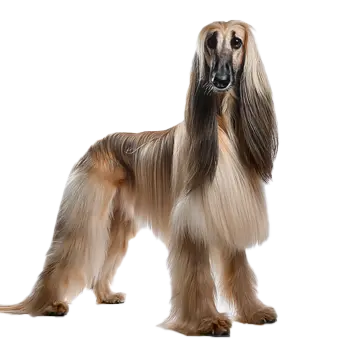
The Ogar Afgan is a sighthound built to cover ground at speed across some of the most demanding terrain on earth, and every element of its physical construction reflects that purpose. Standing roughly 25 to 27 inches at the shoulder and weighing between 50 and 60 pounds, this is a dog that appears larger than its actual weight suggests. The combination of height, long limbs, and a flowing coat creates a visual presence that is unmistakable and often described as regal. Beneath the glamour, though, is a functional hunting machine engineered by centuries of natural selection in the mountains and valleys of Afghanistan.
The head is long, refined, and well balanced between skull and foreface. The skull is neither too narrow nor too broad, with a prominent occiput that gives the back of the head a distinctive shape. The foreface is long with strong jaws capable of subduing quarry, and a slight stop separates it from the skull. The nose is preferably black, though liver is acceptable in lighter-colored dogs. The eyes are large, nearly triangular in shape, and set at a slight upward slant from the inner to the outer corner. They carry what breed enthusiasts describe as an Eastern expression, a gaze that seems to look at and through the observer simultaneously. The ears are set low on the skull, hang flat against the head, and are covered in long silky hair that blends seamlessly into the coat.
The neck is long and powerful, carried with a proud arch that contributes substantially to the breed's aristocratic silhouette. The topline runs practically level from the shoulders to the loin, which is strong and slightly arched. One of the breed's most distinctive structural features is the pronounced prominence of the hipbones, which are clearly visible and contribute to the characteristic outline. The body is well ribbed with a deep brisket of medium width, and the flanks are distinctly tucked up, emphasizing the breed's athletic build.
The forequarters feature well-angulated shoulders that are long and sloping, setting the legs well underneath the body. The forelegs themselves are straight, strong, and notably long between elbow and pastern. The feet are among the breed's most remarkable features: unusually large for a dog of this size, broad, and well padded, with arched toes covered in thick hair. These oversized feet served as natural shock absorbers on the rocky Afghan terrain and remain a defining breed characteristic. The hindquarters are powerful and well muscled, with great length between hip and hock and good angulation at both the stifle and hock joints.
The coat is the feature that draws the most immediate attention. It is long, thick, and silky with an extremely fine texture, covering the hindquarters, flanks, ribs, forequarters, and legs in abundant feathering. The ears carry particularly long hair, and all four feet are well feathered. In contrast, the mature Afghan Hound displays a short, close-fitting saddle of hair along the back, creating one of the breed's most distinctive visual patterns. The topknot of long, silky hair crowning the head is another hallmark. All colors and color combinations are permissible, with the most common being black, black and tan, cream, red, blue, brindle, domino, and white. White markings on the head are discouraged.
The tail is set low, carried in a ring or curve at the end, and is sparsely feathered compared to the body coat. It should never curl over or rest on the back. In motion, the Afghan Hound moves with a smooth, elastic gallop that showcases the breed's speed and power. At a trot on a loose lead, the hind feet track directly into the prints left by the front feet, and the head remains carried high throughout. The overall impression is one of effortless athleticism draped in silk.
Affectionate With Family
★★★★☆
The Ogar Afgan forms deep attachments to its household members, though it expresses affection quietly and on its own schedule rather than with constant physical demands for attention.
Good With Young Children
★★★☆☆
This breed is gentle but not especially tolerant of rough handling. It does best with older children who understand how to interact calmly with a sensitive, independent dog.
Good With Other Dogs
★★★☆☆
Afghan Hounds are generally tolerant of other dogs but tend toward indifference rather than active sociability. They rarely seek out canine playmates with enthusiasm.
Shedding Level
★★☆☆☆
Despite the dramatic coat, the Afghan Hound sheds relatively little compared to many breeds. Unspayed females shed more heavily after heat cycles, and seasonal shedding occurs but is moderate.
Coat Grooming Frequency
★★★★★
The fine, silky coat requires extensive and frequent grooming. Multiple brushing sessions per week and regular bathing are essential to prevent matting and maintain coat health.
Drooling Level
★☆☆☆☆
The Afghan Hound is not a drooler. Its refined, dry mouth structure produces virtually no excess saliva.
Coat Type
★★★☆☆
The coat is long, thick, and silky with an extremely fine texture. Mature dogs display a distinctive short saddle along the back contrasting with the long body coat.
Openness To Strangers
★★☆☆☆
Afghan Hounds are characteristically reserved with unfamiliar people. They observe newcomers from a distance and approach only if they choose to, reflecting their deeply ingrained aloofness.
Playfulness Level
★★★☆☆
The breed alternates between dignified composure and unexpected bursts of clownish energy. Play tends to be on the dog's terms, with zoomies and silly antics appearing without warning.
Watchdog/Protective Nature
★★★☆☆
While naturally alert and aware of their surroundings, Afghan Hounds are not aggressive guardians. Their aloofness toward strangers provides some deterrent value, but active protection is not a breed strength.
Adaptability Level
★★★☆☆
Afghan Hounds can adapt to various living situations if their exercise needs are met, but they are sensitive to household stress and do not handle chaotic environments well.
Trainability Level
★★☆☆☆
This breed's independence makes conventional obedience training challenging. Afghans are intelligent but see little value in repetitive compliance, requiring creative, patient methods.