Norfolk

Norfolk Terrier

Quick Facts

🐕 Breed Group
Terrier Group
📏 Size Category
Small
📏 Height
Males: 9-10 inches, Females: 9-10 inches
⚖️ Weight
Males: 11-12 lbs, Females: 11-12 lbs
⏱️ Life Expectancy
12-16 years
🧣 Coat Type
Wiry Double Coat
🎨 Coat Colors
Red, wheaten, black and tan, grizzle
😀 Temperament
Fearless, Lovable, Alert, Spirited, Sociable
🏃 Exercise Needs
Moderate
🎓 Training Difficulty
Moderate
👶 Good with Children
Yes
🐾 Good with Other Pets
Good with dogs, not safe with small animals

Other Names & Breed Recognition

Norfolk is the simple, affectionate shorthand that owners and breed enthusiasts use for the Norfolk Terrier, dropping the breed-type designation the way one might introduce a friend by first name alone. Among people who know these dogs, saying Norfolk is all that is needed. The name carries immediate recognition in terrier circles, evoking the image of a small, sturdy, drop-eared working dog with more personality per pound than most breeds twice its size. For anyone unfamiliar with the distinction, the Norfolk Terrier is the drop-eared version of a breed that was once registered alongside its prick-eared cousin, the Norwich Terrier, as a single breed.

The separation of the Norfolk and Norwich Terriers into distinct breeds is one of the more interesting classification stories in the terrier world. For decades, both ear types were shown and registered together under the Norwich Terrier name. Drop-eared and prick-eared puppies appeared in the same litters, and the two types were considered varieties of one breed rather than separate breeds. The Kennel Club in the United Kingdom was the first to grant the drop-eared dogs their own identity, officially recognizing the Norfolk Terrier as a separate breed in 1964. The American Kennel Club followed in 1979, establishing the Norfolk Terrier as its own breed within the Terrier Group. The choice of the name Norfolk, drawn from the English county where these terriers were developed, gives the breed a geographic identity distinct from its Norwich-named sibling, even though both names reference the same corner of East Anglia.

The AKC recognizes the Norfolk Terrier within the Terrier Group, and the breed participates in the CHIC health testing program through the Norfolk Terrier Club, the AKC-affiliated parent club. The Kennel Club in the United Kingdom places the breed in its Terrier Group as well. The FCI recognizes the Norfolk Terrier under Group 3, Section 2, classifying it among small terriers. The United Kennel Club and the Canadian Kennel Club both recognize the breed within their respective terrier classifications. Across all registries, the Norfolk Terrier is understood to be a small, hardy, working terrier with a wiry coat, folded ears, and a spirited but agreeable temperament.

The nickname Norfolk persists because it captures something essential about the breed's character. These dogs do not stand on ceremony. They are not fussy about titles or formal introductions. They are Norfolk, straightforward and unpretentious, and the abbreviated name suits their personality perfectly.

Norfolk Organizations & Standards

The Norfolk Terrier Club serves as the AKC parent club and is the primary organization responsible for promoting the breed's welfare, maintaining breed standards, and supporting health research in the United States. The club participates in the CHIC health testing program and encourages its member breeders to screen their dogs for the conditions that have been identified as relevant to the breed. The club also supports research through the AKC Canine Health Foundation, contributing to ongoing efforts to understand and reduce the hereditary health issues that affect Norfolk Terriers.

The AKC breed standard describes the Norfolk Terrier as one of the smallest of the working terriers, a hardy, active little dog with good substance and bone. The standard specifies a height of 9 to 10 inches at the withers, with a weight of approximately 11 to 12 pounds. The overall impression should be of a compact, sturdy dog that is low to the ground but free from any suggestion of toyishness or fragility. The hallmark physical feature that distinguishes the Norfolk from its Norwich cousin is the ears, which are neatly dropped and carried close to the cheeks. The coat is hard, wiry, and straight, lying close to the body with a definite undercoat, and acceptable colors include all shades of red, wheaten, black and tan, and grizzle. The breed standard emphasizes that the Norfolk should convey an impression of fearless independence combined with a lovable, even disposition.

The Kennel Club in the United Kingdom maintains its own standard for the Norfolk Terrier that aligns closely with the AKC description while reflecting the breed's deep roots in British terrier tradition. As the registry that first granted the Norfolk Terrier separate breed status in 1964, The Kennel Club holds particular historical significance for the breed. British breeders have access to health screening through the British Veterinary Association schemes, and The Kennel Club encourages testing for conditions including hip dysplasia and eye disorders.

The recommended health testing protocol for Norfolk Terriers through the CHIC program includes three evaluations: patella evaluation to screen for luxating patellas, a cardiac examination to detect early signs of mitral valve disease, and an ophthalmologist examination to identify hereditary eye conditions including cataracts, primary lens luxation, and glaucoma. These three tests represent the minimum screening that the parent club considers essential for responsible breeding. The cardiac examination is particularly important given the breed's documented predisposition to myxomatous mitral valve disease, and the parent club recommends that breeding dogs receive cardiac evaluations starting at a young age with repeat examinations every one to two years.

The FCI classifies the Norfolk Terrier in Group 3, Section 2 among small terriers, maintaining standards that parallel the AKC and Kennel Club descriptions. The UKC and CKC both recognize the breed within their terrier classifications. Across all registries, the Norfolk Terrier is consistently described as a small but substantial working terrier whose temperament combines the gameness expected of the terrier group with an unusually agreeable and sociable nature.

Kennel Club Recognition

  • American Kennel Club (AKC): Recognized in 1979, Terrier Group
  • United Kennel Club (UKC): Recognized, Terrier
  • Canadian Kennel Club (CKC): Recognized, Terrier
  • FCI: Recognized, Group 3 - Terriers
  • The Kennel Club (UK): Recognized, Terrier

Norfolk Physical Description

The Norfolk is a small dog with the heart and construction of a much larger one. Standing just 9 to 10 inches at the shoulder and weighing approximately 11 to 12 pounds, this terrier packs remarkable substance into a compact frame that was designed for the very physical work of pursuing rats, foxes, and other vermin into tight underground spaces. There is nothing delicate about a Norfolk. The bone is good, the body is sturdy, and the overall impression is of a small dog that could spend a full day working in the field without looking the worse for wear.

The head is broad and slightly rounded, with good width between the ears and a strong, wedge-shaped muzzle that is about one-third the total length of the head from occiput to nose. The jaw is clean and strong, capable of the grip that a working terrier requires, and the teeth meet in a tight scissors bite. The eyes are small, dark, and oval-shaped, set well apart and sparkling with the keen, intelligent expression that is one of the breed's most appealing features. There is a brightness and alertness in the Norfolk's gaze that communicates an active mind constantly assessing its surroundings for anything worth investigating.

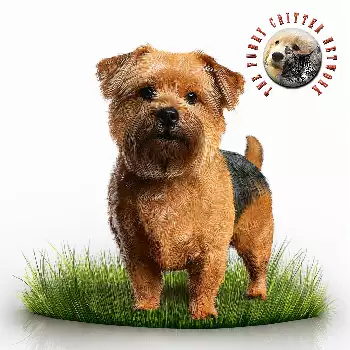
The ears are the defining feature that separates the Norfolk from its prick-eared Norwich cousin. They are medium-sized, V-shaped, and fold forward at the skull line, dropping neatly to lie close to the cheeks. The ear carriage gives the Norfolk a softer, more approachable expression compared to the more alert appearance created by the Norwich's upright ears, and this subtle visual difference was significant enough to justify the separation of the two breeds. The ear leather is smooth and the tips are slightly rounded, framing the face in a way that enhances the breed's characteristic expression of good-natured alertness.

The neck is medium in length, strong and blending smoothly into well-laid-back shoulders. The body is compact with a level topline that remains firm during movement. The chest is moderately deep with well-sprung ribs, providing adequate lung capacity without creating a barrel-chested appearance. The loin is short and the hindquarters are well muscled with good angulation at the stifle. The front legs are short, straight, and powerful, and the feet are round with thick pads that provide traction and protection during digging and rough-terrain work. The tail is traditionally docked to medium length in countries where docking is permitted, carried erect to complete the breed's jaunty, confident outline. In countries where docking is prohibited, the natural tail is moderate in length with a slight curve.

The coat is one of the Norfolk's most practical features. It is hard, wiry, and straight, lying close to the body rather than standing off. A definite undercoat provides warmth and weather protection. The coat is slightly longer and rougher on the neck and shoulders, forming a protective mane, and the hair on the head and ears is shorter and smoother. Eyebrows and a slight whisker are present but not excessive. Acceptable colors include all shades of red, wheaten, black and tan, and grizzle, with dark points on the ears and muzzle adding definition to the face.

The Norfolk moves with a ground-covering, free stride that belies its short legs. The gait is true coming and going, with the front legs reaching well forward and the rear legs driving with purpose. There is nothing mincing or stilted about the Norfolk's movement. This is a dog built to cover ground efficiently over varied terrain, and the smooth, effortless quality of its stride reflects that working heritage. In motion, the breed carries itself with the confident, businesslike demeanor of a terrier that knows exactly where it is going and has no intention of being delayed.

Affectionate With Family
The Norfolk bonds intensely with its people and actively seeks their company throughout the day. This breed wants to be where you are, doing whatever you are doing, and shows its affection with unwavering loyalty.
Good With Young Children
More tolerant of children than most terriers, the Norfolk's pack heritage has produced a dog that handles the unpredictability of kids with patience. Its sturdy build withstands gentle rough-and-tumble play.
Good With Other Dogs
The Norfolk's history as a pack-working terrier makes it unusually sociable with other dogs. It integrates smoothly into multi-dog households and rarely initiates conflict.
Shedding Level
The wiry coat sheds minimally, making the Norfolk a relatively clean housemate. Regular hand-stripping or clipping keeps loose hair to a minimum throughout the year.
Coat Grooming Frequency
Weekly brushing maintains the coat between stripping sessions, with hand-stripping or clipping needed two to four times yearly. Not high-maintenance but not hands-off either.
Drooling Level
The Norfolk is not a drooler. Its clean, tight lip structure means saliva is never a concern for furniture, clothing, or fastidious owners.
Coat Type
A hard, wiry outer coat over a dense undercoat provides weather protection and dirt resistance. The texture is functional and practical rather than ornamental.
Openness To Strangers
Friendlier with new people than most terrier breeds, the Norfolk warms up quickly after a brief initial assessment. It may bark at the door but rarely shows hostility toward visitors.
Playfulness Level
Enthusiastically playful with a terrier's energy and inventiveness, the Norfolk brings genuine joy to games and interactive activities. It retains its playful spirit well into adulthood.
Watchdog/Protective Nature
Alert enough to announce arrivals and unusual sounds with confident barking, the Norfolk takes its notification duties seriously. However, its friendly nature limits its effectiveness as an actual deterrent.
Adaptability Level
The Norfolk's compact size and moderate exercise needs make it adaptable to various living situations, from apartments to country homes. It adjusts well provided its social and exercise needs are met.
Trainability Level
More willing to cooperate than many terriers, the Norfolk responds well to positive reinforcement and genuinely wants to engage with its handler. Prey drive can override training in high-stimulation environments.

Norfolk History & Development

The name Norfolk entered the breed lexicon in 1964 when The Kennel Club in the United Kingdom decided that the drop-eared and prick-eared varieties of what had been called the Norwich Terrier were different enough to warrant separate breed status. The decision was not universally popular at the time, and the debate over whether ear carriage alone justified splitting a breed into two continues to generate spirited conversation among terrier enthusiasts. But for the drop-eared dogs, the separation was the beginning of their own identity, and the name Norfolk, drawn from the English county adjacent to Norwich, gave them a geographical marker that acknowledged their shared regional origins while establishing their independence.

The story of the Norfolk Terrier begins with the story of the Norwich Terrier, because for most of their history these were the same dogs. In the late nineteenth and early twentieth centuries, small, ratting terriers of mixed heritage were common in the East Anglian region of England. These were working dogs first and foremost, kept by farmers, stable hands, and horsemen for their ability to dispatch vermin with speed and enthusiasm. The terriers were small enough to follow quarry into burrows and dens, game enough to confront animals that outweighed them, and sociable enough to live peaceably in a busy stable yard alongside horses, other dogs, and the people who worked with them.

An English horseman named Frank Jones played a central role in developing the type that would eventually become both the Norfolk and Norwich Terriers. Jones bred small red and tan terriers for use around the stables at Cambridge, where they earned a reputation as effective ratters and cheerful companions. American sportsmen who encountered these terriers through the Cambridge connection began importing them to the United States, where they were initially known as Jones Terriers in his honor. The breed gained formal recognition from The Kennel Club in 1932 under the Norwich Terrier name, encompassing both ear types.

For more than three decades, drop-eared and prick-eared dogs competed against each other in the same breed ring. Breeders who favored one ear type or the other found themselves at a disadvantage depending on which type the judge of the day preferred, and the inconsistency of judging across ear types created practical difficulties for both exhibitors and judges. The Kennel Club's 1964 decision to separate the breeds resolved this issue by giving each ear type its own standard, its own ring, and its own path forward. The drop-eared dogs took the Norfolk name while the prick-eared dogs retained the Norwich designation.

The AKC did not follow suit immediately. American breeders continued to show both ear types as Norwich Terriers until 1979, when the AKC officially recognized the Norfolk Terrier as a distinct breed. The delay reflected a genuine philosophical disagreement about whether structural differences beyond ear carriage justified breed separation, but the practical reality of showing two physically distinct types in the same ring eventually tipped the balance in favor of the split.

Since gaining independent breed status, the Norfolk has developed its own identity and its own following. While it shares the same geographic origins, working heritage, and general type as the Norwich, the Norfolk has been selectively bred for decades as its own breed, and subtle differences in temperament, expression, and overall character have emerged. The drop-eared Norfolk is often described as slightly softer in temperament than the prick-eared Norwich, though both breeds retain the fearless, spirited nature expected of working terriers. The Norfolk remains a relatively uncommon breed, consistently ranking in the lower half of AKC registration statistics, which has helped preserve its quality and working character by keeping it out of the hands of high-volume commercial breeders.

Norfolk Temperament & Personality

The Norfolk possesses what many terrier enthusiasts consider the ideal terrier temperament: all of the gameness, courage, and spirit that the group is known for, tempered by an agreeable sociability that makes it one of the most people-friendly terriers in existence. The breed standard describes the Norfolk as fearless with a lovable disposition, and that combination is not contradictory. This is a dog that will chase a rat with unwavering determination and then climb into your lap for an evening of quiet companionship without any apparent sense that these two activities require different versions of itself.

The Norfolk's working heritage as a pack terrier is the foundation of its social nature. Unlike many terrier breeds that were developed to work independently, pursuing quarry alone into underground dens, the Norfolk was historically used in groups. This pack-working background selected for dogs that could cooperate with other terriers, tolerate close proximity to unfamiliar dogs, and function as part of a team rather than as solo operators. The result is a terrier that genuinely likes other dogs, an unusual trait in a group where same-sex aggression and dog-directed reactivity are common concerns.

The Norfolk's intelligence is practical rather than flashy. This breed does not perform elaborate tricks to impress an audience, but it solves problems with a quiet efficiency that reflects its ratting heritage. A Norfolk confronted with a puzzle feeder, a barrier between itself and something it wants, or any other challenge will work through the problem methodically, trying different approaches until it finds one that works. This problem-solving orientation extends to household situations in ways that owners may not always appreciate, as a Norfolk that wants access to something you have restricted will approach the restriction as an engineering challenge rather than an immovable boundary.

Despite its small size, the Norfolk carries itself with the confidence of a much larger dog. It does not shrink from confrontation, does not defer automatically to bigger dogs, and does not display the anxiety-driven behaviors that plague many small breeds. This confidence is earned rather than manufactured. It comes from centuries of selective breeding for dogs that could face quarry underground in dark, confined spaces without hesitation. A Norfolk that encounters something unfamiliar in daily life draws on that same reservoir of courage, approaching new situations with curiosity rather than fear.

The breed's relationship with its owner is characterized by strong attachment and genuine affection. Norfolks are not independent dogs that tolerate human contact. They actively seek it, preferring to be wherever their people are, participating in whatever is happening, and expressing their opinions about household activities with the vocal enthusiasm that terriers are known for. Separation anxiety can develop in Norfolks that are left alone for extended periods, manifesting as barking, destructive behavior, and distress that is out of proportion to the actual duration of the absence.

With strangers, the Norfolk is typically friendly after a brief assessment period. The breed does not display the sharp wariness toward unfamiliar people that characterizes some terrier breeds. It may bark at the doorbell and investigate new arrivals with interest, but outright hostility toward strangers is unusual and not characteristic of the breed. This openness makes the Norfolk a poor choice as a guard dog but an excellent choice for families that receive frequent visitors.

The Norfolk's prey drive is real and should not be underestimated despite the breed's small size and friendly demeanor. These dogs were bred to kill rats, and that hunting instinct remains active. Squirrels, chipmunks, rabbits, and other small animals will trigger a chase response that is intense and focused. The Norfolk's determination when pursuing quarry is remarkable for its size, and owners should not assume that a friendly temperament toward people and dogs extends to the small animals that the breed was specifically developed to hunt.

Norfolk Family Life & Living Requirements

The Norfolk fits into family life with an ease that surprises people who associate terriers with difficulty. At 11 to 12 pounds, this is a dog that adapts to a wide range of living situations, from country homes with acreage to city apartments with limited space. The breed's moderate exercise needs, sociable nature, and manageable size make it one of the more versatile terriers for families, though prospective owners should understand that small size does not mean low maintenance. The Norfolk is still a terrier, with a terrier's energy, prey drive, and capacity for creative mischief when bored.

The breed does well in homes with children and is generally more tolerant of the unpredictable behavior of young kids than many terrier breeds. The Norfolk's pack-working heritage has produced a dog that is patient with the handling and attention that children provide, and its sturdy construction means it is less fragile than many toy breeds of similar weight. That said, children should be taught to interact respectfully with any dog, and supervision is appropriate during play to ensure that neither the child nor the dog becomes too rough. The Norfolk's small size means that a fall or accidental step can cause real injury, and children old enough to understand gentle handling make the best companions for this breed.

Multi-dog households work well for Norfolks, whose pack heritage makes them genuinely comfortable with canine company. The breed typically integrates smoothly with existing dogs and benefits from having a companion during the day, particularly in households where the owners work away from home. The Norfolk's sociability extends to dogs of all sizes, and it does not typically initiate conflict with larger breeds despite having the confidence to hold its ground if challenged. However, small pets including hamsters, gerbils, rabbits, and pet rats should be considered incompatible. The Norfolk was bred to kill these animals, and no amount of training will fully override a hunting instinct this deeply embedded.

Apartment living is feasible with a Norfolk, provided that exercise needs are met and the breed's tendency to bark is managed. The Norfolk is vocal enough to alert you to every delivery person, every neighbor in the hallway, and every interesting sound that penetrates the walls, and this can create friction in shared-wall living situations. Training can moderate the volume and duration of alert barking, but it will not eliminate the behavior entirely. Owners in apartments should plan for daily walks of at least thirty to sixty minutes plus interactive play sessions to burn off energy that might otherwise be channeled into nuisance barking or destructive behavior.

The Norfolk does not tolerate being left alone well. This is a breed that bonds deeply to its people and becomes genuinely distressed when separated from them for extended periods. Households where someone is home for most of the day, or where the dog can accompany its owner to work, provide the best environment. For families where everyone works outside the home, a second dog or a reliable dog walker can help bridge the gaps, but the Norfolk's need for human companionship should be taken seriously during the decision to acquire one.

Norfolk Training & Exercise Needs

Training a Norfolk is a more enjoyable experience than training many terrier breeds, because the Norfolk actually wants to please you. This is not a breed that works against its handler out of spite or dominance. It is a breed that works with its handler when the training is fair, consistent, and rewarding, and it brings genuine enthusiasm to activities that engage its mind. The Norfolk's eagerness to connect with its person provides a training advantage that is uncommon in the terrier group, where many breeds were selected for the kind of stubborn independence that makes obedience feel like a negotiation.

Positive reinforcement works exceptionally well with Norfolks. Food rewards, toy rewards, and enthusiastic verbal praise all motivate the breed, and short, varied training sessions maintain its attention better than long, repetitive drills. The Norfolk is intelligent enough to learn commands quickly but also intelligent enough to get bored with excessive repetition, so keeping sessions fresh and progressing to new challenges regularly produces the best results. Harsh corrections are counterproductive with this breed. The Norfolk is sensitive to its handler's tone and will withdraw from training that feels punitive, and rebuilding trust after a harsh interaction takes longer than the correction was worth.

Recall training deserves the same realistic assessment with the Norfolk as with any terrier breed. In a controlled environment without distractions, the Norfolk can develop reliable recall. In the presence of a fleeing squirrel, a rustling bush, or any other trigger that activates its prey drive, recall becomes aspirational rather than dependable. Responsible owners use leashes and fenced areas to manage this reality rather than relying on recall in situations where the breed's hunting instinct is likely to override compliance.

The Norfolk's digging instinct is another behavioral reality that training must accommodate rather than attempt to eliminate. These dogs were bred to go to ground, and the impulse to dig is deeply wired. Providing a designated digging area in the yard, such as a sandbox or loose-soil patch, gives the Norfolk an acceptable outlet for this behavior and reduces the likelihood that it will redesign your garden beds on its own initiative.

Exercise requirements for the Norfolk are moderate by terrier standards but should not be dismissed as minimal. The breed needs thirty to sixty minutes of active exercise daily, which can include walks, play sessions, and interactive games. The Norfolk's small size means that vigorous play in a fenced backyard can substitute for longer walks on days when time is limited, but the breed should not be treated as a sedentary lap dog. Mental stimulation is equally important. Puzzle feeders, scent games, and trick training all engage the Norfolk's active mind and help prevent the boredom that leads to barking, digging, and other undesirable behaviors.

Earthdog trials, barn hunt, and agility are organized activities that channel the Norfolk's natural abilities into structured outlets. These sports tap into the breed's hunting instincts, physical agility, and problem-solving intelligence in ways that both the dog and handler find deeply satisfying. Norfolks that participate in these activities tend to be better-adjusted pets overall, as the combination of physical exercise and mental engagement satisfies the breed's need for purposeful work.

Norfolk Health Concerns

The Norfolk is a generally hardy breed with a lifespan of twelve to sixteen years, but it carries several documented health predispositions that prospective owners and breeders should understand. The breed's small size offers some protection against conditions that predominantly affect larger dogs, but the Norfolk has its own specific vulnerabilities that require targeted screening and proactive management.

Dental disease is a significant and often underappreciated concern in the Norfolk. Small breeds are disproportionately affected by periodontal problems, and the Norfolk's compact jaw structure can contribute to crowding that accelerates plaque and tartar accumulation. Without regular dental care including home brushing and professional cleanings, periodontal disease can progress to painful tooth loss and, in severe cases, bacterial spread to other organ systems through the bloodstream.

Common Health Issues

  • Myxomatous mitral valve disease is the Norfolk's most significant health concern - A degenerative cardiac condition affecting roughly sixty percent of aging dogs in the breed that causes progressive valve deterioration, heart enlargement, and potential congestive heart failure.
  • Hip dysplasia affects approximately thirty-five percent of Norfolk Terriers despite their small size - Involving abnormal hip joint development that leads to chronic inflammation and progressive arthritis with significant mobility impact.
  • Patellar luxation occurs when the kneecap displaces from its normal groove during movement - Causing intermittent lameness or a skipping gait that ranges from mild inconvenience to a condition requiring surgical intervention.
  • Cataracts involve progressive clouding of the eye lens that impairs vision and may require surgical removal by a veterinary ophthalmology specialist to restore sight. - Cataracts involve progressive clouding of the eye lens that impairs vision and may require surgical removal by a veterinary ophthalmology specialist to restore sight.
  • Primary lens luxation is an acute condition in which the lens detaches from its supporting structures - Causing sudden pain, elevated intraocular pressure, and potential permanent vision loss without prompt treatment.
  • Dental disease is particularly prevalent in the Norfolk due to the breed's compact jaw structure - Leading to accelerated plaque accumulation, periodontal inflammation, and potential tooth loss without consistent preventive care.

Preventive Care & Health Monitoring

  • Cardiac examination by a veterinarian is one of three CHIC-required tests for Norfolk breeding stock and should be repeated every one to two years - As early detection of myxomatous mitral valve disease through murmur identification enables timely intervention.
  • Patella evaluation through OFA screening identifies luxating patellas in breeding stock and is required for CHIC certification - Helping breeders reduce the incidence of this orthopedic condition in future generations.
  • Ophthalmologist examination by a board-certified veterinary eye specialist screens for cataracts - Primary lens luxation, and glaucoma, completing the three-test CHIC protocol that the Norfolk Terrier Club requires.
  • Radiographic hip evaluation is strongly recommended despite the breed's small size - Given the unusually high thirty-five percent incidence of hip dysplasia documented in the Norfolk Terrier population.
  • Daily dental care including tooth brushing with canine-specific toothpaste - Supplemented by professional veterinary dental cleanings, is essential to combat the breed's predisposition to accelerated periodontal disease.

Norfolk Grooming & Maintenance

The Norfolk's wiry double coat is both attractive and functional, providing weather protection and resistance to dirt and debris while requiring a grooming commitment that falls between the low-maintenance short-coated breeds and the high-maintenance long-coated ones. The coat's hard, close-lying texture naturally repels much of the mud and grime that the breed encounters during outdoor adventures, and a Norfolk that has been romping through the yard will often look presentable again once it dries, which is a pleasant surprise for owners accustomed to breeds that seem to absorb every particle of dirt they contact.

Weekly brushing with a slicker brush or a stiff bristle brush keeps the coat in good condition between stripping sessions. This routine maintenance removes loose hair, prevents minor tangles, and allows you to inspect the skin for any developing issues. The longer hair on the neck and shoulders may need slightly more attention than the shorter body coat, and the furnishings around the face should be checked for food debris and moisture that can cause irritation if left unaddressed.

Hand-stripping is the traditional and preferred grooming method for maintaining correct coat texture in the Norfolk. This process involves removing dead outer coat by hand or with a stripping knife, allowing new, properly textured wire hair to grow in its place. For show dogs, hand-stripping is essential because it preserves the hard, protective quality of the coat that the breed standard requires. The process is typically done two to four times per year, either by the owner who has learned the technique or by a groomer experienced with terrier coats. For companion Norfolks that do not compete in conformation, clipping with electric clippers is a common and perfectly acceptable alternative that simplifies maintenance considerably. Owners should understand that clipping produces a softer regrowth over time that lacks the harsh, water-resistant quality of hand-stripped coat, but this trade-off has no effect on the dog's comfort or health.

Bathing should be done as needed rather than on a rigid schedule. The wiry coat's natural oils contribute to its dirt-shedding properties, and overwashing strips these oils and can leave the coat dry and dull. When bathing is necessary, a shampoo formulated for wire-coated breeds produces the best results, and thorough rinsing and drying prevent skin irritation.

Dental care requires particular diligence with the Norfolk given the breed's predisposition to periodontal disease. Daily tooth brushing with canine-specific toothpaste is the gold standard, though several times per week provides meaningful benefit if daily brushing is not feasible. Professional dental cleanings under veterinary supervision should be scheduled as recommended by your veterinarian, typically annually or more frequently for dogs with rapidly accumulating tartar. Starting dental care when the dog is a puppy establishes the routine early and makes the process easier for both the dog and the owner throughout its life.

Nail trimming every two to three weeks, weekly ear checks with gentle cleaning as needed, and periodic inspection of the foot pads complete the grooming routine. The Norfolk's drop ears warrant slightly more attention to ear hygiene than prick-eared breeds, as the folded ear flap reduces airflow and can create a warmer environment that favors microbial growth.