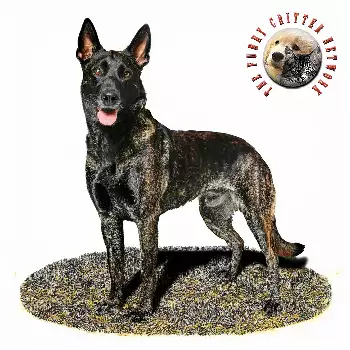
The Hollandse Herder is a medium-sized, well-muscled dog that gives an immediate impression of athleticism and functional capability. The build is balanced and proportionate - strong enough for physical work but not so heavy that it sacrifices agility or endurance. Males stand 22.5 to 24.5 inches at the shoulder and weigh 50 to 70 pounds, with females slightly smaller at 21.5 to 23.5 inches and 45 to 60 pounds. The overall silhouette is rectangular, slightly longer in body than tall at the withers, with clean lines and no exaggeration in any feature.
The head is proportionate to the body with a moderately broad skull and a well-defined but not excessive stop. The muzzle is slightly shorter than the skull, strong and blunt without being coarse. The expression is intelligent and alert, with almond-shaped eyes that are dark brown and carry a lively, attentive quality. The ears are medium-sized, triangular, and carried erect, adding to the breed's watchful appearance. The overall head structure differs from the German Shepherd in being less refined and angular, and from the Belgian Malinois in being broader through the backskull.
The breed's most defining physical characteristic is its coat color. All three coat varieties display a brindle pattern - dark striping over a gold or silver base - that is unique among herding breeds and serves as the primary visual identifier that separates the Hollandse Herder from its German and Belgian cousins. The brindle should be clearly defined and distributed evenly across the body, though some darkening over the back and lighter color on the belly and legs is natural. A small amount of white on the chest and toes is tolerated but not preferred.
The three coat varieties give the breed a remarkable range of appearance within a single standard. The short-haired variety has a hard, close-fitting coat with a woolly undercoat and visible furnishings on the breeches and tail. The long-haired variety features straight, harsh-textured fur that lies flat against the body with distinct ruff, breeches, and tail feathering. The rough-haired (wire-coated) variety has a dense, harsh, tousled coat over the entire body with a woolly, dense undercoat. Each coat type creates a distinctly different visual impression while sharing the same underlying structure and brindle pattern.
The body is built for sustained work. The chest is deep to the elbow with well-sprung ribs, the back is strong and level, and the loin is muscular without being exaggerated. The hindquarters are well-angulated with strong thigh muscles that provide the driving power for the breed's ground-covering movement. The tail reaches to the hock and is carried with a slight curve at rest, rising higher during activity but never curling tightly over the back.
Movement in the Hollandse Herder is smooth, efficient, and covers ground with ease. The gait is balanced with good reach in front and strong drive from behind, and the dog maintains a level topline while moving. There is a springy quality to the trot that reflects the breed's athletic nature - this is a dog that can shift between a working trot and a full sprint without losing its coordination. The feet are oval and compact with well-arched toes, and the overall impression during movement is of a versatile athlete equally capable of herding sheep across pastureland, running down a training field, or navigating an agility course.
Affectionate With Family
★★★★★
The Hollandse Herder bonds closely with its household and wants to be part of daily activities. This is a dog that is happiest when it has a role in the family rather than being left on the sidelines.
Good With Young Children
★★★★☆
Generally patient and gentle with children, especially when raised together. The breed's herding instinct may emerge as nipping at heels during play, which needs early redirection.
Good With Other Dogs
★★★☆☆
Most Hollandse Herders get along well with other dogs when properly socialized. Some individuals can be pushy or assertive, particularly in same-sex dynamics.
Shedding Level
★★★★☆
Short and long-haired varieties shed steadily with heavier seasonal blowouts. The rough-haired variety sheds less but still requires coat management.
Coat Grooming Frequency
★★★☆☆
Regular brushing keeps the short and long coats in shape. The rough-haired coat should be hand-stripped rather than brushed and needs professional grooming once or twice a year.
Drooling Level
★☆☆☆☆
Not a drooling breed. The Hollandse Herder keeps things clean and dry around the mouth.
Coat Type
★★★☆☆
Available in three distinct coat varieties - short, long, and rough (wire-haired) - all featuring the breed's signature brindle pattern over a weather-resistant double coat.
Openness To Strangers
★★★☆☆
Neither overly friendly nor suspicious, the Hollandse Herder is typically neutral with strangers and warms up at its own pace. Well-socialized dogs are approachable without being pushy.
Playfulness Level
★★★★☆
Energetic and enthusiastic during play, the Hollandse Herder brings genuine joy to games and physical activities. The playful drive lasts well into adulthood.
Watchdog/Protective Nature
★★★★☆
Alert and attentive to its surroundings, the Hollandse Herder notices changes in the environment and will alert the household. Protective instincts are present but balanced.
Adaptability Level
★★★☆☆
Reasonably adaptable to different living situations if exercise needs are consistently met. Does best with access to outdoor space but can manage in larger homes without a yard.
Trainability Level
★★★★★
Highly trainable and eager to work, the Hollandse Herder excels across a wide range of disciplines. The breed's intelligence and drive make it a standout in obedience, protection, and service work.