German Boxer

Boxer

Quick Facts

🐕 Breed Group
Working Group
📏 Size Category
Medium to Large
📏 Height
Males: 23-25 inches, Females: 21.5-23.5 inches
⚖️ Weight
Males: 65-80 pounds, Females: 50-65 pounds
⏱️ Life Expectancy
10-12 years
🧣 Coat Type
Short, smooth, tight-fitting
🎨 Coat Colors
Fawn and brindle with or without white markings, black mask
😀 Temperament
Playful, loyal, bright, active, fun-loving
🏃 Exercise Needs
High
🎓 Training Difficulty
Moderate
👶 Good with Children
Excellent
🐾 Good with Other Pets
Good with proper socialization

Other Names & Breed Recognition

German Boxer is the full name that most English speakers have shortened to simply Boxer, dropping the national origin the way we tend to do with breeds that become popular enough to feel like they belong to everyone. But the German part is not decorative. It points directly to where and how this breed came into existence, and understanding that origin matters if you want to understand why the dog behaves the way it does. This was a breed developed with German precision for specific working purposes, and the traits that make it such a popular family dog today are direct consequences of those original design decisions.

The breed most people call the Boxer was developed in Munich during the late 1800s, primarily from a now-extinct German hunting dog called the Bullenbeisser crossed with the English Bulldog. The name Boxer itself has disputed origins - some say it comes from the breed's tendency to play by batting with its front paws, others trace it to a corruption of the Bullenbeisser name, and still others point to the German word for a type of slaughterhouse worker. Whatever the etymology, the German Boxer name stuck in continental Europe while English-speaking countries eventually dropped the prefix.

In Germany and across much of Europe, referring to this breed as the German Boxer or Deutscher Boxer is still common and considered more precise than the abbreviated form. The FCI standard uses the German name, and the breed's parent club in Germany, the Boxer Klub e.V. Sitz Munchen, has maintained the breed standard since 1895. The AKC recognized the breed simply as Boxer in 1904, placing it in the Working Group, and the shortened name became standard across the English-speaking world.

Other kennel clubs including the UKC, CKC, and the Kennel Club in the UK all recognize the breed under the single-word name. The German Boxer designation shows up most often in international breeding circles, historical references, and among enthusiasts who want to distinguish the breed from unrelated uses of the word Boxer. For the reader who searched this term, the answer is straightforward - the German Boxer and the Boxer are the same dog, and everything that follows describes the breed you already know by its shorter name.

German Boxer Organizations & Standards

The American Boxer Club serves as the AKC parent club in the United States and maintains the breed standard that governs how the breed is judged in conformation. That standard describes a medium-sized, square-built dog with a strong jaw, alert expression, and a proud carriage. The emphasis falls on balance, substance, and athleticism - this should be a dog that looks capable of the work it was originally bred to do, not a caricature built for the show ring at the expense of function. The standard specifically calls for a dog that is neither cumbersome nor lacking in substance, hitting that middle ground where power and agility coexist.

The FCI standard originates from the German parent club, the Boxer Klub, which has been the guardian of the breed since its founding in Munich in 1895. The German standard and the AKC version agree on most fundamental points but diverge on a few details that reflect different breeding philosophies across the Atlantic. European Boxers tend to be slightly larger and heavier-boned than their American counterparts, and the FCI standard permits a somewhat broader head type. Both standards require the distinctive undershot jaw, the black mask, and the short smooth coat in fawn or brindle, with or without white markings. White markings that exceed one-third of the body are penalized in the show ring under both systems.

The Boxer Klub in Germany maintains particularly stringent breeding requirements that include mandatory health testing and temperament evaluation before a dog can be approved for breeding. This approach reflects the breed's German working heritage and the philosophy that a dog's character and health are as important as its physical appearance. German breeders are generally required to demonstrate that their dogs can pass a basic temperament assessment before breeding clearance is granted, which helps maintain the stable, confident disposition that the breed is known for.

Health testing requirements through the American Boxer Club's CHIC program include OFA hip evaluation, autoimmune thyroiditis screening, and a cardiac evaluation. Optional but strongly recommended tests include DNA screening for degenerative myelopathy and arrhythmogenic right ventricular cardiomyopathy. Given the breed's well-documented susceptibility to heart disease and cancer, these tests represent the bare minimum that responsible breeders should be conducting. Any breeder producing German Boxer puppies who cannot provide documentation for these health clearances on both parents is not someone you should be doing business with.

Kennel Club Recognition

  • American Kennel Club (AKC): Recognized in 1904, Working Group
  • United Kennel Club (UKC): Recognized, Guardian Dog
  • Canadian Kennel Club (CKC): Recognized, Working Dogs
  • FCI: Recognized, Group 2: Pinscher and Schnauzer
  • The Kennel Club (UK): Recognized, Working

German Boxer Physical Description

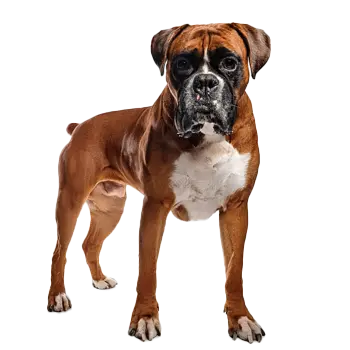
The German Boxer is built like a middleweight athlete - compact, muscular, and square in proportion, with enough substance to be imposing but not so much that it sacrifices mobility. Males stand 23 to 25 inches at the shoulder and weigh 65 to 80 pounds. Females measure 21.5 to 23.5 inches and carry 50 to 65 pounds. The body should be as long as it is tall at the withers, creating that characteristic square profile that defines correct breed type. Every line on this dog suggests a combination of strength and agility, with no feature exaggerated at the expense of function.

The head is where the German Boxer makes its strongest first impression. The muzzle is broad, blunt, and distinctly undershot, meaning the lower jaw extends beyond the upper jaw and curves slightly upward. This jaw structure was originally designed for gripping and holding game, and it gives the breed its recognizable expression - alert, intelligent, and slightly quizzical. The skull is slightly arched and the cheeks are well-developed without being overly prominent. The stop between skull and muzzle is pronounced. Dark brown eyes are set forward-facing in the skull, giving the breed good binocular vision and that characteristic direct, engaging gaze.

The ears are set high on the skull and in their natural state fold forward and hang close to the cheeks. Cropping was historically standard in the breed but has become increasingly uncommon and is banned in many countries including Germany itself. The natural ears suit the dog's expression well and do not detract from the alert, attentive look that defines the breed. The nose is broad with well-opened nostrils, set slightly higher than the root of the muzzle, and always black.

The neck is muscular and rounded, flowing into well-laid-back shoulders that provide the reach necessary for ground-covering movement. The chest is deep, reaching to the elbows, and moderately broad to allow proper lung and heart capacity without appearing barrel-chested. The topline is firm and the loin is short and muscular, connecting to well-angulated hindquarters that provide the driving force behind the breed's powerful gait. The forelegs are straight and parallel when viewed from the front, with strong bone and tight feet. The hindquarters carry substantial muscular development through the thigh and second thigh, and the hocks are well let down, providing leverage for the breed's characteristic powerful push-off during movement. The tail is set high and historically was docked short, though natural tails are now the standard in most of the world and are carried with a moderate upward curve.

The coat is short, smooth, tight-fitting, and carries a natural sheen when the dog is healthy. Fawn ranges from light tan to deep mahogany, and brindle presents as dark stripes over a fawn base in patterns that vary considerably from dog to dog. Some brindles carry stripes so dense that the fawn base barely shows through, while others display wide spacing that makes each stripe individually visible. White markings may appear on the chest, face, and feet. The black mask is a breed hallmark, covering the muzzle and sometimes extending around the eyes, creating the expressive contrast that makes each Boxer's face so readable and engaging.

Movement is one of the breed's defining qualities. A well-structured German Boxer covers ground with a smooth, powerful stride that shows good reach in front and strong drive behind. The topline should remain firm during movement, and the overall impression should be of a dog moving with purpose, efficiency, and athletic confidence. This is a breed that was meant to work, and correct movement reflects a body that is genuinely built for sustained physical effort.

Affectionate With Family
Thrives on close contact with family members and expresses its devotion through physical closeness, leaning, pawing, and an almost constant desire to be in the same room as its people.
Good With Young Children
Natural patience and playfulness make this breed a strong match for families with children, though its high energy and physical exuberance require supervision with very small kids.
Good With Other Dogs
Generally friendly but can be pushy during play and may not back down from confrontations, particularly with same-sex dogs that challenge its confidence.
Shedding Level
Moderate shedding throughout the year with a slight increase during seasonal transitions, manageable with regular brushing.
Coat Grooming Frequency
The short smooth coat requires minimal grooming effort, needing only occasional brushing and the odd bath to stay clean and healthy.
Drooling Level
Moderate drooling is typical, increasing after drinking water, during exercise, and in warm weather due to the breed's shorter muzzle structure.
Coat Type
A single-layer short coat that fits tight to the body, providing minimal insulation but requiring virtually no maintenance beyond basic brushing.
Openness To Strangers
Initially watchful with unfamiliar people but warms up relatively quickly once it determines there is no threat, especially if the owner is relaxed.
Playfulness Level
Famous for retaining a puppy-like enthusiasm for play well into adulthood, this breed approaches games and interaction with infectious energy and joy.
Watchdog/Protective Nature
Naturally alert and protective of its family with an imposing presence that serves as an effective deterrent, backed by genuine courage when the situation demands it.
Adaptability Level
Can adjust to various living situations but needs sufficient exercise and does not tolerate extreme heat or cold well due to its short coat and brachycephalic features.
Trainability Level
Intelligent and willing to learn with a handler who keeps things fun and consistent, though it can test boundaries with playful stubbornness.

German Boxer History & Development

The German Boxer name is not just a geographic label. It is a direct reference to the breed's development in late 19th-century Germany, specifically in and around Munich, where breeders combined the old Bullenbeisser with English Bulldog stock to create the foundation of the modern breed. The Bullenbeisser, whose name translates roughly to bull-biter, was a large hunting dog used for centuries by German nobility to hold big game - boar, bear, and deer - until the hunter could arrive for the kill. As formal hunting with large catch dogs declined, the smaller, more versatile descendants of the Bullenbeisser found new roles as butcher's dogs, cattle dogs, and general-purpose working companions.

The critical period of breed development occurred between the 1880s and 1900s. Breeders in Munich, led by Friedrich Robert, Elard Konig, and R. Hopner, established the Boxer Klub in 1895 and held the first breed show the following year. They had a clear vision for what the German Boxer should be - a medium-sized, square-built dog with a strong undershot jaw, enough athleticism for work, and a temperament that combined courage with controllability. The English Bulldog crosses added the shorter muzzle and compact build, while the Bullenbeisser heritage contributed prey drive, tenacity, and the gripping jaw structure.

The breed's German military service during both World Wars cemented its reputation as a versatile working dog. German Boxers served as messenger dogs, pack carriers, guard dogs, and patrol animals. Their intelligence, trainability, and physical durability made them well-suited to military roles, and returning soldiers who had worked with Boxers in the field became some of the breed's most effective ambassadors when they brought dogs home after the wars. The breed's popularity in the United States surged after World War II, when American servicemen introduced the German Boxer to families back home.

The AKC had recognized the breed as early as 1904, but it was the post-war period that transformed the Boxer from a relatively uncommon working breed into one of the most popular companion dogs in America. By the 1950s, the Boxer consistently ranked among the top ten most registered breeds with the AKC, a position it has maintained for most of the decades since. The German prefix faded from common American usage as the breed became thoroughly domesticated and associated more with family life than with its European working origins.

In Germany and continental Europe, the Deutscher Boxer name persists and the breed retains stronger connections to its working heritage. European breeding programs tend to emphasize temperament testing and working evaluations alongside conformation judging, reflecting a philosophy that views the breed as a functional animal first and a show dog second. This difference in emphasis has produced subtle but real divergences between American and European Boxer lines over the past several decades, though the breeds remain recognizably the same dog regardless of which side of the Atlantic produced them.

German Boxer Temperament & Personality

The German Boxer's temperament is the reason this breed has stayed near the top of the popularity charts for over seven decades. It is one of the most genuinely fun dogs to live with - playful to an almost absurd degree, loyal in a way that borders on possessive, and equipped with an emotional expressiveness that makes every interaction feel like a conversation. These dogs do not hide their feelings. Joy, concern, curiosity, displeasure - everything shows up on that expressive face and in the body language that accompanies it. Living with a Boxer means living with a dog that wears its heart on its sleeve and expects you to do the same.

The playfulness is not a puppy phase that the breed outgrows. Boxers remain puppy-like in their enthusiasm and approach to play well into middle age and beyond. The characteristic Boxer bounce - that spring-loaded, paws-up greeting - persists in many dogs for most of their lives. This permanent puppyhood is endearing but it has practical implications. A 70-pound dog that greets every visitor with full-body enthusiasm can knock people down, and the breed's exuberant play style requires supervision around small children and elderly family members who cannot absorb the impact of an airborne Boxer.

Beneath the clown exterior sits a genuinely courageous and protective dog. The German Boxer was bred to be a guardian, and that instinct has not faded. These dogs take the security of their family seriously, and they possess a natural suspicion of unfamiliar situations that makes them excellent watchdogs. The alert bark is sharp and carries authority, and a Boxer in full protective mode is an intimidating animal despite its medium size. The breed's courage is well-documented and not for show - a Boxer that perceives a genuine threat to its family will not hesitate to intervene.

The bond with family is intense and frequently manifests as what owners affectionately call being Velcro dogs. A Boxer wants to be touching you, sitting on you, leaning against you, or at minimum within arm's reach at all times. This attachment is charming in moderation but can become problematic if the dog develops separation anxiety, which is common enough in the breed to warrant proactive management from the start. Crate training, gradual departures, and ensuring the dog has coping skills for time alone all help prevent attachment from becoming unhealthy dependence.

With other dogs, the German Boxer is generally social but carries enough confidence to stand its ground in any encounter. Same-sex aggression can develop, particularly in intact males, and the breed's play style is physical enough that not all dogs appreciate a Boxer's approach to social interaction. Early and consistent socialization builds the social skills that allow a Boxer to navigate dog-to-dog relationships without conflict, and exposure to dogs of various sizes and temperaments during puppyhood helps calibrate the breed's natural intensity to appropriate levels.

German Boxer Family Life & Living Requirements

The German Boxer was practically designed for family life, and its popularity as a household companion reflects how well it fills that role. These dogs integrate into the daily rhythm of a busy family with remarkable ease, matching their energy to the activity level around them - lively and engaged during play, calm and settled during quiet evenings, and always tuned in to whatever the household is doing. The breed's genuine fondness for children is one of its strongest selling points, and generations of families have trusted Boxers around their kids for good reason.

That said, the breed's physical exuberance requires realistic management in homes with very young children. A Boxer does not intend to knock a toddler over, but a dog that weighs 70 pounds and expresses excitement through jumping and full-body wiggles creates that risk through pure physics. Teaching the dog appropriate greeting behavior and giving young children safe interaction guidelines makes the combination work beautifully. Older children and Boxers tend to form particularly strong bonds because they match each other's energy level and appetite for outdoor play.

Housing needs are moderate by working-breed standards. A Boxer can adapt to apartment living if it receives sufficient daily exercise, though a house with a fenced yard provides a more natural outlet for the breed's energy. The key requirement is not square footage but engagement. A Boxer in a mansion that gets ignored will be more destructive and unhappy than a Boxer in a small apartment that gets walked, played with, and included in daily activities. These dogs need to be with their people, and physical separation from the family for extended periods produces behavioral problems that range from nuisance barking to destructive chewing.

The breed's sensitivity to temperature extremes deserves practical attention. The short coat provides almost no insulation in cold weather, and the brachycephalic muzzle structure compromises the breed's ability to cool itself efficiently in heat. Winter walks may require a jacket, and summer activities should be scheduled for early morning or evening hours when temperatures are lower. Air conditioning is not optional for Boxer households in warm climates. Heatstroke is a real and potentially fatal risk for this breed, and it can develop faster than owners expect.

Multi-pet households work well when introductions are handled properly and the Boxer's sometimes-overwhelming play style is managed around smaller or less robust companions. The breed's prey drive is moderate, and most Boxers coexist comfortably with cats they were raised alongside, though individual variation exists.

German Boxer Training & Exercise Needs

Training a German Boxer requires a sense of humor and a commitment to consistency, because this breed will test both regularly. Boxers are intelligent, willing to please, and entirely capable of learning complex commands and routines. They are also independent thinkers who will cheerfully ignore instructions they find boring or unnecessary, especially if something more interesting is happening nearby. The key to a well-trained Boxer is making cooperation more rewarding than the alternatives, and positive reinforcement methods accomplish this far more effectively than punishment-based approaches. Food rewards, play rewards, and enthusiastic praise all register with this breed, and short, varied training sessions outperform long repetitive ones by a wide margin.

Early socialization is essential because the breed's natural protectiveness needs to be balanced with confident, relaxed behavior in public settings. A Boxer that has been widely socialized during puppyhood understands that not every stranger is a threat and not every unfamiliar dog is a challenge. One that missed that window may become reactive, overly suspicious, or difficult to manage in normal social situations. Puppy classes, neighborhood walks that include positive interactions with new people and dogs, and controlled exposure to various environments and stimuli all build the behavioral foundation that supports a well-adjusted adult.

The breed's physical power makes basic obedience training practically important. A Boxer that does not walk reasonably on leash is pulling its handler down the street. One that does not have a reliable recall cannot be safely exercised in open areas. A solid sit-stay prevents the dog from launching itself at visitors when the door opens. These are not optional skills for a breed this strong and this enthusiastic - they are daily quality-of-life requirements for both the dog and the people who live with it.

Exercise needs are substantial and should not be underestimated. Adult Boxers need at least an hour of vigorous daily activity to stay physically and mentally balanced. Brisk walks, running, fetch, tug games, and interactive play sessions all contribute to meeting this requirement. The breed also excels at organized activities including agility, obedience competition, rally, and tracking, all of which provide the combination of physical exercise and mental engagement that keeps a Boxer satisfied. Exercise should be managed around temperature extremes, with reduced intensity during hot or humid conditions to prevent overheating, and brief warm-up periods before intense activity in cold weather to protect joints and muscles.

German Boxer Health Concerns

The German Boxer faces some of the most serious health challenges of any popular breed, and being straightforward about them is the only responsible approach. Cancer affects this breed at strikingly high rates - estimates suggest that up to 40 percent of Boxers will develop some form of cancer during their lifetime. Mast cell tumors are the most common, appearing as lumps on or under the skin that can range from benign to highly aggressive. Lymphoma, hemangiosarcoma, and brain tumors also occur with notable frequency. Any new lump on a Boxer should be evaluated by a veterinarian promptly, because early detection meaningfully affects treatment outcomes for many cancer types.

Degenerative myelopathy is a progressive spinal cord disease that causes hind limb weakness and loss of coordination, typically developing in middle-aged to older dogs. A DNA test identifies the associated gene mutation, and this test is available through the CHIC program. Hypothyroidism occurs frequently enough in the breed to be included in the standard health testing protocol. The breed's brachycephalic structure also contributes to heat sensitivity and can cause varying degrees of breathing difficulty, particularly during exertion or in warm conditions. Working with a veterinarian who understands the German Boxer's specific health profile and scheduling regular cardiac evaluations are among the most important investments an owner can make.

Common Health Issues

  • Arrhythmogenic right ventricular cardiomyopathy (ARVC) - A breed-specific heart condition where fatty tissue replaces normal heart muscle, causing dangerous arrhythmias that can lead to fainting, collapse, or sudden death.
  • Mast cell tumors - The most common cancer type in Boxers, presenting as skin lumps that range from low-grade and easily treated to high-grade and aggressively malignant.
  • Lymphoma - Cancer of the lymphatic system that occurs at elevated rates in this breed, presenting with enlarged lymph nodes, weight loss, and declining energy.
  • Aortic stenosis - A congenital narrowing of the heart's aortic outflow that forces the left ventricle to pump harder, ranging from mild to life-threatening depending on severity.
  • Gastric dilatation-volvulus (GDV) - Stomach bloating and potential torsion requiring emergency surgery, associated with the breed's deep chest conformation.
  • Degenerative myelopathy - Progressive spinal cord degeneration causing hind limb weakness and loss of coordination, typically developing in middle-aged to older dogs.
  • Hip dysplasia - Abnormal hip joint development causing arthritis and pain, occurring at moderate rates in the breed and managed through weight control and activity modification.
  • Hypothyroidism - Insufficient thyroid hormone production causing weight gain, lethargy, and coat changes, managed with daily oral medication.

Preventive Care & Health Monitoring

  • Annual Holter monitoring to screen for ARVC by recording heart rhythm over 24 hours - Recommended beginning at age two and continuing throughout the dog's life.
  • OFA hip evaluation to screen breeding stock for hip dysplasia and reduce the incidence of joint disease in future generations. - OFA hip evaluation to screen breeding stock for hip dysplasia and reduce the incidence of joint disease in future generations.
  • Autoimmune thyroiditis screening through an OFA-approved laboratory to detect thyroid dysfunction before clinical symptoms develop. - Autoimmune thyroiditis screening through an OFA-approved laboratory to detect thyroid dysfunction before clinical symptoms develop.
  • Cardiac evaluation by a veterinarian or board-certified cardiologist to assess for aortic stenosis and other structural heart abnormalities. - Cardiac evaluation by a veterinarian or board-certified cardiologist to assess for aortic stenosis and other structural heart abnormalities.
  • DNA testing for degenerative myelopathy and ARVC gene mutations to inform both breeding decisions and individual health monitoring plans. - DNA testing for degenerative myelopathy and ARVC gene mutations to inform both breeding decisions and individual health monitoring plans.
  • Regular skin checks for new lumps or changes in existing growths - With prompt veterinary evaluation of any suspicious masses given the breed's high cancer incidence.
  • Temperature management during exercise and outdoor activities - Avoiding exertion in hot or humid conditions due to the breed's brachycephalic-related heat sensitivity.

German Boxer Grooming & Maintenance

The German Boxer is one of the easiest breeds to maintain from a grooming perspective. The short, tight-fitting coat does not mat, does not require trimming, and cleans up with minimal effort. A weekly brushing with a rubber curry comb or soft bristle brush removes loose hair, stimulates the skin, and maintains the natural sheen that a healthy Boxer coat should display. During seasonal shedding periods, which are relatively mild compared to double-coated breeds, twice-weekly brushing keeps things under control. The coat dries quickly after getting wet and does not hold odor the way longer or denser coats tend to.

Bathing is an occasional need rather than a regular event. Every four to six weeks is typical for most Boxers, though dogs that spend a lot of time outdoors or have skin sensitivities may need more or less frequent bathing depending on circumstances. Use a mild shampoo formulated for dogs, and pay attention to the facial folds around the muzzle where moisture and debris can accumulate. These folds should be wiped clean regularly between baths using a damp cloth or unscented baby wipe, as trapped moisture in skin folds creates an environment for bacterial or yeast growth that leads to irritation and odor.

The breed's facial structure requires some specific maintenance attention. The shorter muzzle means drool collects around the mouth and chin, particularly after drinking, eating, or exercise. Keeping a towel handy for quick wipe-downs is a practical habit that most Boxer owners develop quickly. The eyes should be checked regularly for discharge or irritation, which can occur more frequently in brachycephalic breeds.

Nail trimming every two to three weeks keeps the feet comfortable and maintains proper gait mechanics. A Boxer's nails grow at a moderate pace, and regular trimming prevents the discomfort and altered movement that overgrown nails cause. Ears should be checked weekly for redness, odor, or excessive wax, and cleaned as needed. Dogs with natural uncropped ears may need slightly more frequent ear attention since the folded ear flap creates a warmer, more enclosed environment. Dental care through regular brushing and professional cleanings when indicated helps prevent the periodontal disease that affects all breeds over time. The overall grooming commitment with a German Boxer is minimal, which is part of why the breed appeals to people who want an athletic, handsome dog without the maintenance burden that many breeds demand.