Entle

Entlebucher Mountain Dog

Quick Facts

🐕 Breed Group
Herding Group
📏 Size Category
Medium
📏 Height
Males: 17-21 inches, Females: 16-20 inches
⚖️ Weight
Males: 50-65 pounds, Females: 40-55 pounds
⏱️ Life Expectancy
11-13 years
🧣 Coat Type
Short, dense double coat
🎨 Coat Colors
Tricolor: black base with rust and white markings
😀 Temperament
Loyal, energetic, confident
🏃 Exercise Needs
High
🎓 Training Difficulty
Moderate to Challenging
👶 Good with Children
Yes, with socialization
🐾 Good with Other Pets
Good with socialization

Other Names & Breed Recognition

Entle is the nickname that the breed's community settled on almost organically. When the full name - Entlebucher Mountain Dog - is used regularly in conversation among people who own and love these dogs, shortening it becomes practical necessity. Entle captures the breed's identity in a single syllable that anyone familiar with the breed understands immediately. It is not an official designation recognized by any kennel club registry, but within the Entlebucher community in North America and Europe it functions as the breed's everyday name.

The full official name, Entlebucher Mountain Dog, is what you will find in AKC registration records, OFA health testing databases, CHIC certification files, and breed club documentation. The National Entlebucher Mountain Dog Association (NEMDA) serves as the AKC parent club in the United States. The breed was admitted to the AKC's Herding Group in 2011, a relatively recent recognition that reflects the breed's rarity in North America even as it has been established in its native Switzerland for well over a century.

In Switzerland and German-speaking Europe, the breed is known as the Entlebucher Sennenhund - Sennenhund being the German term for the Swiss mountain dog family, derived from the word Senn meaning Alpine dairyman or herdsman. The four Swiss Sennenhunde are the Entlebucher, the Appenzeller, the Bernese Mountain Dog, and the Greater Swiss Mountain Dog. Of these four, the Entlebucher is the smallest and the least commonly encountered outside of Switzerland, which contributes to the practical value of the Entle nickname - it signals insider knowledge and community membership in a way that the full formal name does not.

For anyone who came to this page via the Entle nickname, the navigational reality is that all formal resources - breeders, health testing records, breed standards, club information - will be found under Entlebucher Mountain Dog. NEMDA's website and the OFA database are the two most important starting points for serious prospective owners. The breed's rarity means that wait times for puppies from health-tested breeders are often significant, and connecting with the community through NEMDA is the most reliable path to a responsibly bred dog.

The Entle name has a warmth to it that reflects how people in this community feel about these dogs. Those who have lived with one tend to be enthusiastic advocates, and the nickname is often the first sign that you are talking to someone who has firsthand experience with the breed rather than just breed research. It is the name of affection, earned by the dog's personality as much as by the practicality of shortening a four-syllable breed name.

Entle Organizations & Standards

The National Entlebucher Mountain Dog Association (NEMDA) is the AKC parent club for the Entlebucher Mountain Dog in the United States, and it is the most important organizational resource for anyone seeking a responsibly bred Entle in North America. NEMDA maintains the breed standard, a breeder code of ethics, a health and genetics committee that drives testing protocol development, and a BCOE (Breeder Code of Ethics) certification program that identifies breeders who commit to specific health testing and ethical breeding practices. Their health committee's work on PRA testing in partnership with Cornell University and Optigen produced the first DNA test for the breed's primary genetic eye condition - a concrete example of the kind of breed-specific health research that makes a real difference in a rare breed with a small gene pool.

For CHIC certification, NEMDA requires four health tests: OFA hip evaluation, OFA patellar luxation evaluation, annual OFA CAER eye examination, and a PRA DNA test from Optigen (prcd-PRA). The annual eye exam requirement is notable - it is not a one-and-done certification but an ongoing yearly commitment. Eye health in the Entle can change over a dog's lifetime, and breeders who keep their dogs' eye exams current are demonstrating ongoing health monitoring rather than just checking a box before breeding.

The breed standard for the Entlebucher Mountain Dog describes a compact, well-muscled herding dog with a rectangular body, a distinctive tricolor coat in black with rust and white markings, a lively and intelligent expression, and an energetic, confident character. Key measurements include 17 to 21 inches at the shoulder for males, 16 to 20 inches for females, and weight ranging from 40 to 65 pounds depending on sex. The standard emphasizes balance, substance, and working capability alongside the specific physical characteristics that identify the breed.

In Switzerland, the breed is governed by the Schweizerischer Klub fuer Entlebucher Sennenhunde, and the FCI recognizes the Entlebucher Mountain Dog under Group 2, Section 3 as a Swiss Mountain Dog. The FCI standard is the source document from which international standards derive, and Switzerland as the country of origin maintains the definitive version. Breeders who work across both North American and European lines often do so specifically to maintain the genetic diversity that a small worldwide population requires.

For anyone seeking an Entle through the NEMDA breeder referral program, asking for CHIC numbers and the BCOE designation narrows the field to breeders who have made a formal commitment to health testing and ethical breeding practices. In a breed this rare, knowing you are working with a breeder who is genuinely plugged into the community makes a meaningful difference in both the puppy you receive and the support available to you as a new owner.

Kennel Club Recognition

  • American Kennel Club (AKC): Recognized in 2011, Herding Group
  • United Kennel Club (UKC): Recognized, Herding Dog Group
  • Canadian Kennel Club (CKC): Recognized, Herding Group
  • FCI: Recognized, Group 2 - Pinscher and Schnauzer

Entle Physical Description

The Entle is a compact, hard-bodied dog that looks exactly like what it is - a working mountain dog built for steep terrain, long days, and genuine physical demands. This is not a decorative small breed that happens to be placed in the herding group. It is a functional, muscular animal whose build reflects centuries of selection for cattle work in the Swiss Alps, and that background shows in every structural element.

Size places the Entle in the medium category - 16 to 21 inches at the shoulder, 40 to 65 pounds depending on sex. In the context of the four Swiss mountain dogs, it is the smallest by a significant margin - the Bernese Mountain Dog is substantially larger, and the Greater Swiss Mountain Dog larger still. But "smallest of the Swiss mountain dogs" still means a real, substantial dog. This is not a lightweight. The bone is moderate to heavy for the size, and the musculature is dense and functional rather than refined.

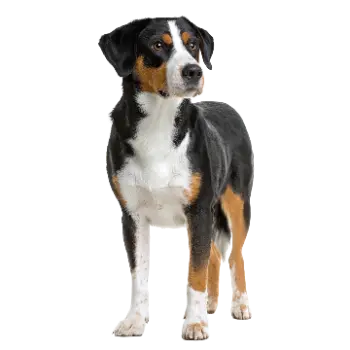
The body is rectangular - longer than it is tall - with a level, strong topline and a broad, well-muscled back. The chest is deep and moderately broad, providing the lung capacity a working dog needs. The ribcage is well-sprung and extends well back, giving depth through the thorax without creating the very narrow chest profile associated with bloat-susceptible breeds. The abdomen has a slight tuck. The tail is either naturally bobbed - a historic herding dog trait - or of normal length and carried at or below the topline when the dog is relaxed.

The head is flat-skulled and moderately broad, with a well-defined stop and a muzzle that is shorter than the skull length. The muzzle is strong and tapers slightly to a rounded tip. The lips are tight and clean. The eyes are dark brown, almond-shaped, and carry the alert, lively expression that characterizes the breed. The ears are set high, triangular, and carried folded close to the head in repose. When the dog is attentive, the ears lift and come forward, framing the face with an expression of focused intelligence.

The legs are straight and well-boned in front, with moderate angulation behind. The feet are compact and round with arched toes and firm pads. Movement should be free, powerful, and ground-covering - a dog of this build should move with an efficiency that reflects structural soundness. Short, choppy movement or any sign of hind limb weakness is a concern in a breed where hip dysplasia and patellar luxation are documented health issues.

The coat is the Entle's most visually striking feature. The outer coat is short, hard, and dense - harsh to the touch and resistant to wet and cold. The undercoat is dense and softer, providing genuine insulation for a dog that worked at elevation in the Swiss Alps. The tricolor pattern is precise: a jet black base with rich rust markings above the eyes, on the cheeks, on the chest, on the legs, and under the tail, and white markings on the muzzle blaze, on the chest, and on the feet. The rust and white must be clear and correctly placed - smudged or incorrect markings are a fault under the standard. This tricolor pattern, shared with its Swiss mountain dog relatives, is one of the most distinctive and recognizable coat patterns in the herding group.

At the trot, the Entle moves with energy and purpose - the drive from the hindquarters is strong, and the front reaches forward cleanly. Watching a physically sound Entle move across a field gives a clear sense of why this dog could spend a full day working cattle on steep mountain terrain. The combination of dense musculature, moderate bone, and tight construction produces a dog that covers ground efficiently without wasted motion.

Affectionate With Family
The Entle is devoted to its family with an intensity that surprises people unfamiliar with the breed. This dog wants to be wherever its people are, involved in whatever is happening.
Good With Young Children
Good with children it knows when properly socialized, but the herding instinct and high energy can be overwhelming for very young kids. Best with children old enough to engage appropriately.
Good With Other Dogs
Generally does well with other dogs when socialized early. The confident, assertive personality means some individual Entles are more selective about dog companions than others.
Shedding Level
Moderate shedding year-round with heavier seasonal shedding. The dense double coat requires regular brushing to manage the undercoat before it ends up on every surface of the house.
Coat Grooming Frequency
Weekly brushing and occasional baths keep the Entle's coat in good condition. No trimming is required, and the tricolor markings stay crisp with basic routine maintenance.
Drooling Level
Minimal drooling. The Entle has tight, clean lips and is not a breed that creates significant mess in this department.
Coat Type
Short, hard, dense outer coat with a significant undercoat. The tricolor pattern - jet black with rust and white - is one of the most striking in the herding group.
Openness To Strangers
The Entle is reserved with strangers and takes its time making assessments. The natural wariness of a cattle dog bred to guard as well as herd means this dog does not warm up instantly.
Playfulness Level
Enthusiastic and playful with a zeal that can be overwhelming for calmer households. The Entle brings energy and initiative to play and keeps going long after many owners are ready to stop.
Watchdog/Protective Nature
Alert and territorial, the Entle takes its role as household sentinel seriously. It will announce strangers with confidence and maintain awareness of its surroundings consistently.
Adaptability Level
Adaptable to different environments when exercise and mental stimulation needs are met. Without adequate activity, adaptability drops significantly - this dog needs a job.
Trainability Level
Intelligent and quick to learn, though the independent thinking that served the breed on Swiss mountain farms also shows up in training. Clear, consistent leadership produces excellent results.

Entle History & Development

The Entle's history is inseparable from the Swiss Alps and the tradition of Alpine cattle herding that shaped dogs throughout the mountain regions of Switzerland for centuries. The Entlebucher takes its name from the Entlebuch Valley, a region in the canton of Lucerne in central Switzerland, where the breed was developed and used as a cattle dog - driving livestock up to summer mountain pastures and back down again, a demanding job that required a dog with confidence, physical stamina, intelligence, and the toughness to work in difficult terrain and variable mountain weather.

The four Swiss Sennenhunde breeds - the Entlebucher, Appenzeller, Bernese, and Greater Swiss - share a common ancestry in the working dogs that accompanied Swiss herdsmen for generations, likely with some influence from Roman Molossian dogs that traveled through the region during the Roman occupation of the Alps. The breeds were differentiated by size and regional type, each associated with a specific valley or region of Switzerland. The Entlebucher, as the smallest, was the most agile and the most suited to fast cattle work rather than the draft and guarding work better suited to its larger relatives.

The breed was formally documented and distinguished from the other Swiss mountain dogs in the late nineteenth and early twentieth centuries. A group of Entlebuchers was shown in Switzerland in 1889, and the breed was officially recognized by the Swiss Kennel Club. Professor Albert Heim, the zoologist who worked systematically to identify and preserve the four Swiss mountain dog breeds, is credited with drawing attention to the Entlebucher and advocating for its preservation as a distinct type. A breed club was established in Switzerland in 1926.

The nickname Entle developed naturally within the community of owners and breeders who work with these dogs regularly. When a breed name is four syllables long and used dozens of times daily in conversation, community shorthand develops. Entle is warm and specific - it signals membership in a community that knows this breed well, and it has spread through the international Entlebucher community as the dog has become better known outside Switzerland.

In North America, the breed remained extremely rare through most of the twentieth century. Early imports established small breeding programs, but numbers stayed low. The National Entlebucher Mountain Dog Association was founded and worked to grow awareness of the breed while maintaining rigorous health testing standards. AKC recognition came in 2011, admitting the Entlebucher Mountain Dog to the Herding Group. Even with AKC recognition, the Entle remains a rare breed - puppy availability is limited, and wait times from responsible breeders are normal. That rarity means that anyone seeking an Entle is dealing with a tight-knit community where reputation, health testing, and ethical breeding practices are easier to verify than in breeds with hundreds of breeders.

The Entle name carries that community history in it. It is not an official designation but it is a real one - earned through years of shared experience among people who take this breed seriously and want others to understand why they do. When you meet someone who calls the breed an Entle without explanation, you are meeting someone who has been in that community long enough for the shorthand to feel natural.

Entle Temperament & Personality

Anyone who calls the Entle a "laughing dog of the Swiss Alps" - a description that shows up in breed writing - has met one. There is a quality of enthusiasm and expressiveness in this breed that is genuinely cheerful, and it comes packaged with intelligence, intensity, and a clear-eyed awareness of everything happening in its environment. This is not a dog that drifts through the world. It is fully present, fully engaged, and frequently in motion.

The bond the Entle forms with its family is one of its most defining characteristics. This is a deeply devoted dog that keeps track of its people, monitors household activity, and participates in family life with an investment that owners find either deeply endearing or slightly exhausting depending on their tolerance for a dog that notices everything. The devotion is not needy in a clingy, anxious way - it is the watchful attentiveness of a working dog that was bred to be in constant communication with its handler about what to do next.

With strangers, the Entle is reserved. The natural wariness of a dog bred to guard mountain farms alongside its herding work means this breed does not warm up instantly to people it does not know. A well-socialized Entle will observe and assess, and given appropriate time and neutral interaction, it will accept people its owner has indicated are welcome. An under-socialized Entle can become problematically suspicious, barking persistently at strangers or refusing to accept people who are regularly in its environment. Early, broad socialization is not optional with this breed - it is foundational.

The herding instinct is present and shows up in ways that can be charming or frustrating depending on context. Entles may attempt to herd children, other pets, or even adults by nudging, circling, or nipping at heels. This behavior is instinctive rather than aggressive, but it requires management and clear communication that the family members are not livestock. Channeling the herding drive into structured activities - actual herding work, agility, or other sports that require the dog to respond to directional cues - gives this instinct an appropriate outlet.

When an Entle's considerable physical and mental needs are not met, the consequences are specific and predictable. This is not a dog that quietly withdraws when bored. It becomes vocal, destructive, and prone to problem behaviors that reflect frustrated intelligence looking for an outlet. Digging, barking, harassing other pets, and inventing its own activities that are rarely compatible with household furniture are the typical results. The flip side of this is that an Entle with appropriate exercise, mental challenges, and clear structure is one of the most rewarding dogs to live with - quick, responsive, funny, and genuinely interested in whatever its people are doing.

Experienced Entle owners often describe the breed as having an almost uncanny ability to read their owner's mood and intentions. This sensitivity is a double-edged quality - it makes the dog responsive to genuine communication and guidance, but it also means that inconsistency, frustration, or unclear expectations are picked up immediately and responded to. The Entle works best with someone who brings calm confidence to the relationship rather than reactivity or uncertainty.

Entle Family Life & Living Requirements

The Entle is a dog for active households. This is the foundational reality of life with this breed, and it needs to be evaluated honestly before committing to one. A family that hikes, runs, does farm work, or participates in dog sports will find the Entle a magnificent companion whose energy is an asset rather than a burden. A family whose lifestyle is predominantly sedentary will find this dog's needs difficult to meet, and an under-exercised Entle is not a pleasant household companion.

Space requirements lean toward houses with yards rather than apartments, though apartment life is possible for owners who are genuinely committed to providing the exercise the dog needs through daily outdoor activity. The Entle's size - 40 to 65 pounds - and energy level mean that it takes up physical and energetic space in a home in a way that smaller, calmer breeds do not. A securely fenced yard where the dog can move freely and safely is a significant quality-of-life advantage for this breed.

With children, the Entle can be a wonderful family dog when the socialization groundwork has been laid properly. The breed is playful and physically engaged, which tends to match well with the activity levels of school-age children who want an active play partner. The herding instinct can complicate interactions with very young children - chasing and circling toddlers is instinctive behavior that requires active management and training. Teaching the dog that chasing family members is not an acceptable outlet for herding instinct, while simultaneously teaching children how to interact appropriately with the dog, creates the conditions for a successful relationship.

The Entle is not well-suited to a life of isolation. This is a breed that was developed to work closely with humans, and it maintains that orientation strongly. Dogs left alone for long periods without adequate mental and physical engagement develop the problem behaviors that give cattle breeds their challenging reputation. If the household schedule creates long stretches of time alone, planning for the dog's needs during those periods - whether through a dog walker, doggy daycare, or a second dog - is a practical necessity rather than a luxury.

Families who invest the time and energy that the Entle requires are rewarded with a dog of remarkable loyalty, intelligence, and personality. This breed does not give its heart casually - it earns trust on both sides of the relationship. But once that relationship is established, the Entle is one of the most fully engaged canine companions available, present and attentive in a way that larger or more independent herding breeds sometimes are not.

Entle Training & Exercise Needs

Training an Entle requires a specific mindset: you are working with a thinking dog that has its own perspective on situations. The same intelligence that makes this breed quick to learn new things also means it evaluates instructions for reasonableness and may decide to offer an alternative if it thinks it has a better idea. Owners who find that quality frustrating will struggle with this breed. Owners who find it engaging and work with it through clear, consistent communication and genuine positive reinforcement will get more out of an Entle than almost any other medium-sized breed.

Early socialization is the most important investment a new Entle owner can make. The natural reserve toward strangers that is a breed characteristic can solidify into problematic wariness or reactivity if the puppy is not exposed broadly - to many kinds of people, environments, sounds, and situations during the critical developmental window. Puppy classes, planned outings to busy public spaces, and regular visits from a variety of people to the home all contribute to building the social confidence that allows this breed's intelligence and loyalty to shine without the edge of mistrust that can make an under-socialized Entle difficult to manage.

Exercise needs are high by any reasonable measure. A healthy adult Entle needs at least one to two hours of vigorous physical activity daily - not just walking, but genuine aerobic exercise. Hiking, jogging, fetch, frisbee, swimming, and dog sports like agility or herding trials all work well. The mental dimension of exercise matters as much as the physical - a dog that runs five miles but has no mental engagement during the day is still an under-stimulated Entle. Combining physical exercise with training sessions, puzzle toys, and scent work addresses both dimensions.

Herding activities are the most natural expression of this dog's capabilities, and owners who have access to herding clinics or herding trial training often find it transforms the dog's overall settledness at home. The Entle also excels in agility, rally obedience, and tracking - any activity that requires the dog to think, respond, and work as a team with its handler. These activities build the cooperative relationship that makes living with an intelligent, independent herding dog genuinely enjoyable rather than an ongoing negotiation. The investment made in early training and socialization with an Entle pays dividends across the dog's entire 11-to-13-year lifespan. A well-trained Entle is a genuine pleasure - quick, responsive, and deeply satisfying to work with.

Entle Health Concerns

The Entle is a fundamentally healthy breed with a lifespan of 11 to 13 years and a constitution shaped by generations of working life in demanding alpine conditions. The health concerns that exist are specific and well-understood, and the breed community's investment in testing and research means that informed breeders can manage the most significant risks through careful pairing decisions.

Entlebucher Urinary Syndrome (EUS), involving ectopic ureter placement, is a condition found with notable frequency in the breed. Research mapping ureter placement in Entles in both North America and Europe has shown that very few individuals have fully normal ureter positioning, though most do not develop clinical symptoms affecting renal health or life expectancy. Breeders committed to monitoring for this condition often perform ultrasound evaluation on breeding stock. Autoimmune conditions including immune-mediated thrombocytopenia and autoimmune hemolytic anemia have been documented in individual Entles, though the genetic basis is not fully understood. Working with a veterinarian familiar with the Entlebucher breed and its specific health profile ensures that monitoring and preventive care are appropriately targeted to the conditions that actually matter for this dog.

Common Health Issues

  • Progressive retinal atrophy - Prcd type (PRA-prcd): A hereditary progressive blindness condition for which a DNA test is available through Optigen; the breed's significant carrier frequency makes testing of all breeding stock mandatory for responsible programs.
  • Hereditary cataracts and posterior polar cataracts - PPC, : Documented in the breed and detectable through annual CAER eye examination by a board-certified veterinary ophthalmologist; cataracts can affect vision and may progress over time.
  • Glaucoma: An increase in intraocular pressure that can lead to blindness and is documented in the Entle - NEMDA recommends annual eye exams including eye pressure measurement to monitor for this condition.
  • Hip dysplasia: A developmental joint condition causing progressive pain and arthritis - OFA hip evaluation is required for CHIC certification and breeding stock should be evaluated at 24 months or older.
  • Patellar luxation: Dislocation of the kneecap documented in the breed; OFA evaluation required for CHIC certification - Severity ranges from occasional slipping to surgery-requiring dislocation.
  • Entlebucher Urinary Syndrome (EUS) - Ectopic ureters: A high-frequency anatomical anomaly in the breed where ureters enter the bladder at an incorrect position; most affected dogs do not develop clinical renal symptoms, but breeders monitor through ultrasound evaluation of breeding stock.

Preventive Care & Health Monitoring

  • PRA DNA test from Optigen (prcd-PRA) required for CHIC certification - Breed only Normal/Clear dogs to Normal/Clear or Carrier dogs to ensure no affected (blind) puppies are produced.
  • Annual OFA CAER eye examination required for CHIC certification - Must be renewed each year, not just done once; breeders with a current eye exam on record demonstrate ongoing health monitoring commitment.
  • OFA hip evaluation required for CHIC certification at minimum 24 months of age. - OFA hip evaluation required for CHIC certification at minimum 24 months of age.
  • OFA patellar luxation evaluation required for CHIC certification. - OFA patellar luxation evaluation required for CHIC certification.
  • Ask breeders about ultrasound evaluation of breeding stock for ectopic ureter positioning as part of the Entlebucher Urinary Syndrome monitoring program. - Ask breeders about ultrasound evaluation of breeding stock for ectopic ureter positioning as part of the Entlebucher Urinary Syndrome monitoring program.
  • Provide physical and mental exercise appropriate to the breed's high-energy working heritage - An under-exercised Entle is more prone to stress-related health and behavior problems.
  • Work with a veterinarian experienced with herding breeds to establish a preventive care schedule that includes regular joint monitoring given the breed's documented hip and patellar conditions. - Work with a veterinarian experienced with herding breeds to establish a preventive care schedule that includes regular joint monitoring given the breed's documented hip and patellar conditions.

Entle Grooming & Maintenance

The Entle's short, dense double coat is straightforward to maintain but requires consistent attention to the undercoat. The outer coat is hard and close-lying, resistant to dirt and moisture - a practical feature for a dog whose ancestors worked in wet alpine conditions. The undercoat is denser and softer, and it sheds moderately year-round with heavier blowouts in spring and fall. Weekly brushing with a slicker brush or undercoat rake removes loose hair before it ends up on furniture and clothing, and it keeps the coat healthy and the skin stimulated.

Bathing is needed only occasionally - every four to six weeks or when the dog has gotten genuinely dirty. The short coat dries relatively quickly, and the natural coat oils provide good weather resistance. Over-bathing can strip those oils and reduce the coat's natural protective qualities. Between baths, a wipe-down with a damp cloth removes surface dust and keeps the tricolor markings looking crisp and clean.

The distinctive tricolor pattern - jet black with rust and white markings in precisely defined locations - stays sharp with regular grooming and stays clean more easily than longer-coated breeds. There is no trimming required, and the coat does not mat. What the Entle owner needs to stay on top of is the undercoat during heavy shedding periods, when daily brushing for a week or two prevents the house from accumulating a notable quantity of shed hair.

Ears should be checked weekly and cleaned as needed. The folded ear creates a partially enclosed environment that can trap moisture and debris, so regular inspection and gentle cleaning with a veterinarian-recommended ear cleanser is worthwhile. Nails need trimming every two to three weeks - a task that is much easier when the dog has been consistently handled and desensitized to foot manipulation from puppyhood. Dental hygiene rounds out a grooming routine that is genuinely manageable. The Entle is one of those breeds where the grooming investment is proportionate to its size and coat type - straightforward, regular maintenance rather than extensive or technically complex care. The overall grooming investment for an Entle is modest relative to the breed's energy and personality - a straightforward routine that leaves time for the activities this dog actually needs.