Boston

Boston Terrier

Quick Facts

🐕 Breed Group
Non-Sporting Group
📏 Size Category
Small to Medium
📏 Height
Males: 15-17 inches, Females: 15-17 inches
⚖️ Weight
Males: Under 25 lbs (three weight classes), Females: Under 25 lbs (three weight classes)
⏱️ Life Expectancy
11-13 years
🧣 Coat Type
Short, smooth, fine
🎨 Coat Colors
Black and white, brindle and white, seal and white
😀 Temperament
Friendly, lively, intelligent, gentle
🏃 Exercise Needs
Moderate
🎓 Training Difficulty
Easy to moderate
👶 Good with Children
Yes - affectionate and playful
🐾 Good with Other Pets
Generally good with proper introduction

Other Names & Breed Recognition

People who know this breed well almost never call it by its full name. It is just the Boston - a shortened, familiar form that captures both the breed's city-specific identity and the easy affection its owners feel for it. You hear it at dog parks, in vet waiting rooms, and in the homes of multi-generation Boston families who have been calling them that long enough to make the full name feel unnecessarily formal. If you searched for "Boston" to find this page, you already belong to this group.

The full name - Boston Terrier - has been the official AKC designation since 1893, making it one of the earliest American breeds to earn formal recognition. The AKC classifies it in the Non-Sporting Group, which is a catch-all category that does not diminish the breed's real history so much as acknowledge that its primary job for well over a century has been companionship rather than field work. The Boston was the first American breed developed and recognized by the AKC, which gives it a specific historical significance beyond the charm of the dog itself.

Other names you will encounter for this breed include the Boston Bull, the Boston Bull Terrier, and the older nickname "American Gentleman," which refers to the distinctive tuxedo-like pattern of white and dark markings the breed carries. The American Gentleman nickname has enough staying power that it still circulates in breed writing and advertising more than a century after it first appeared. Originally, early specimens of the breed were sometimes called "Round Heads," a reference to the breed's characteristic square, well-rounded skull. That name was officially replaced in 1891, and the AKC recognition followed two years later.

The "terrier" designation in the formal name is worth addressing honestly: modern Bostons are not working terriers in any functional sense. The breed carries terrier ancestry from the Bull Terrier lines used in its development, but the terrier qualities have been moderated over a century of selective breeding for companionship. What remains is mostly a confident, alert personality with occasional flashes of terrier independence. The Boston club community acknowledges this, and the breed functions fully as a companion dog rather than a working terrier.

Boston Organizations & Standards

The Boston Terrier Club of America is the AKC parent club for this breed and the primary organizational body for Boston standards, health advocacy, and breeder ethics in the United States. The BTCA maintains a code of ethics for member breeders, manages a breed rescue network, and runs educational resources for owners and prospective buyers. It participates in the AKC's Canine Health Information Center program, which maintains a centralized database of health screening results for Boston Terriers submitted by member breeders.

The AKC breed standard for the Boston Terrier defines the breed as a small, compact, well-balanced dog with a short head, flat nose, and the distinctive white-and-dark tuxedo pattern. The standard describes three weight classes: under 15 pounds, 15 to 20 pounds, and 20 to 25 pounds. No Boston should exceed 25 pounds under the standard. The head should be square and flat on top, the muzzle short and wide with an even or slightly undershot bite, and the eyes large, round, and set wide apart. The upright, naturally erect ears are one of the breed's most recognizable physical signatures.

The BTCA's CHIC-required health testing for breeding stock covers three primary areas: OFA evaluation of the patellas for luxation, OFA or CAER eye certification to document hereditary eye conditions, and hearing testing through either OFA or GDC to identify congenital deafness, a documented risk in the breed. Breeders who complete all three required evaluations and submit results to the OFA database receive a CHIC number for their dog, which signals commitment to health-responsible breeding. The BTCA also offers the OFA Respiratory Function Grading System testing at its national specialty, which grades brachycephalic airway syndrome severity - an increasingly important tool as the breed community works on improving respiratory health.

The Kennel Club in the UK places the Boston in the Utility Group. The FCI classifies it in Group 9, Section 11. The UKC places it in the Companion Dog Group. Across all registries, the standard descriptions are consistent in the key features: compact square body, flat-faced structure, erect ears, and the tuxedo pattern that gives the breed its visual distinctiveness.

The BTCA's rescue program connects owners surrendering Boston Terriers with new homes through a network of breed-specific volunteers. This is a meaningful resource for the breed community: the same health conditions that make Bostons rewarding companions also mean that some owners find the management requirements beyond what they anticipated, and a functioning rescue network reduces the number of dogs entering general shelters. The BTCA website maintains current contact information for both the rescue network and the breeder referral service.

Kennel Club Recognition

  • American Kennel Club (AKC): Recognized in 1893, Non-Sporting Group
  • United Kennel Club (UKC): Recognized, Companion Dog Group
  • Canadian Kennel Club (CKC): Recognized, Non-Sporting Group
  • FCI: Recognized, Group 9 - Companion and Toy Dogs
  • The Kennel Club (UK): Recognized, Utility Group

Boston Physical Description

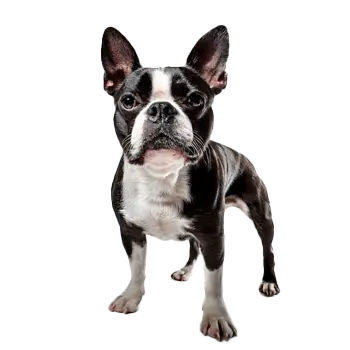
The Boston hits you immediately as a dog that knows it looks good. Square-headed, erect-eared, tuxedo-marked - it has a naturally polished appearance that manages to look simultaneously serious and ridiculous, which is part of the appeal. The head is the breed's defining feature: a nearly perfect square when viewed from the front, flat on top, with a short, wide muzzle that turns the face into a compressed geometry of prominent eyes and a button nose. The stop - the transition from skull to muzzle - is abrupt, giving the face its characteristic flat-fronted look.

Those eyes are genuinely impressive. Large, round, set wide apart, and deeply expressive, they give the Boston a perpetual look of engaged curiosity. They also represent the breed's primary physical vulnerability: the eyes protrude enough that corneal injuries from debris, rough play, or contact with vegetation are a documented and real concern. Owners learn quickly to check the eyes after outdoor activity and to keep face care as part of the regular routine. The ears stand naturally erect without cropping - they are one of the features that most immediately distinguish the Boston from other flat-faced small breeds.

The body is compact and square, with the chest broad for the dog's size and the back short. Well-muscled hindquarters give the Boston a surprisingly athletic quality beneath its tidy exterior. The tail is naturally short - either straight or screw-tailed - and carried low. The coat is short, smooth, and tight against the body, requiring almost no grooming beyond an occasional bath and wipe-down.

The tuxedo pattern is where the breed's visual character lives. The base coat color is black, brindle, or seal (which looks black in most light but shows reddish tones in direct sun), and the white markings follow a specific distribution: a blaze up the muzzle and between the eyes, a white muzzle band, white chest and forechest, and white on the front legs at minimum. The ideal show Boston has white on all four feet and a white collar - the more complete the tuxedo, the more prized the presentation. But temperament, health, and structure matter more than marking perfection in any honest assessment of the breed.

Weight runs under 25 pounds across all three recognized size classes, with a height of roughly 15 to 17 inches at the withers. Despite the small package, the Boston moves with a jaunty, rhythmic stride that has been described as springy and self-assured - exactly what you would expect from a dog with this much personality in a compact frame.

The muzzle, while short, gives the face a broad, open quality that reads as approachable rather than severe. The nose leather is wide and the nostrils are ideally open enough to allow comfortable breathing, though this varies significantly between individuals - some Bostons have near-normal nostril openings while others are significantly stenotic and benefit from surgical correction. The jaw meets in a level or slightly undershot bite, and the lips are full and cover the lower jaw cleanly. Despite the compressed facial anatomy, the face of a healthy Boston carries an expression of alertness and warmth that owners find deeply appealing.

The neck is slightly arched, connecting the square head to a compact, well-ribbed body. The topline is level, the chest deep and well-sprung, and the overall impression is of a small dog that is physically capable rather than merely decorative. Pick up a Boston and you immediately notice more muscle than you expected - the broad chest and strong hindquarters give the body real substance beneath the smooth coat.

Affectionate With Family
A Boston is practically velcro when it comes to its people - this breed was purpose-built for human companionship and takes that job seriously. Expect a dog that wants to be wherever you are.
Good With Young Children
Generally great with kids - playful, gentle, and small enough that younger children do not feel intimidated. Their own delicate eyes and brachycephalic airways mean rough play should still be supervised.
Good With Other Dogs
Bostons tend to be sociable, though some individuals carry the terrier-bred confidence that makes them willing to challenge dogs far above their weight class. Early socialization smooths this out considerably.
Shedding Level
The short, smooth coat sheds lightly. A weekly wipe-down with a soft cloth or a quick pass with a grooming mitt keeps most loose hair off your furniture without much effort.
Coat Grooming Frequency
About as low-maintenance as coats get. An occasional bath, regular face fold cleaning, and weekly brushing is all the coat needs. The Boston's grooming time is mostly going to be face care.
Drooling Level
Not a drooler by any meaningful measure. The short muzzle means occasional snorting and snuffling, but you are not signing up for slobber-protection furniture covers with this breed.
Coat Type
Short, smooth, and tight against the body - the tuxedo markings stand out clearly against the clean lines of the coat. Low-maintenance and always polished-looking, which probably contributes to the "American Gentleman" nickname.
Openness To Strangers
Bostons are generally friendly and curious with new people rather than suspicious. They may bark to announce arrivals but typically warm up quickly once they have sized the person up.
Playfulness Level
Lively, spirited, and genuinely fun to have around - the Boston brings energy to play sessions without the relentless intensity some small breeds carry. They know when to settle down, too.
Watchdog/Protective Nature
Alert enough to announce strangers and take its household watch duties seriously, but not the intimidating physical deterrent that a larger guardian breed provides. Barking notification is the main contribution.
Adaptability Level
Arguably the Boston's strongest suit as a practical companion - this breed slides into apartment life, city living, suburban homes, or country settings with minimal friction. Size and temperament both work in its favor here.
Trainability Level
Intelligent, eager to please, and genuinely responsive to positive training methods. The occasional terrier stubbornness appears, but a patient and consistent approach resolves it quickly.

Boston History & Development

The Boston is a genuinely American creation. Unlike most breeds that trace their origins to European working traditions, this one was developed in the city that bears its name during the late nineteenth century, by a community of dog enthusiasts in Massachusetts who were crossing Bulldogs and Bull Terriers to produce a compact companion breed. The founding dog is generally credited as Judge, a Bull Terrier and Bulldog cross brought from England to Boston around 1870. From Judge's descendants, early Boston fanciers refined the breed over roughly two decades into something recognizable as the modern dog.

The name "Boston" became attached to the breed naturally - it is where the dogs came from, where the breeders were based, and where the early club activity centered. In 1891, the breed was formally named the Boston Terrier, replacing the earlier informal names that had circulated including "Round Head." Two years later, in 1893, the AKC recognized the Boston Terrier, making it one of the first American-developed breeds to receive that recognition. The breed was a rare thing in a hobby dominated by imported European breeds: an American original, developed by American fanciers, carrying an American city's name.

The nickname "Boston" grew naturally from the full name and has been in common use for most of the breed's history. Owners who live with these dogs develop an easy familiarity with them that the abbreviated name reflects - calling the dog a Boston Terrier at all times would feel oddly formal, the way calling a close friend by their full name would signal distance rather than closeness. The shortened form persists in modern use across all the communities that keep this breed.

The "American Gentleman" nickname developed somewhat later, emerging from the breed's naturally refined appearance and its reputation as a clean, well-mannered household companion. By the early twentieth century, the Boston had become one of the most popular breeds in the United States - a status that reflected genuine quality as a companion dog rather than mere novelty.

Over the twentieth century, breeding priorities shifted gradually toward the flatter face and more compact structure that characterize modern show Bostons. This shift produced the brachycephalic health challenges the breed now carries - conditions that were less severe in earlier specimens with slightly longer muzzles. The breed community today is actively engaged with health improvement through programs like the OFA Respiratory Function Grading System.

The Boston's development as a specifically American breed deserves acknowledgment. At a time when the AKC and American dog fancy were dominated by imported European breeds - German Shepherds, English Setters, Scottish Terriers - the Boston was something unusual: a dog designed, named, and developed in an American city by American enthusiasts. That homegrown identity is part of why the breed carried such appeal in the early twentieth century, and it gives the shortened name "Boston" a specifically local pride that the full name captures but the nickname lives more comfortably.

Boston Temperament & Personality

If you have spent any time around a Boston, you already know that their personality is the main reason people keep coming back to the breed. They are tuned in to their people in a way that goes beyond simple attachment - they read moods, respond to emotional cues, and manage to be exactly what the room needs at any given moment. Playful when you have energy for it, settled when you do not, and reliably affectionate throughout. It is a calibration you do not get from every companion breed.

The intelligence is genuine and gets them into predictable trouble. A bored Boston will find something to do, and the thing it finds will usually not be what you had in mind. Their problem-solving inclination means they figure out cabinet latches, toy containers, and gates faster than most small breeds. The same intelligence makes training them a pleasure when approached with positive methods and consistency - they pick up cues quickly and genuinely enjoy the interaction that training sessions provide.

The terrier ancestry shows up most clearly in a confident, occasionally stubborn streak that surfaces when they disagree with an instruction they find unreasonable. This is not aggression or defiance so much as a considered opinion about the situation. You can argue with it, or you can work with it by making compliance feel worthwhile. The latter approach works considerably better and produces a dog that cooperates willingly rather than grudgingly.

Bostons are social with people by default - they tend toward curiosity and warmth with strangers rather than suspicion, which makes them easy companions in social situations. At dog parks, they typically insert themselves into the group confidently, sometimes forgetting that their compact frame does not back up the boldness they project. Some individuals will challenge much larger dogs with complete apparent unawareness of the size differential, which requires owner awareness to manage safely.

With children, the breed is generally excellent. Playful enough to keep up with kids, gentle enough not to overwhelm younger ones, and small enough not to present the physical risk that a large exuberant dog might. The breed's own vulnerability - particularly the prominent eyes - means rough play should be supervised, but temperamentally the Boston is one of the better small breed choices for family life with active children.

The Boston's sensitivity to human emotion is worth noting specifically. These are dogs that seem to track their owner's mood and calibrate their behavior in response - more subdued when someone in the household is unwell or distressed, more animated when the energy in the room is positive. Owners who pay attention to this quality often describe it as one of the most rewarding aspects of the breed. It is the difference between a dog that happens to be present and one that is genuinely participating in the household's emotional life.

Boston Family Life & Living Requirements

The Boston is legitimately one of the most adaptable companion dogs available, and that adaptability is the core of its broad appeal. It slots into apartments, townhouses, and suburban homes without the friction that many other breeds create. It does not need a yard - though it will happily use one - and it manages city life well given adequate daily walks. The size is practical in a way that matters in daily living: it fits on furniture without taking it over, travels without requiring a freight calculation, and does not eat the budget that a large breed does.

What the Boston actually needs is company. This is not a breed that does well with long solitary hours. The strong human attachment that makes them wonderful companions also means that extended isolation produces anxiety, which shows up as destructive behavior, excessive vocalization, or other signs of stress. Households where someone is home most of the time are the best fit. For working owners who are away regularly, a second dog or dog walker coverage makes the arrangement considerably more humane for the Boston.

Heat is the lifestyle management piece that requires the most attention. The flat face restricts airflow efficiently enough that Bostons overheat quickly - faster than most owners new to brachycephalic breeds expect. Summer activities need to happen in the cooler parts of the day. Air conditioning is genuinely important for this breed in warm climates, not a luxury. The signs of overheating - labored breathing, bright red gums, extreme distress - progress quickly and require fast action.

With other pets, the Boston generally manages well when introductions are handled thoughtfully. The confident personality can create friction with dogs that read that confidence as a challenge, but in established multi-pet households they typically settle into easy social arrangements. The terrier heritage means cats and smaller animals should be introduced carefully, though many Bostons coexist peacefully with cats they have been raised alongside.

The Boston's small size is a practical advantage that should not be understated. Travel is simpler, vet costs tend to scale with size, and the physical space requirements are minimal. For people in apartments, condos, or smaller homes, this is a real consideration. The breed's adaptability is not just temperamental - the physical package makes it genuinely workable in living situations where a larger breed would create friction.

Boston Training & Exercise Needs

Bostons are genuinely fun to train. They pay attention, pick things up quickly, and seem to enjoy the interaction that structured sessions provide. Positive reinforcement methods - treats, praise, play - are the approach that works best with this breed. They respond to enthusiasm and reward well, and they are sensitive enough that harsh corrections or frustrated energy from the handler sets them back rather than sharpening focus. Keep sessions short, upbeat, and reward-heavy, and you will have a Boston doing things you did not know it could learn.

The stubbornness that appears occasionally is specific rather than general - it typically shows up around particular instructions that the dog has decided it disagrees with. The solution is making the correct behavior more appealing than the alternative rather than entering a battle of wills. A battle of wills with a Boston produces exactly the outcome you would expect: an impasse, with neither party satisfied and the training relationship slightly damaged. Approach it as a negotiation instead, and the Boston comes around.

Exercise needs are moderate - a couple of good daily walks handles the physical requirement for most dogs. The Boston is a lively companion who enjoys active play and benefits from regular exercise, but it is not a high-drive working breed that needs two hours of running to be tolerable indoors. The brachycephalic structure sets the ceiling on exercise intensity: extended high-effort activity in warm weather causes breathing stress that can escalate quickly. Morning and evening activity during summer, with rest and air conditioning during the heat of the day, is the sensible management approach.

Mental stimulation matters as much as physical exercise for a breed this smart. Puzzle feeders, training games, and social interaction all help discharge the energy that produces undesirable behavior when unaddressed. A Boston that gets regular walks plus genuine interaction and occasional training sessions is a settled, happy companion. One that gets only perfunctory exercise and spends most of its day alone is more likely to find creative entertainment at your expense.

One exercise consideration specific to the Boston: the breed tends toward enthusiasm in play that exceeds what the brachycephalic airway can comfortably sustain, particularly in young dogs. They will run and play past the point of comfortable breathing unless you manage the session length. Watch for hard panting with exaggerated effort, and build in rest periods during active play - especially in warm weather. The dog will not always self-regulate appropriately.

Boston Health Concerns

The Boston's health picture is shaped largely by its flat face. Brachycephalic Airway Syndrome - which in the Boston involves some combination of stenotic nares, an elongated soft palate, and sometimes a hypoplastic trachea - is present to some degree in virtually all dogs of this breed. The severity varies considerably: many Bostons breathe comfortably through normal daily life, while others need surgical intervention to widen the nostrils or shorten the soft palate to make breathing sustainable. The BTCA offered Respiratory Function Grading System testing at its 2024 national specialty, and results showed about 22% of tested dogs were Grade 2 or 3, indicating clinically meaningful breathing compromise. Heat management and weight control are the main daily levers available to owners.

Mitral valve disease has been documented in Boston Terriers as a cardiac concern worth monitoring as dogs age. Annual cardiac auscultation from middle age onward gives early warning of murmur development. This is not a CHIC requirement but is a reasonable addition to the wellness routine for any Boston approaching its senior years.

Common Health Issues

  • Brachycephalic Airway Syndrome - BAOS, : A combination of anatomical features including narrowed nostrils, an elongated soft palate, and sometimes a hypoplastic trachea that together restrict airflow. Severity ranges from mild snoring and exercise intolerance to breathing compromise severe enough to require surgical correction. Present to some degree in virtually all Boston Terriers.
  • Patellar luxation: The kneecap slipping out of its normal groove in the stifle joint - Causing lameness that ranges from occasional skipping to consistent limping. Documented specifically in Boston Terriers and a CHIC-required evaluation for breeding stock.
  • Hereditary cataracts: Progressive clouding of the lens that can lead to vision loss - Documented in Boston Terriers and covered by the CAER eye certification that is a CHIC requirement for breeding stock.
  • Glaucoma: Increased pressure within the eye that causes pain and can result in permanent vision loss without prompt treatment - Boston Terriers are documented as at elevated risk due to their eye anatomy.
  • Congenital deafness: Genetic hearing loss present at birth - Affecting some Bostons in one or both ears. Hearing testing is a CHIC requirement for Boston breeding stock.

Preventive Care & Health Monitoring

  • OFA patella evaluation for all breeding stock - A CHIC-required screening that documents kneecap health and helps responsible breeders reduce the incidence of patellar luxation in their lines.
  • CAER or OFA eye certification - Documents hereditary eye conditions including cataracts and covers the eye health requirements for Boston Terrier CHIC participation.
  • OFA or GDC hearing test - Screens for congenital deafness, which occurs in a documented portion of Boston Terriers.
  • Weight management - Keeping the Boston at a lean, healthy weight reduces stress on the airway, joints, and overall cardiovascular system. Even modest excess weight meaningfully worsens brachycephalic breathing.
  • Regular facial fold cleaning and dental hygiene - Preventing skin fold infections and dental disease requires consistent at-home maintenance that is more important in this breed than in most others.

Boston Grooming & Maintenance

The Boston's coat is about as low-maintenance as it gets in the dog world. Short, smooth, and tight, it requires only an occasional bath and a weekly wipe-down with a grooming mitt or soft cloth to look presentable. Shedding is light and manageable. If coat care were the only consideration, the Boston would be a groom-and-forget proposition.

The face is where the actual maintenance work lives. The skin folds around the nose and sometimes between the eyes need regular cleaning - moisture and debris collect in these folds and create conditions for bacterial or yeast infections if left unaddressed. A daily wipe with a slightly damp cloth, followed by thorough drying, prevents most fold-related problems. The prominent eyes need regular checking for debris, discharge, and any signs of developing conditions. After outdoor activity, particularly in brushy or dusty environments, a quick eye check is sensible.

Ears should be cleaned every couple of weeks - the upright carriage means they do not trap moisture the way drop ears do, but debris still accumulates and should be cleared. Nails need trimming monthly, or more frequently if the dog is not walking on hard surfaces regularly. Dental hygiene is important: the brachycephalic skull structure crowds the teeth, and dental disease develops more readily in Boston Terriers than in longer-muzzled breeds. Brushing three to four times per week with dog-appropriate toothpaste is the most effective preventive, backed up by veterinary dental cleanings on the schedule your vet recommends. The fold cleaning, eye care, and dental hygiene together are probably twenty minutes of effort spread across a week - manageable for any owner who makes it part of a regular routine.

One practical note on bathing: the Boston's flat face means water and shampoo around the muzzle and eyes needs particular care. Getting product or rinse water into the nostrils of a brachycephalic dog is uncomfortable and potentially dangerous. A washcloth for the face rather than direct spray or submersion is the right approach, and thorough drying of the skin folds after the bath is essential to prevent the moisture-related infections those folds can develop.