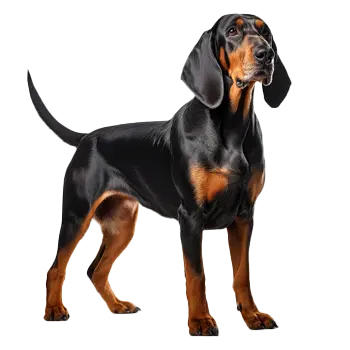
The Black and Tan Coonhound is built for a specific job: moving at a sustained trot through mountain terrain, its nose working close to the ground, following a cold scent trail that might be hours or days old. Everything about its physical structure serves that function. It is a large, substantial dog - athletic rather than massive, with the deep chest for lung capacity and the long legs for ground-covering movement that a trailing hound needs.
The head is distinctively hound, with the long low-set ears and developed flews that are hallmarks of the Bloodhound lineage running through this breed's foundation. The skull is oval when viewed from the top, moderately angular in profile, with a slight pronounced stop. The muzzle is deep and wide, providing the olfactory surface area that supports this breed's famously cold nose - the ability to follow old, faint trails that other breeds cannot detect. The large, well-opened nostrils continue that olfactory system externally. The flews are well-developed but not excessively pendulous like a Bloodhound's; they contribute to scent retention around the muzzle during trailing. The eyes are hazel to dark brown with a direct, friendly expression. Ectropion - the lower eyelid rolling outward - is an inherited condition seen in the breed and something to be aware of in breeding dogs.
The ears are a defining physical feature. They are long, wide, thin, and set very low and far back on the skull, hanging in loose folds that sweep the ground when the dog puts its head down to trail. Many people theorize that these ears function to stir up ground scents toward the nose as the dog moves - a practical hypothesis, though debated. Functionally, they create a pronounced visual impression: a Black and Tan working a trail is all ear and nose, sweeping low to the ground.
The neck is muscular and of moderate length, flowing into well-laid-back shoulders. The topline is level. The chest is broad, deep, and well-ribbed to provide the lung capacity needed for extended trailing. The depth of chest is one of the features associated with elevated GDV (bloat) risk - the deep chest that enables the dog's endurance also creates the anatomical conditions that make GDV possible. The tail is set slightly below the natural line of the back and carried nearly perpendicular - at a right angle to the spine - when the dog is alert or excited.
The legs are long in proportion to body length, providing the stride necessary to cover rough terrain efficiently. Musculature is substantial throughout, particularly in the hindquarters, which supply the driving force for sustained movement. The feet are catlike and compact, well-padded for the varied terrain of mountain coon hunting. The overall movement is free and rhythmic, with reach and drive that covers ground without wasted effort.
The coat is short, dense, and glossy - a field coat that requires minimal maintenance but provides adequate protection for brush and moderate weather. Color is coal black over the body with rich tan markings in precisely defined locations: above each eye (the pumpkin seeds), on the sides of the muzzle, on the chest as two distinct marks, on the forelegs from the ankle forward, inside the rear legs, and around the vent. These markings are consistent and breed-characteristic. The coloring is analogous to the pattern seen in Dobermans and Rottweilers in terms of genetics and distribution, though this breed acquired its pattern through the Bloodhound and Virginia Foxhound lineage rather than through any relationship to those breeds.
Most Black and Tan Coonhounds drool to some extent - a function of the flews and the generally heavy mouth construction. The face and jowls may need regular wiping. There is also a characteristic hound odor, sometimes described as musty or yeasty, that regular bathing reduces but does not eliminate entirely. Both the drool and the odor are breed characteristics worth knowing before adopting one.
Sexual dimorphism is moderate: males are larger throughout with more prominent head features, while females are refined and athletic. Both sexes carry the same conformation type and color pattern.
One physical characteristic that surprises new owners is the jowl and mouth construction. The well-developed flews that make this dog such an effective scent holder also produce the moderate drool and the characteristic hound odor that are part of living with a Black and Tan. The face folds around the muzzle collect moisture and need regular wiping. This is not a fastidious dog physically, and it should not be expected to be. It is a working hound built to spend days in the field, and its construction reflects that purpose rather than drawing room delicacy.
The tail carriage when alert or excited - nearly perpendicular to the back - is one of the breed's most recognizable visual signatures in motion. Combined with the head down on a trail and the ears sweeping the ground, the working Black and Tan in full stride is an unmistakable sight.
Affectionate With Family
★★★★☆
The Black and Tan is a warm, people-oriented dog that bonds deeply with its family. It is not a clingy breed indoors but it genuinely wants to be near its people, often choosing to be in whatever room you're in.
Good With Young Children
★★★★☆
Gentle and tolerant with children, this is one of the more reliably patient of the large hound breeds around kids. The size warrants supervision with toddlers, but the temperament is fundamentally kind.
Good With Other Dogs
★★★★☆
Pack-oriented by design, the Black and Tan generally does well with other dogs and enjoys canine company. It was bred to work alongside other hounds and that cooperative nature carries into the household.
Shedding Level
★★★☆☆
The short, dense coat sheds moderately year-round. Weekly brushing with a hound mitt keeps it manageable, but black and tan hairs will find their way onto furniture and clothing.
Coat Grooming Frequency
★☆☆☆☆
Minimal coat maintenance beyond a weekly brush-down. The short, glossy coat practically takes care of itself and requires no trimming or professional grooming for basic upkeep.
Drooling Level
★★★☆☆
The well-developed flews (pendulous upper lips) and the hound mouth style mean some drool is expected, particularly around mealtime, after drinking, and during exertion. It is not a Great Dane-level drooler, but it is noticeable.
Coat Type
★☆☆☆☆
A classic field dog coat: short, dense, and glossy with enough substance to protect the skin in rough terrain. Single-care, easy to maintain, sheds rain and debris readily.
Openness To Strangers
★★★☆☆
The Black and Tan can be somewhat reserved when first meeting strangers, which is consistent with its Bloodhound heritage. It warms up, but it assesses first rather than greeting immediately. It may bay at new arrivals.
Playfulness Level
★★★☆☆
Calm and settled indoors, but the outdoor switch flips on readily. The Black and Tan enjoys play and activity but is not a hyperactive breed - it has a good gear range from resting at your feet to trotting trails for hours.
Watchdog/Protective Nature
★★★☆☆
The voice is the protection here - the Black and Tan's bay carries a long distance and will alert to unusual sounds or arrivals. It is not an aggressive guardian, but a baying large hound at the door is a deterrent in itself.
Adaptability Level
★★★☆☆
The Black and Tan adapts reasonably well to different living situations as long as exercise needs are met. It can live in suburban settings with diligent exercise commitment but is genuinely happiest with room to range.
Trainability Level
★★☆☆☆
Intelligent but strongly nose-driven, the Black and Tan engages its independent scent-following brain before it consults you for instructions. Training requires patience, high-value rewards, and genuine acceptance of the breed's priorities.