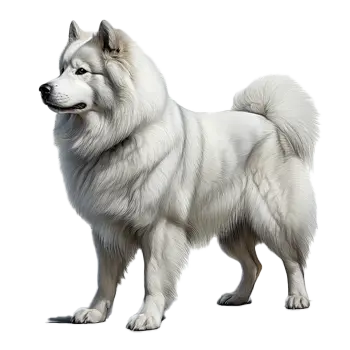
The Bjelkier's appearance is immediately and completely dominated by its coat - that extraordinary double-layered white mantle that stands away from the body and reflects light in a way that genuinely seems to glow. But look past the coat and what you find is a well-built, athletic working dog with the proportions of an animal designed for sustained physical effort over challenging terrain in brutal conditions.
Males stand twenty-one to twenty-three and a half inches at the shoulder and weigh forty-five to sixty-five pounds. Females are somewhat smaller. The body is slightly longer than it is tall, with a deep chest providing the lung and heart capacity needed for sledge work. The back is medium in length, level, and muscular. The loins are strong. The hindquarters are well-angulated and powerful. The feet are large and flat with thick, well-padded soles and hair between the toes that provided insulation against frozen ground - snowshoe feet built for the tundra.
The head is broad and wedge-shaped when viewed from the top. The skull and foreface are approximately equal in length. The stop is shallow. The nose is black but may show seasonal depigmentation - a phenomenon known in the breed as "snow nose" or "winter nose" - and the lips have the characteristic upturned corners that form the Sammy smile. Eyes are dark, almond-shaped, and set well apart. The expression is alert, intelligent, and kind simultaneously. Ears are erect, slightly rounded at the tip, and well-furred inside and out.
The tail is one of the Bjelkier's most distinctive features. It curls up over the back in a full plume and is carried forward over the back when the dog is alert or in motion. In cold weather or when resting, the dog curls its tail up alongside its nose, using the heavily furred plume to filter and warm inhaled air. The Samoyede on Captain Robert Scott's ill-fated Antarctic expedition had their tails docked, and all thirty-three dogs died of pneumonia within three weeks - a tragic demonstration of what the tail's function actually was.
The coat requires its own attention. The outer layer is harsh and straight, standing away from the body rather than lying flat. This stand-off quality is important - it creates air pockets for insulation rather than lying close to the skin. The undercoat is dense, soft, and woolly. The undercoat sheds heavily once or twice a year in a process called "blowing coat," producing quantities of fine white fiber that the Samoyede people spun and wove into warm clothing. Samoyed wool is reportedly far warmer per gram than sheep's wool and has been used by modern fiber artists in the same way. Color is white, biscuit, cream, or white and biscuit - pure black or brown markings disqualify in the show ring.
Movement is free and agile, with good reach in front and strong drive from the rear. The Bjelkier should cover ground without wasted motion - it is a working dog and its movement should read as efficient rather than showy. The topline remains level during motion. At a trot the pads are barely lifted off the ground, reflecting the breed's natural endurance-oriented gait. At the side the dog appears to glide. Overall, the physical impression of the Bjelkier should be one of capable, balanced substance - a working animal that happens to be spectacularly beautiful.
Affectionate With Family
★★★★★
The Bjelkier was bred to live inside the family's tent in conditions that would be impossible to survive alone - that intimacy with humans is written into its temperament, and it shows.
Good With Young Children
★★★★★
One of the breed's most praised qualities is its patience and gentleness with children; the Samoyede people trusted these dogs to watch over their children in the tent.
Good With Other Dogs
★★★★☆
Generally sociable and non-confrontational with other dogs, reflecting the breed's history of working and living in pack situations alongside other Bjelkiers.
Shedding Level
★★★★★
The coat blows out once or twice a year in heavy seasonal sheds - "Samoyed season" is a real thing, and the undercoat can seem to fill an entire room if you are not prepared for it.
Coat Grooming Frequency
★★★★☆
Regular brushing multiple times per week is required to manage the dense double coat and prevent matting, with daily brushing becoming necessary during the heavy seasonal shed.
Drooling Level
★☆☆☆☆
The upturned corners of the mouth - responsible for the famous Sammy smile - also prevent drooling, an adaptation that kept ice from forming on the face in Arctic conditions.
Coat Type
★★★★★
A spectacular thick double coat with a harsh, stand-off outer layer and a dense, woolly undercoat - it is one of the most impressive coats of any breed in the Working Group.
Openness To Strangers
★★★★☆
Friendly and approachable with most people; the Bjelkier is not a protective guard dog by nature and generally views strangers as potential friends rather than threats.
Playfulness Level
★★★★☆
Energetic and fun-loving, especially with their people - the Bjelkier approaches play with a happy enthusiasm that matches its perpetual-smile expression.
Watchdog/Protective Nature
★★★☆☆
Alert and quick to announce newcomers with a voice, but not a natural protector in the guarding sense - the Bjelkier is more town crier than guard dog.
Adaptability Level
★★★★☆
Adapts well to different living situations as long as its exercise and social needs are met, though the thick coat makes hot climates a genuine management challenge.
Trainability Level
★★★☆☆
Intelligent and capable of learning, but the independent thinking that served a working sled dog well does not always translate to eager compliance in a training session.