American Sealyham Terrier

Sealyham Terrier

Quick Facts

🐕 Breed Group
Terrier Group
📏 Size Category
Small
📏 Height
Males: 10.5 inches, Females: 10.5 inches
⚖️ Weight
Males: 23-24 pounds, Females: 18-22 pounds
⏱️ Life Expectancy
12-14 years
🧣 Coat Type
Double coat - hard wiry outer, soft dense undercoat
🎨 Coat Colors
All white, or white with lemon, tan, or badger markings on head and ears
😀 Temperament
Charming, spirited, loyal, calm, humorous, alert
🏃 Exercise Needs
Moderate
🎓 Training Difficulty
Moderate to difficult - stubborn streak
👶 Good with Children
Yes
🐾 Good with Other Pets
Conditional - good with dogs, high prey drive toward small animals

Other Names & Breed Recognition

American Sealyham Terrier is an informal designation that occasionally appears in breed discussions to distinguish the Sealyham Terrier as it developed and is bred within the United States from the breed as it exists in its native Wales and elsewhere in Europe. The name does not represent a separate breed or a recognized variant. It reflects the reality that American breeding programs, shaped by the preferences of American show judges and the priorities of the American Sealyham Terrier Club, have at various points in the breed's history produced dogs that differ subtly from their British and continental counterparts in matters of substance, head type, and coat presentation. These differences have never been formalized into a separate standard, and all dogs compete under the same breed name regardless of national origin.

The breed itself has carried a consistent name since its formal establishment. Sealyham Terrier derives from Sealyham House, the Pembrokeshire estate where Captain John Edwardes developed the breed in the mid-nineteenth century. During the earliest stages of formal recognition, the breed was briefly known in some circles as the Welsh Border Terrier or the Cowley Terrier, but neither name gained lasting traction. By the time kennel clubs on both sides of the Atlantic began registering the breed, Sealyham Terrier was the settled designation. The affectionate shorthand "Sealy" is universal among fanciers but has never carried official weight.

The Sealyham Terrier is recognized by every major kennel club in the English-speaking world and by the FCI internationally. The American Kennel Club admitted the breed in 1911, placing it in the Terrier Group where it has remained for over a century. The Kennel Club in the United Kingdom recognized the breed in the same year. The United Kennel Club followed in 1919, the Canadian Kennel Club carries the breed in its Terrier Group, and the FCI classifies it in Group 3 Terriers, Section 2 Small-sized Terriers. Despite this broad recognition, the Sealyham Terrier is one of the rarest terrier breeds in existence, with annual AKC registrations typically numbering fewer than one hundred and UK Kennel Club registrations placing it firmly in vulnerable native breed status.

Anyone encountering the term American Sealyham Terrier is looking at the same breed recognized worldwide under the name Sealyham Terrier. The prefix serves as informal geographic context rather than a breed distinction. Whether bred in Pembrokeshire, London, New York, or California, the Sealyham Terrier is the same white, low-slung, wiry-coated terrier developed to hunt vermin in the Welsh countryside and now valued primarily as a companion dog with a devoted following among terrier enthusiasts.

American Sealyham Terrier Organizations & Standards

The American Sealyham Terrier Club, founded on May 15, 1913, is the AKC parent club for the breed in the United States. The ASTC coordinates the annual national specialty show, maintains a breeder referral service, publishes breed health and educational information, and serves as the custodian of the breed standard as it applies to AKC competition. For a breed as rare as the Sealyham, the parent club functions as the primary network connecting the small community of breeders and owners committed to the breed's preservation. The ASTC's membership tends to be experienced and deeply knowledgeable, and the organization plays a critical role in ensuring that breeding decisions prioritize health, temperament, and structural soundness over simple aesthetics.

The AKC breed standard describes the Sealyham Terrier as the embodiment of power and determination, keen and alert, possessing extraordinary substance while remaining free from clumsiness. The standard calls for a height of approximately 10.5 inches at the withers, with males weighing 23 to 24 pounds and females slightly less. The head is the breed's signature feature, described as long, broad, and powerful, in perfect balance with the body. The skull is slightly domed with a moderate stop, and the muzzle is long and powerful with flat cheeks and square jaws. The eyes are very deep set and widely spaced, dark in color, and the ears are folded level with the top of the head, rounded at the tips, and carried close to the cheek.

The Kennel Club standard in the United Kingdom is broadly consistent with the AKC version but specifies weight somewhat differently, calling for approximately 9 kilograms for males and 8 kilograms for females. The FCI uses the Kennel Club standard as its reference document. Subtle differences in interpretation between American and British judges have over the decades led to variations in how the breed is presented in the two countries. American-bred Sealyhams have at times tended toward slightly greater substance and a more heavily furnished head, while British dogs have sometimes been leaner and more moderate. These differences are matters of emphasis within the same standard rather than structural divergence.

The breed's rarity places particular responsibility on breed clubs and individual breeders to maintain genetic diversity while adhering to the standard. With such a small breeding population worldwide, every litter carries weight for the breed's future. The ASTC and its British counterparts, the Sealyham Terrier Breeders Association and the Sealyham Terrier Club, cooperate informally on health initiatives and occasionally facilitate international breeding arrangements to broaden the gene pool. Health testing, including DNA screening for primary lens luxation and ophthalmologic examinations, is strongly encouraged by all breed organizations.

Kennel Club Recognition

  • American Kennel Club (AKC): Recognized in 1911, Terrier Group
  • United Kennel Club (UKC): Recognized in 1919, Terrier Group
  • Canadian Kennel Club (CKC): Recognized, Terrier Group
  • FCI: Recognized, Group 3 - Terriers
  • The Kennel Club (UK): Recognized in 1911, Terrier

American Sealyham Terrier Physical Description

The American Sealyham Terrier presents a distinctive silhouette within the terrier group: white, low to the ground, rectangular in outline, and possessing a head of remarkable size and character relative to its body. Standing approximately 10.5 inches at the withers and weighing between 18 and 24 pounds depending on sex, this is a compact dog that carries considerably more substance than its modest height suggests. The overall impression should be one of density, power, and athletic readiness compressed into a small, well-proportioned frame. Despite being one of the short-legged terrier breeds, the Sealyham should move freely and with purpose, covering ground efficiently without the exaggerated low carriage that would impede function.

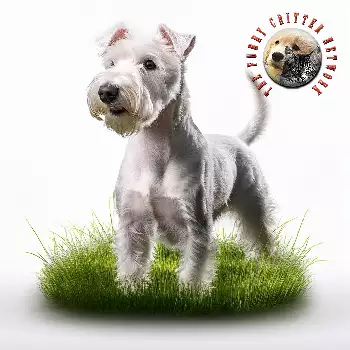
The head is the breed's most defining physical characteristic and receives extensive attention in the standard. The skull is broad and slightly domed, with a moderate stop and a long, powerful muzzle that does not taper. The jaws are strong and square, reflecting the breed's original purpose of confronting badger and fox underground. The eyes are deeply set, widely spaced, and dark in color, giving the face an expression that combines intelligence with determination. The ears are medium-sized, folded level with the top of the skull, rounded at the tips, and carried close to the cheek. The nose is large and black. Perhaps the most immediately recognizable feature is the fall, a mass of hair that drapes across the forehead and partially obscures the eyes, giving the breed a distinctive and somewhat rakish appearance.

The body is strong, level-backed, and oblong in overall proportion. The chest is deep and broad with a well-developed forechest that provides ample room for heart and lungs. The ribs are well-sprung but not barrel-shaped, allowing free movement of the front legs. The loin is short and muscular. The legs are short, heavy-boned, and straight, with the front legs as straight as possible for a short-legged breed. The hindquarters are powerful and well-angulated, providing the driving force for the breed's characteristic ground-covering movement. The feet are large, round, and well-padded, designed for digging and navigating rough terrain. The tail, when docked, is carried upright; undocked tails are increasingly common and are carried erect.

The coat is a functional double layer consisting of a hard, wiry outer coat and a soft, dense undercoat. This combination provides weather resistance and protection from thorns, brush, and underground hazards. The body of the coat should be predominantly white, with lemon, tan, or badger-colored markings permitted on the head and ears. Heavy body markings are undesirable. The coat's texture should feel harsh and springy, not soft or silky. Profuse furnishings on the legs, chest, and face complete the breed's characteristic appearance, with the leg hair and beard requiring regular attention to prevent matting.

Affectionate With Family
The American Sealyham Terrier is deeply devoted to its family and thrives on close companionship. Unlike many terrier breeds that maintain a degree of emotional independence, the Sealy actively seeks out attention and physical proximity with its people. It will follow household members through the house, claim a spot on the sofa beside you, and greet returning family members with genuine enthusiasm. This is a breed that bonds tightly and repays that bond with steady, warm affection.
Good With Young Children
The Sealyham Terrier is one of the more child-friendly terrier breeds, possessing a sturdy build that holds up well to the unpredictable movements of young children and a temperament that leans toward patience rather than irritability. Its relatively low energy level compared to other terriers means it is less likely to become overstimulated during boisterous play. Supervision is always appropriate with any dog and young child, but the Sealy's good humor and fondness for people generally extend to the youngest members of the household.
Good With Other Dogs
Sealyham Terriers were historically worked in packs alongside otterhounds, which gives them a slightly better foundation for canine sociability than many terrier breeds. Most Sealys will coexist comfortably with other dogs when properly introduced and socialized from puppyhood. However, the breed retains enough terrier assertiveness that it will not back down if challenged, and some individuals may display resource guarding or same-sex tension. Early socialization and neutral-ground introductions set the stage for harmonious multi-dog living.
Shedding Level
The Sealyham Terrier's wiry double coat sheds minimally when properly maintained through regular hand stripping or clipping. Dead hair is largely retained in the coat rather than dropping onto furniture and clothing, which makes the breed a reasonable choice for owners who prefer a cleaner home environment. Some seasonal undercoat loss does occur, but it is modest compared to smooth-coated or heavy-shedding breeds and is easily managed with routine brushing.
Coat Grooming Frequency
The Sealyham Terrier's coat demands consistent attention. Hand stripping every eight to twelve weeks is the gold standard for maintaining the correct harsh texture required by the breed standard, though many pet owners opt for clipping, which is less labor-intensive but softens the coat over time. Between stripping or clipping sessions, the coat requires brushing and combing several times per week to prevent matting, particularly in the leg furnishings and the characteristic fall of hair over the forehead.
Drooling Level
The Sealyham Terrier is an exceptionally clean breed when it comes to drooling. Its tight-fitting lips and compact muzzle produce virtually no excess saliva under normal conditions. Owners will not encounter wet spots on furniture or clothing after handling the dog. This tidiness extends to drinking and eating, where the Sealy is neater than many similarly bearded breeds.
Coat Type
The Sealyham Terrier carries a weather-resistant double coat consisting of a hard, wiry outer layer and a dense, soft undercoat. This combination was developed to protect the dog while working underground and in wet Welsh terrain. The outer coat should feel harsh and springy to the touch rather than soft or silky. The breed's profuse leg furnishings and the distinctive fall of hair across the forehead give it a unique silhouette within the terrier group.
Openness To Strangers
The Sealyham Terrier occupies a middle ground between the suspicious wariness of some terrier breeds and the effusive friendliness of companion breeds. It is generally reserved upon first meeting a new person, taking a moment to assess the situation before engaging. Once satisfied that a visitor is welcome, the Sealy warms up readily and can be quite charming. This measured approach makes it a reliable alert dog without the persistent distrust that complicates hospitality.
Playfulness Level
The Sealyham Terrier has a genuine playful side that enthusiasts describe as a dry sense of humor. It will engage happily in games of fetch, tug, or chase, and it takes visible pleasure in making its owners laugh. However, the Sealy is notably less hyperactive than most terrier breeds and is often described as the couch potato of the terrier world. Its play comes in moderate, enthusiastic bursts rather than relentless demands for activity.
Watchdog/Protective Nature
Despite its modest stature, the Sealyham Terrier possesses a surprisingly deep, authoritative bark that it deploys readily when something warrants attention. The breed is naturally alert and territorial enough to announce visitors, unusual sounds, or anything that deviates from the household routine. It does not typically escalate beyond vocal alerting, but the volume and conviction of that bark are disproportionate to the dog's size and serve as an effective deterrent.
Adaptability Level
The Sealyham Terrier adapts well to a variety of living situations, from city apartments to rural homes. Its moderate exercise needs and compact size make it genuinely suited to urban life, while its terrier heritage means it is equally content exploring a country garden. The breed adjusts to changes in routine, travel, and household composition with relative equanimity, provided its basic needs for companionship and moderate activity are met.
Trainability Level
The Sealyham Terrier is intelligent and capable of learning a wide range of commands and behaviors, but it approaches training on its own terms. The breed possesses the classic terrier independence that can manifest as stubbornness when it decides a particular exercise is not worth the effort. Positive reinforcement methods using food and play as motivators produce the best results. Short, varied training sessions hold the Sealy's attention far better than long, repetitive drills.

American Sealyham Terrier History & Development

The Sealyham Terrier was created by one man with a single-minded purpose. Captain John Edwardes of Sealyham House, a country estate near Wolfscastle in Pembrokeshire, Wales, began developing his ideal working terrier around 1850. Edwardes wanted a small, predominantly white dog with enough courage and jaw strength to face badger, fox, and otter underground, enough stamina to work alongside his otterhound pack, and a white coat that would prevent hunters from mistaking the terrier for the quarry when it emerged from a burrow. He worked on this breeding program for over forty years until his death in 1891, selecting ruthlessly for working ability and culling dogs that did not meet his standards.

Edwardes kept no breeding records, which has left the Sealyham's precise ancestry a matter of informed speculation. Breed historians have proposed various combinations of foundation stock, with the most commonly cited contributors including the Dandie Dinmont Terrier, the Wire Fox Terrier, the West Highland White Terrier, the Bull Terrier, the Welsh Corgi, and a now-extinct white terrier sometimes called the Cheshire Terrier. The Bull Terrier connection is supported by the incomplete pigmentation around the eye rims and pigment spots on the skin that appear in some modern Sealyhams, characteristics closely associated with the white variety of Bull Terrier. The Dandie Dinmont is often cited as the source of the Sealyham's low station and substantial bone. Whatever the precise recipe, the result was a distinctly recognizable type that bred true by the time of Edwardes' death.

After Edwardes passed, other Welsh breeders, most notably Fred Lewis, continued to refine and promote the breed. The Sealyham's first recorded show appearance was at a local event in Wales in 1903. The Sealyham Terrier Club was established in 1908, and the Kennel Club officially recognized the breed in 1911. American recognition followed immediately, with the AKC admitting the Sealyham in the same year. The American Sealyham Terrier Club was founded in 1913 to support the breed in the United States. The breed surged in popularity during the 1920s and 1930s, becoming fashionable among the Hollywood elite and British aristocracy. Humphrey Bogart, Gary Cooper, Cary Grant, and most famously Alfred Hitchcock all owned Sealyhams, with Hitchcock's dogs making cameo appearances in multiple films including The Birds and Suspicion.

The breed's popularity peaked between the World Wars and has declined steadily since. Changing tastes in companion dogs, the specific grooming demands of the wiry coat, and the breed's limited marketing appeal compared to newer and flashier breeds have all contributed to falling registration numbers. In the United Kingdom, the Kennel Club lists the Sealyham Terrier as a vulnerable native breed, with annual registrations sometimes dropping below fifty. American numbers are similarly modest, with the breed typically ranking near the bottom of AKC registration statistics. Despite this decline, the breed retains a dedicated following of enthusiasts who value its unique combination of terrier spirit, manageable size, and genuine affection for its people.

American Sealyham Terrier Temperament & Personality

The Sealyham Terrier's temperament is one of the breed's most compelling attributes and one of the primary reasons its devoted following remains committed despite the breed's rarity. This is a terrier with the courage and determination of its working ancestors but with a notably calmer, more companionable disposition than most of its terrier cousins. Breed enthusiasts frequently describe the Sealy as the couch potato of the terrier world, and while that characterization slightly undersells the breed's energy, it accurately captures the fundamental difference between the Sealyham and the higher-drive terrier breeds. The Sealy is content to relax between adventures, does not demand constant stimulation, and settles into household rhythms with a grace that many other terriers lack.

Beneath that calm exterior is a dog of genuine character and intelligence. Sealyham Terrier owners consistently describe a breed with a sly, dry sense of humor, a dog that seems to understand timing and takes visible pleasure in making its people laugh. This quality is difficult to quantify but immediately apparent to anyone who spends time with the breed. The Sealy will invent games, offer commentary through a range of vocalizations, and occasionally engage in deliberate clowning that suggests a degree of self-awareness rare in dogs. This humor is paired with a dignity that the breed maintains even in its most playful moments.

With its family, the Sealyham is warmly affectionate and genuinely devoted. It bonds tightly to its household and prefers to be included in daily activities rather than relegated to a kennel or yard. The breed is notably good with children, displaying a patience and tolerance that sets it apart from many terrier breeds. Its sturdy build handles the inadvertent rough handling of young children without the fragility concerns that accompany smaller companion breeds, and its calm disposition reduces the risk of overstimulated, reactive behavior during boisterous family play.

With strangers, the Sealyham is reserved but not suspicious. It will assess newcomers with quiet interest before deciding how much warmth to offer, and most individuals warm up relatively quickly once introductions are made. The breed possesses enough territorial awareness to serve as an effective alarm dog, and its deep, authoritative bark is disproportionately impressive for its size. However, it does not typically escalate beyond vocalization and lacks the sustained aggression toward people that would make it a genuine protection dog. Its prey drive, inherited from generations of vermin hunting, remains active and is the primary behavioral consideration for owners with cats, rabbits, or other small household pets.

American Sealyham Terrier Family Life & Living Requirements

The Sealyham Terrier is one of the more adaptable terrier breeds when it comes to living arrangements. Its moderate exercise needs, compact size, and relatively calm indoor demeanor make it genuinely suited to apartment or condominium living, provided it receives adequate daily activity and mental stimulation. The breed is equally comfortable in a suburban home with a fenced yard or a rural property, though it should never be left unsupervised outdoors for extended periods due to its digging instinct and prey drive, both of which can lead to escape attempts or confrontations with wildlife. A securely fenced yard with barriers extending below ground level is ideal for this breed.

The Sealyham's energy level is moderate by terrier standards, which is one of its primary advantages as a companion breed. A couple of moderate walks per day supplemented by some play time is generally sufficient to keep the breed physically and mentally satisfied. The Sealy does not require the intense, sustained exercise that higher-drive terrier breeds demand, and it is notably less likely to develop destructive behaviors from moderate periods of inactivity. That said, it is still a terrier, and a Sealyham that receives no exercise or mental engagement at all will become bored, and a bored Sealyham expresses itself through barking, digging, and creative destruction.

The breed does well in families with children of all ages, which is not a claim that can be made for all terrier breeds. The Sealyham's combination of sturdy build, patient disposition, and genuine fondness for people makes it a reliable family dog. It participates in household activities with enthusiasm without the constant demand for attention that characterizes some companion breeds. The breed's moderate energy level also means it adapts well to the schedules of working families, though it should not be left alone for extended periods. Sealyhams that spend long hours without companionship may develop separation anxiety, excessive barking, or other stress-related behaviors.

Household integration with other pets requires some consideration. The Sealyham generally coexists well with other dogs, particularly when raised together from puppyhood. Its pack-hunting heritage gives it a slightly better foundation for canine sociability than many terrier breeds. Small animals, however, present a challenge. The breed's prey drive is deeply ingrained and difficult to fully suppress through training. Cats may be tolerated if introduced during the Sealyham's puppyhood and if the cat is confident enough to stand its ground, but rabbits, guinea pigs, hamsters, and similar small pets should be housed securely and never left unsupervised with the dog.

American Sealyham Terrier Training & Exercise Needs

Training a Sealyham Terrier requires an understanding of the breed's particular cognitive style, which combines genuine intelligence with an independent streak that can test the patience of even experienced handlers. The Sealy is fully capable of learning complex commands and performing reliably in obedience, agility, earthdog trials, and other structured activities. However, it approaches training as a negotiation rather than a directive, and it will evaluate whether any given command is worth the effort of compliance before deciding how to respond. This is not defiance in the confrontational sense but rather the working intelligence of a dog bred to make independent decisions underground, where handler direction was impossible.

Positive reinforcement is the only training approach that produces consistent results with this breed. Food rewards are particularly effective, as the Sealyham is genuinely food-motivated, though this must be balanced against the breed's tendency toward weight gain. Toy rewards and play also serve as effective motivators for many individuals. Correction-based methods tend to produce resistance and withdrawal rather than compliance, and harsh handling can damage the trust relationship that forms the foundation of a productive training partnership. Short, varied sessions that maintain novelty and engagement will accomplish more than long, repetitive drills that bore the dog into disengagement.

Early socialization is critically important for the Sealyham Terrier and should begin as soon as the puppy's vaccination status permits safe exposure. The breed's natural reserve with strangers benefits significantly from structured exposure to a variety of people, environments, surfaces, sounds, and other animals during the first four months of life. Puppy kindergarten classes provide an efficient framework for this early socialization while also introducing basic obedience concepts. Particular attention should be given to recall training, as the breed's prey drive can override obedience commands once the dog locks onto a target of interest.

Exercise needs are moderate but consistent. Two walks of twenty to thirty minutes each per day, supplemented by some interactive play or training activity, satisfies the breed's physical requirements for most individuals. The Sealyham excels at earthdog trials, which tap directly into its natural instinct to pursue quarry underground. Agility and rally obedience offer additional outlets for physical and mental engagement. Scent work and tracking exercises leverage the breed's keen nose and provide cognitive stimulation that physical exercise alone cannot match. Despite its low-energy reputation, the Sealy that is consistently under-exercised will find outlets for its energy that owners are unlikely to appreciate.

American Sealyham Terrier Health Concerns

The Sealyham Terrier is a generally robust breed with a life expectancy of twelve to fourteen years, but its small gene pool and specific physical characteristics create vulnerabilities that owners and breeders must understand and manage proactively. The most significant health concern in the breed is primary lens luxation, an inherited condition in which the fibers suspending the lens within the eye degenerate and break, allowing the lens to displace. When the lens falls forward into the anterior chamber, it can block fluid drainage and produce secondary glaucoma, causing acute pain and rapid vision loss. A DNA test is available that reliably identifies clear, carrier, and affected dogs, and responsible breeders test all breeding stock before making pairing decisions.

Retinal dysplasia is the second major eye condition affecting the breed. In its mildest form, retinal dysplasia produces small folds in the retinal tissue that do not significantly impair vision. In its most severe form, total retinal dysplasia involves complete detachment of the retina and results in blindness. Litter screening by a veterinary ophthalmologist identifies affected puppies so that buyers can make informed decisions. Progressive retinal atrophy, a separate inherited condition causing gradual photoreceptor degeneration and eventual blindness, has also been documented in the breed, with a genetic test available to identify carriers. The convergence of these three distinct eye conditions makes comprehensive ophthalmologic screening an essential component of any Sealyham Terrier health program.

Congenital deafness occurs in the breed at a rate consistent with other predominantly white-coated breeds. The genetic mechanisms linking white coat color to sensorineural hearing loss are well documented across multiple species, and the Sealyham is not exempt. Both unilateral and bilateral deafness occur. BAER testing performed on puppies as young as five weeks of age accurately identifies hearing status and should be standard practice for all litters. Unilaterally deaf dogs can live normal companion lives with appropriate management, while bilaterally deaf dogs require specialized handling and a commitment from owners willing to adapt their communication and safety practices.

Intervertebral disc disease is a structural concern rooted in the breed's elongated body and short legs. The mechanical stress placed on the spinal column by this body type predisposes the breed to disc degeneration and herniation, which can produce symptoms ranging from mild back pain to severe paralysis. Weight management is the single most important preventive measure, as excess body weight dramatically increases the load on the spine. Avoiding high-impact activities such as jumping from elevated surfaces and providing ramps for furniture access also reduce risk. Allergic dermatitis is commonly reported in the breed, manifesting as chronic skin irritation, recurrent ear infections, and coat thinning. Identifying and managing the underlying allergens, whether environmental, dietary, or contact-based, requires veterinary guidance and often ongoing treatment.

Common Health Issues

  • Primary lens luxation (PLL) - An inherited condition in which the zonular fibers holding the lens in position degenerate and rupture, causing the lens to displace. Anterior luxation can obstruct fluid drainage and produce secondary glaucoma, leading to pain and vision loss without surgical intervention. A DNA test is available to identify clear, carrier, and affected dogs.
  • Retinal dysplasia (total retinal dysplasia) - A congenital malformation of the retina that ranges in severity from mild folds in the retinal tissue to complete detachment. The total form can cause blindness. Litter screening through ophthalmologic examination is recommended by breed clubs to identify affected puppies before placement.
  • Progressive retinal atrophy (PRA) - A group of inherited degenerative diseases causing progressive photoreceptor cell death in the retina, leading to gradual vision loss and eventual blindness. Early symptoms typically include night blindness and dilated pupils, usually appearing between three and five years of age. A genetic test is available for this condition.
  • Congenital deafness - Sensorineural deafness present from birth, associated with the breed's predominantly white coat and the pigmentation genetics that accompany it. Affected dogs may be unilaterally or bilaterally deaf. BAER testing identifies hearing status in puppies as young as five weeks.
  • Intervertebral disc disease (IVDD) - Degeneration or herniation of the cushioning discs between vertebrae, producing back pain, reduced mobility, or in severe cases hind limb paralysis. The breed's relatively long body and short legs create mechanical predisposition to spinal stress, particularly when combined with excess body weight.
  • Allergic dermatitis - Chronic skin allergies triggered by environmental, food-based, or contact allergens are reported at elevated frequency in the breed. Symptoms include itching, redness, recurrent ear infections, and coat thinning. Management typically involves allergen identification, dietary modification, and veterinary-prescribed medication.

Preventive Care & Health Monitoring

  • DNA test for primary lens luxation (PLL) from an approved laboratory before breeding - The PLL DNA test identifies clear, carrier, and affected dogs. Breeding stock should be tested and results documented. Only clear-to-clear or clear-to-carrier matings should be considered, with carrier status disclosed to puppy buyers.
  • Annual ophthalmologic examination by a board-certified veterinary ophthalmologist - Given the breed's elevated risk for multiple eye conditions including PLL, retinal dysplasia, PRA, and cataracts, annual eye examinations are essential for early detection and management.
  • BAER hearing test for all puppies before placement - Brainstem auditory evoked response testing identifies unilateral and bilateral deafness in puppies. Results should be documented and shared with buyers so that appropriate training and management strategies can be implemented.
  • Weight management and body condition monitoring at every veterinary visit - The Sealyham Terrier's low energy level and enthusiastic appetite create a strong tendency toward weight gain. Excess weight increases mechanical stress on the spine and joints, elevating risk for IVDD and other musculoskeletal problems.
  • Hip evaluation through radiographic assessment - Although not a required health test for the breed, hip scoring is recommended given reports of hip dysplasia. Radiographs should be evaluated by an appropriate registry to establish baseline joint health.
  • Regular skin and ear inspection for early signs of allergic dermatitis - The breed's predisposition to skin allergies warrants routine monitoring for itching, redness, hot spots, and ear canal inflammation. Early intervention prevents secondary infections and chronic discomfort.

American Sealyham Terrier Grooming & Maintenance

The Sealyham Terrier's coat is one of the breed's most demanding practical requirements and is often cited as a contributing factor to its declining popularity among casual pet owners. The breed carries a double coat consisting of a hard, wiry outer layer and a soft, dense undercoat. When properly maintained through hand stripping, the outer coat retains its correct harsh texture, lies flat against the body, and sheds minimally. Hand stripping involves pulling dead outer coat hairs from the root using fingers or a stripping knife, a process that must be performed every eight to twelve weeks to maintain the coat's proper condition. The process is time-consuming and requires either professional grooming expertise or a willingness on the owner's part to learn the technique.

Many pet Sealyham owners opt for clipping rather than hand stripping. Clipping is faster, less physically demanding for both dog and groomer, and produces a tidy appearance. However, regular clipping gradually changes the coat's texture, softening the wiry outer layer until it becomes indistinguishable from the undercoat. A clipped Sealyham will develop a softer, fluffier coat over time that lacks the weather resistance and characteristic harsh feel of the properly stripped coat. For owners who do not plan to show their dogs, this cosmetic compromise may be perfectly acceptable. For those involved in conformation competition, hand stripping is non-negotiable.

Between stripping or clipping sessions, the Sealyham requires regular brushing and combing to prevent matting. The leg furnishings, beard, and fall are particularly prone to tangling and should be combed through several times per week using a steel comb and slicker brush. The beard collects food debris and water and should be wiped clean after meals and drinking. The fall needs regular attention to keep it clean and free from the eye irritation that accumulated hair and debris can cause. Ear care is important given the breed's predisposition to allergic skin conditions that often manifest in the ear canal. Weekly inspection and cleaning with a veterinarian-approved ear solution help prevent infection.

Nail trimming should be performed every two to three weeks, or as needed depending on the dog's activity level and the surfaces it walks on. The breed's compact feet benefit from keeping the nails short, as overgrown nails alter gait mechanics and can cause discomfort. Dental care should include regular brushing with canine toothpaste several times per week, supplemented by professional dental cleanings as recommended by the veterinarian. Dental disease is a significant source of preventable discomfort and systemic health complications in all small breeds, and the Sealyham is no exception. Establishing a complete grooming routine early in the dog's life makes each component easier to manage and ensures the dog accepts handling without resistance.