
Maroon Bellied Conure Species Guide - Furry Critter Network

Maroon Bellied Conure

Quick Facts

🔬 Scientific Name
Pyrrhura frontalis
📊 Care Level
Intermediate
😊 Temperament
Affectionate, Playful, Gentle, Social
📏 Adult Size
10-11 inches
⏱️ Lifespan
20-30 years
🔊 Noise Level
Low to Moderate
🗣️ Talking Ability
Limited
🍽️ Diet Type
Pellet-based with fresh supplements
🌍 Origin
Southeastern Brazil, Paraguay, Argentina, Uruguay
🏠 Min Cage Size
24x24x30 inches
📐 Size
Small

Maroon Bellied Conure - Names & Recognition

The Maroon Bellied Conure (Pyrrhura frontalis) is a small New World parrot that goes by a number of common names in both ornithological literature and avicultural circles. It is formally recognized as the Maroon-bellied Parakeet by the International Ornithologists' Union and BirdLife International, while aviculturists and pet owners overwhelmingly refer to it as the Maroon Bellied Conure. Additional common names include the Reddish-bellied Parakeet, the Brown-eared Conure, and the Scaly-breasted Conure, each of which highlights a different aspect of the bird's physical appearance.

The species was formally described in 1818 by French ornithologist Louis Pierre Vieillot, who originally placed it under the genus Psittacus with the binomial name Psittacus frontalis. Vieillot drew upon the earlier description and illustration published by Francois Levaillant in 1801, who referred to the bird as La Perruche Ara a bandeau rouge. The specific epithet frontalis references the narrow maroon frontal band above the cere, a distinguishing field mark that separates it from several closely related Pyrrhura species. The species was subsequently transferred to the genus Pyrrhura, where it is grouped with other small, long-tailed South American parrots known collectively as the red-tailed conures.

Two subspecies are generally recognized by taxonomic authorities. The nominate subspecies, Pyrrhura frontalis frontalis, occupies the northern and central portions of the range in southeastern Brazil. The subspecies Pyrrhura frontalis chiripepe, sometimes called Azara's Conure, is found further south into eastern Paraguay and northeastern Argentina. The chiripepe subspecies differs subtly from the nominate form in having an olive-toned upper tail rather than a green tail variably tipped with dull red. A third subspecies, P. f. kriegi, was previously described and circulated under the avicultural name Krieg's Conure, but it is now considered a junior synonym of the nominate form and is no longer recognized as taxonomically distinct.

In its native range, the species carries regional vernacular names including Chiripep e cabeza verde in Argentina and Paraguay, and Tiriba-de-testa-vermelha in Brazil. In French-language aviculture it is known as the Conure de Vieillot, honoring the ornithologist who first described it. Despite the variety of names, the designation Maroon Bellied Conure remains the most widely used in English-speaking pet trade and avicultural publications, and it is the name under which most captive-bred birds are marketed and discussed.

Maroon Bellied Conure Physical Description

The Maroon Bellied Conure is a compact, slender parrot measuring approximately 25 to 28 centimeters (10 to 11 inches) from the tip of the beak to the end of the graduated tail. Adults typically weigh between 72 and 94 grams, making them one of the slightly larger members of the Pyrrhura genus while still falling firmly within the small parrot category. Sexual dimorphism is not visually apparent in this species, and reliable sex determination requires DNA testing or surgical sexing, as males and females are essentially identical in plumage and body proportions.

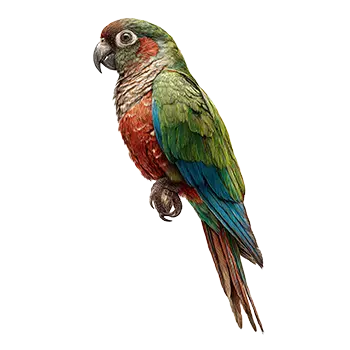
The overall plumage is predominantly green, with the upperparts displaying a rich, dark grass-green that extends across the mantle, back, rump, and upper wing coverts. The crown is dark brownish-green, and a narrow rufous to dark maroon frontal band sits just above the pale yellowish-white cere. Greyish-brown ear coverts form a noticeable patch on each side of the head, contributing to the alternate common name Brown-eared Conure. The feathers of the breast, throat, and sides of the neck are olive to brownish-green with pale yellow margins and dark olive-brown tips, producing the distinctive scalloped or barred pattern that gives rise to the name Scaly-breasted Conure.

The feature that defines this species in common parlance is the variable maroon patch on the central abdomen, which ranges from a subtle brownish-red wash to a well-defined deep maroon blaze depending on the individual and subspecies. The undertail coverts are also maroon, and the upper tail surface in the nominate subspecies is green with variable dull red tipping, though the chiripepe subspecies shows a more olive-toned tail without red. The primary flight feathers are blue on the outer webs, green on the inner webs, and tipped with dark grey, creating a flash of blue visible in flight. The undersides of the flight and tail feathers reveal a striking combination of blue, purple, and crimson tones that is only visible when the wings are spread or the bird is viewed from below.

The beak is dark grey to black and relatively small but strong, well suited to cracking small seeds and manipulating food items. The eyes are dark brown with a prominent bare greyish-white periorbital ring that gives the face an expressive quality. The legs and feet are dark grey with zygodactyl toes providing excellent grip for climbing and perching on branches. Juvenile birds closely resemble adults but may show slightly duller plumage overall, a less defined belly patch, and a narrower frontal band that becomes more distinct as the bird matures through its first year.

Affection Level
Maroon Bellied Conures are among the most affectionate members of the Pyrrhura genus. They actively seek physical contact with their owners, frequently nestling against the neck, burrowing under clothing, or lying on their backs in a trusted person's hand. Unlike many parrot species that tolerate touch on their terms alone, these conures often initiate cuddling and seem to genuinely crave close physical contact throughout the day.
Sociability
These conures are naturally flock-oriented birds that transfer their social instincts readily to a human household. They generally accept multiple family members rather than bonding exclusively to one person, though they may still show a mild preference. Early and consistent handling by different people helps reinforce their naturally gregarious temperament and reduces the risk of one-person bonding.
Vocalization
One of the quietest conure species available in aviculture, the Maroon Bellied Conure produces soft chattering, gentle whistles, and occasional contact calls that are far less piercing than those of sun conures or jenday conures. While they may vocalize more during morning and evening hours, their overall noise output is well suited to apartment living and shared-wall housing.
Intelligence
Maroon Bellied Conures are clever and curious birds that enjoy puzzle toys, foraging challenges, and learning simple tricks. While they do not match the cognitive feats of larger parrots such as African Greys or macaws, they demonstrate solid problem-solving abilities and can learn sequences of behaviors with patient, positive reinforcement training. Their intelligence is best expressed through play and exploration.
Exercise Needs
These active small parrots benefit from at least two to three hours of supervised out-of-cage time daily. They enjoy climbing, swinging, and investigating their surroundings. Providing a play gym or tree stand outside the cage encourages healthy physical activity. While they are not as demanding as larger parrots, regular exercise prevents obesity and supports overall well-being.
Maintenance Level
Compared to larger parrot species, Maroon Bellied Conures are moderately demanding in terms of daily upkeep. Cage cleaning, fresh food preparation, and water changes are daily necessities, while full cage disinfection should occur weekly. They produce less dust and dander than cockatoos or African Greys, but their tendency to dip food in water creates a need for frequent water bowl replacement.
Trainability
These conures respond well to positive reinforcement and can learn step-up commands, simple tricks, and target training with relative ease. Their naturally trusting and food-motivated disposition makes training sessions productive, though their attention span is shorter than that of larger parrot species. Brief, consistent daily sessions of five to ten minutes yield the best results.
Independence
Maroon Bellied Conures enjoy companionship but can entertain themselves with toys and foraging activities for moderate stretches when their owners are occupied. They are less prone to separation anxiety than cockatoos or African Greys, though prolonged neglect will still lead to behavioral issues. Households where someone is present for part of the day provide an ideal balance for this species.

Natural Habitat & Range

The Maroon Bellied Conure is native to southeastern South America, with a range stretching from southeastern Brazil through eastern Paraguay and northeastern Argentina into Uruguay. Within Brazil, the species is found primarily in the Atlantic Forest region, spanning the states of Bahia, Minas Gerais, Espirito Santo, Rio de Janeiro, Sao Paulo, Parana, Santa Catarina, and Rio Grande do Sul. The chiripepe subspecies extends the range southward and westward into Misiones Province in Argentina and eastern Paraguay, with occasional records from far-eastern Bolivia, though its presence there remains unconfirmed by some authorities.

These conures inhabit a variety of forested environments, showing a preference for subtropical and tropical moist forest, forest edges, and secondary growth woodland. They are frequently encountered in Araucaria pine forests in southern Brazil, where the seeds of the Parana pine (Araucaria angustifolia) form an important seasonal food source. They also occupy gallery forests along waterways, agricultural margins with remnant tree cover, and increasingly, parks and gardens in urban and suburban areas where mature trees provide adequate food and nesting resources.

In the wild, Maroon Bellied Conures are gregarious birds that typically move through the forest in small flocks of six to twelve individuals, though larger aggregations of up to forty birds have been observed at abundant food sources or communal roosting sites. They are arboreal and spend the majority of their active hours in the canopy and mid-story of the forest, descending to lower levels primarily to forage. Their flight is swift and direct, with rapid wingbeats and a characteristic chattering contact call that helps flock members maintain cohesion as they travel between feeding and roosting areas.

The conservation status of the Maroon Bellied Conure is currently assessed as Least Concern by the International Union for Conservation of Nature. The species remains relatively common throughout much of its range, and its adaptability to degraded and fragmented habitats has helped buffer it against the extensive deforestation that has impacted the Atlantic Forest biome. However, the species is listed on CITES Appendix II, regulating international trade. Historical trade records show that tens of thousands of individuals were exported in the decades following the species' listing in 1981, though trade volumes have declined substantially as captive breeding has reduced demand for wild-caught birds.

Temperament

The Maroon Bellied Conure has earned a well-deserved reputation as one of the gentlest and most agreeable companion parrots available in aviculture. Their temperament is frequently described as affectionate, playful, and remarkably easygoing, particularly when compared to the more demanding or high-strung personality profiles of some larger parrot species. These qualities, combined with their manageable size and relatively modest noise output, have made them a favorite among both first-time bird owners and experienced aviculturists seeking a companionable smaller parrot.

One of the most endearing behavioral traits of this species is their strong inclination toward physical affection. Well-socialized Maroon Bellied Conures actively seek out contact with their owners, snuggling against the neck, burrowing into shirt collars, or resting contentedly in a cupped hand. Many individuals enjoy being held on their backs, a position that would be stressful for most parrot species but appears to be genuinely comfortable for these trusting birds. This willingness to engage in close physical contact makes them exceptionally rewarding companions for owners who value hands-on interaction with their pets.

Socially, these conures tend to be more accepting of multiple household members than many parrot species that develop strong single-person bonds. While individual preferences certainly exist, and some birds may favor one person above others, they generally do not display the aggressive territorial behavior toward non-preferred people that can be problematic in species like Amazon parrots or cockatoos. Their flock-oriented nature translates well to a household setting, and they often integrate smoothly into families with multiple adults and responsible older children.

Playfulness is another hallmark of the Maroon Bellied Conure personality. These birds are naturally curious and entertaining, engaging in acrobatic antics on play gyms, wrestling with foot toys, and inventing games with household objects. They have a mischievous streak that manifests in behaviors like hiding under blankets, hanging upside down from perches, and investigating anything new in their environment. This blend of gentle affection and spirited playfulness gives them a personality that many owners describe as having all the charm of a larger parrot compressed into a much more manageable package.

Care Requirements

Housing a Maroon Bellied Conure properly begins with selecting an appropriately sized cage. The minimum recommended cage dimensions are 24 inches long by 24 inches wide by 30 inches tall, though a larger enclosure is always preferable for a bird that will spend significant time inside it. Bar spacing should be no wider than half an inch to three-quarters of an inch to prevent the bird from getting its head caught between bars. The cage should be constructed of powder-coated or stainless steel and positioned in a social area of the home where the bird can observe and participate in household activities without being exposed to drafts, direct sunlight for extended periods, or kitchen fumes.

Inside the cage, provide a variety of perches made from natural wood branches of varying diameters to promote healthy foot condition. Rope perches, concrete conditioning perches for nail maintenance, and at least one comfortable sleeping perch positioned high in the cage round out the perching options. Toys are essential and should include a mix of shreddable materials such as palm leaf or balsa wood, foraging toys that require the bird to work for food rewards, and sturdy acrylic or stainless steel toys for more vigorous chewing and manipulation. Toy rotation every few days prevents boredom and keeps the environment stimulating.

Out-of-cage time is a non-negotiable component of daily care. Maroon Bellied Conures should receive a minimum of two to three hours of supervised time outside the cage each day, ideally on a dedicated play stand or gym equipped with additional toys and foraging stations. This time allows for physical exercise, social bonding, and the mental stimulation that cannot be replicated inside even the most well-appointed cage. The play area should be in a bird-safe room where potential hazards such as ceiling fans, open water, toxic houseplants, exposed electrical cords, and accessible windows or mirrors have been addressed.

Bathing is an important element of routine care that many Maroon Bellied Conures actively enjoy. In the wild, these birds bathe by spreading their wings in rainfall, and captive birds often appreciate a daily misting with a clean spray bottle of lukewarm water or access to a shallow ceramic dish for splashing. Regular bathing supports feather condition, reduces dust, and provides behavioral enrichment. Temperature management is also a consideration, as these subtropical birds should not be exposed to ambient temperatures below 60 degrees Fahrenheit for prolonged periods, and sudden temperature fluctuations should be avoided.

Feeding & Nutrition

A well-balanced diet is fundamental to the long-term health of the Maroon Bellied Conure, and modern avian nutrition emphasizes a pellet-based approach supplemented with fresh whole foods. High-quality formulated pellets designed for small parrots should constitute approximately 60 to 70 percent of the daily diet, providing a consistent and complete nutritional foundation that seed-based diets cannot match. Pellets eliminate the selective eating that often occurs with seed mixes, where birds pick out preferred high-fat seeds and discard more nutritious components.

Fresh vegetables should be offered daily and represent the most important supplementary food category. Dark leafy greens such as kale, Swiss chard, dandelion greens, and spinach provide vitamins A and K along with calcium and other essential minerals. Chopped carrots, bell peppers, broccoli, snap peas, cooked sweet potato, and squash add variety and additional nutrient density. Vegetables rich in vitamin K are particularly important for this species, as Pyrrhura conures are known to be susceptible to conure bleeding syndrome, a condition associated with vitamin K deficiency that can cause spontaneous and potentially fatal hemorrhaging.

Fresh fruits should be offered in moderation due to their sugar content, typically comprising no more than 10 to 15 percent of the daily food intake. Berries, apple slices, grapes, banana, mango, and papaya are well accepted by most individuals. Treats such as small amounts of unsalted nuts, cooked whole grains, cooked legumes, and hard-boiled egg can be offered occasionally for variety and as training rewards. Maroon Bellied Conures are noted for their willingness to try new foods, which makes dietary management somewhat easier than with more neophobic parrot species.

Certain foods must be strictly avoided. Avocado, chocolate, caffeine, alcohol, onion, garlic, and fruit pits or seeds containing cyanogenic compounds are all toxic to parrots. A cuttlebone or mineral block should be available in the cage at all times to provide supplemental calcium. Clean, fresh water must be provided daily and changed whenever it becomes soiled, which is frequently, as these conures have a well-documented habit of dunking food morsels into their water dish before eating them.

Maroon Bellied Conure Health & Lifespan

With attentive care and proper husbandry, Maroon Bellied Conures are considered hardy and resilient birds that commonly live 20 to 30 years in captivity. Some well-cared-for individuals have been reported to exceed 30 years, making ownership a substantial long-term commitment that should not be entered into lightly. The species does not carry a heavy burden of breed-specific genetic diseases, and the majority of health problems encountered in captive Maroon Bellied Conures are related to husbandry shortcomings rather than inherent vulnerabilities.

Conure bleeding syndrome is the single most significant species-relevant health concern for Maroon Bellied Conures and other members of the Pyrrhura genus. This condition involves episodes of spontaneous bleeding from the nostrils, mouth, cloaca, or beneath the skin, and it is linked to deficiencies in vitamin K and related clotting factors. The condition can progress rapidly from minor bruising to life-threatening hemorrhage if not recognized and treated promptly. Ensuring adequate dietary vitamin K through green vegetables and, when recommended by a veterinarian, targeted supplementation is the primary preventive measure.

Respiratory infections, both bacterial and fungal, represent another category of health risk. Aspergillosis, caused by inhalation of Aspergillus mold spores, is a particular concern in environments where ventilation is poor or bedding materials become damp and contaminated. Maintaining clean, dry cage conditions with good air circulation substantially reduces this risk. Psittacosis, a bacterial infection with zoonotic potential, can be contracted from infected birds or contaminated environments and requires antibiotic treatment under veterinary supervision.

Regular wellness examinations with a veterinarian experienced in avian medicine are essential for maintaining health over the bird's long lifespan. Annual visits should include a thorough physical examination, fecal parasite screening, and baseline blood work including a complete blood count and biochemistry panel. Because birds are adept at concealing signs of illness as a survival instinct inherited from their wild ancestors, subtle changes in weight, droppings, appetite, or behavior should prompt an immediate veterinary consultation rather than a wait-and-see approach.

Common Health Issues

  • Conure Bleeding Syndrome - A condition linked to vitamin K deficiency that causes spontaneous bleeding episodes. Maroon Bellied Conures and other Pyrrhura species appear particularly susceptible. Symptoms include bleeding from the nostrils, mouth, or under the skin, and the condition can become life-threatening without prompt veterinary intervention and dietary correction.
  • Psittacosis - A bacterial infection caused by Chlamydia psittaci that can affect Maroon Bellied Conures, particularly those under stress or housed in crowded conditions. Symptoms include lethargy, nasal discharge, and respiratory difficulty. The infection is zoonotic and can be transmitted to humans, making early diagnosis and treatment with appropriate antibiotics essential.
  • Proventricular Dilatation Disease - A viral condition caused by avian bornavirus that affects the nerves supplying the gastrointestinal tract. Affected birds may show weight loss despite a normal appetite, regurgitation, and undigested food in droppings. Diagnosis requires specialized testing, and while there is no cure, supportive care and anti-inflammatory treatment can manage symptoms.
  • Feather Destructive Behavior - Though less common in Pyrrhura conures than in some other parrot genera, feather plucking can develop in Maroon Bellied Conures subjected to chronic stress, boredom, or inadequate social interaction. Underlying medical causes such as skin infections or hormonal imbalances should be ruled out before attributing the behavior to psychological factors.
  • Aspergillosis - A fungal respiratory infection caused by Aspergillus mold spores that thrive in damp, poorly ventilated environments. Maroon Bellied Conures housed in areas with stale air or moldy bedding material are at increased risk. Symptoms include labored breathing, tail bobbing, and lethargy, and treatment typically requires prolonged antifungal therapy.

Preventive Care & Health Monitoring

  • Annual Avian Veterinary Examinations - Routine wellness visits with a veterinarian experienced in avian medicine allow for early detection of developing health issues through physical examination, fecal analysis, and blood work. Birds are skilled at masking illness, making proactive veterinary monitoring essential for long-term health.
  • Vitamin K Supplementation and Diet Management - Because Pyrrhura conures are susceptible to conure bleeding syndrome, ensuring adequate vitamin K intake through leafy greens such as kale, broccoli, and spinach is critical. However, foods excessively high in vitamin K should be rotated rather than fed daily, and any dietary supplementation should be discussed with an avian veterinarian.
  • Balanced Pellet-Based Nutrition - A high-quality pelleted diet formulated for small parrots should comprise the foundation of the daily food offering, supplemented with fresh vegetables, limited fruits, and occasional healthy treats. Seed-heavy diets contribute to obesity, fatty liver disease, and nutritional deficiencies and should be avoided as a primary food source.
  • Environmental Enrichment and Mental Stimulation - Providing a rotating selection of foraging toys, shreddable materials, puzzle feeders, and climbing structures prevents boredom-related behavioral problems. Maroon Bellied Conures are naturally curious and active, and mental stimulation is as important to their well-being as proper nutrition.
  • Hygiene and Cage Maintenance - Daily removal of soiled cage liner, washing of food and water dishes, and weekly deep cleaning of the cage and perches reduce the risk of bacterial and fungal infections. These conures enjoy bathing, and regular misting or access to a shallow water dish supports feather health and hygiene.
  • Full-Spectrum Lighting - Providing access to full-spectrum UV lighting or supervised exposure to natural unfiltered sunlight supports vitamin D3 synthesis and calcium metabolism. Birds housed exclusively indoors without UV light supplementation may develop deficiencies that affect bone density and overall metabolic health over time.

Training & Vocalization

Maroon Bellied Conures are receptive and willing training subjects that respond best to positive reinforcement methods. Clicker training, where a small mechanical clicker marks the desired behavior at the precise moment it occurs and is immediately followed by a food reward, is highly effective with this species. Basic commands such as step up, step down, and station (going to a designated perch) can typically be taught within the first few weeks of consistent daily training sessions. More advanced tricks including wave, turn around, retrieve, and flight recall are well within the capabilities of a motivated Maroon Bellied Conure working with a patient trainer.

Training sessions should be kept short, ideally five to ten minutes per session, as these small birds have limited attention spans and can become frustrated or disinterested during prolonged sessions. Multiple short sessions spread throughout the day are more productive than a single lengthy one. The training environment should be free of distractions, and the bird should be slightly hungry, having not eaten immediately before the session, to ensure food rewards retain their motivational value. Favored treats such as small sunflower seed kernels, millet spray fragments, or tiny pieces of nut work well as high-value rewards.

In terms of vocalization, the Maroon Bellied Conure is recognized as one of the quieter conure species, a quality that contributes significantly to its popularity as a pet bird. Their natural vocalizations include soft chattering, gentle whistling, and brief contact calls that are far less penetrating than the screams of sun conures, jenday conures, or nanday conures. While they may become vocal during the morning and evening hours, reflecting their wild behavior of calling at dawn and dusk, the volume and duration are generally manageable and rarely generate complaints in multi-unit housing situations.

Talking ability in this species is limited compared to renowned talkers like African Greys or budgerigars. Some individuals learn to mimic a small repertoire of words and short phrases, though the clarity is typically moderate and the vocabulary small. Whistled tunes are often learned more readily than spoken words. Owners should appreciate these conures for their charm, personality, and companionship rather than selecting them with the expectation of extensive verbal mimicry.

Children & Other Pets

The Maroon Bellied Conure's gentle and forgiving temperament makes it one of the better small parrot choices for households with children, provided that interactions are properly supervised and children are taught respectful handling techniques. These conures are less likely to bite defensively than many parrot species, and their small beak, while capable of delivering a pinch, is far less likely to cause serious injury than the beak of a larger parrot. However, young children should never be left unsupervised with any bird, as even well-intentioned but clumsy handling can injure a small parrot or provoke a defensive bite.

Children old enough to understand and follow handling guidelines, generally age seven and older, can develop wonderful bonds with Maroon Bellied Conures. Teaching children to approach the bird calmly, offer a hand for stepping up rather than grabbing, and recognize signs that the bird wants to be left alone builds a foundation for a safe and rewarding interspecies relationship. Involving children in age-appropriate aspects of daily care, such as helping prepare fresh food or refilling water dishes, fosters a sense of responsibility and strengthens the bond between child and bird.

Regarding other household pets, caution and common sense are essential. Maroon Bellied Conures should never be left unsupervised with cats or dogs, regardless of how trustworthy the mammalian pet may appear. Predatory instincts can be triggered without warning, and even a playful swat from a cat or an overly enthusiastic nudge from a dog can injure or kill a small bird. If cats and dogs share the home, the bird's cage should be positioned in a location where it cannot be accessed by four-legged pets, and out-of-cage time should occur in rooms where other animals have been excluded.

Cohabitation with other birds requires careful consideration of species compatibility, individual temperament, and adequate space. Maroon Bellied Conures generally coexist well with other Pyrrhura conures of similar size and temperament, and in spacious aviary settings, they can be maintained in pairs or small groups. Introducing them to birds of different genera or significantly different sizes should be approached cautiously, with a lengthy supervised introduction period and the ability to separate birds immediately if aggression occurs. Housing them with larger, more dominant parrot species is not recommended, as the gentle Maroon Bellied Conure is likely to be bullied or injured.