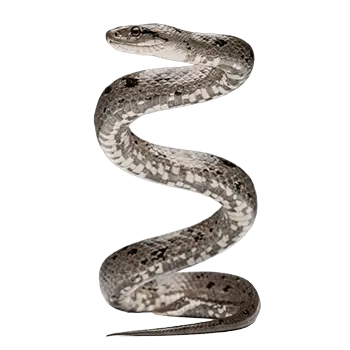

Origins & Discovery

The Gray Rat Snake (Pantherophis spiloides) is a large, non-venomous colubrid native to the eastern and central United States. Its range stretches from southwestern New England and the mid-Atlantic states southward through the Piedmont and Appalachian regions, westward across the Ohio River Valley, and into portions of the upper Gulf Coast. Within this broad territory the species occupies a striking variety of habitats, from dense hardwood forests and rocky hillsides to agricultural bottomlands, old-growth river bluffs, and the rafters of rural outbuildings. This ecological versatility has made it one of the most commonly encountered large snakes across much of its range and has ensured centuries of close interaction with human communities.

Western scientific recognition of the Gray Rat Snake emerged during the great wave of North American natural history cataloging in the eighteenth and nineteenth centuries. Early naturalists working in the colonies and the young republic documented a bewildering diversity of serpents across the eastern forests, and the large, boldly patterned rat snakes attracted particular attention. The species was originally described under the broad umbrella of Elaphe obsoleta, a taxonomic designation that for many decades encompassed several related rat snake forms across eastern North America, including the Black Rat Snake, the Yellow Rat Snake, and the Texas Rat Snake. Distinguishing among these closely related populations proved to be one of the more persistent challenges in North American herpetological taxonomy.

The Gray Rat Snake as a distinct entity was recognized on the basis of its characteristic coloration and pattern: a ground color of light gray to pale brown overlaid with darker gray or brownish blotches that remain distinct throughout the animal's life, unlike the Black Rat Snake populations to the north and east that typically darken to near-uniform black as adults. These pattern differences, combined with geographic separation and subtle differences in scalation, led early twentieth-century taxonomists to designate the Gray Rat Snake as a subspecies, Elaphe obsoleta spiloides, a classification that persisted for most of the twentieth century.

The taxonomic history of the Gray Rat Snake underwent a major revision in the early twenty-first century when molecular phylogenetic studies demonstrated that the North American rat snakes previously grouped under Elaphe were not closely related to the Eurasian species that anchored that genus. This led to the transfer of North American rat snakes to the genus Pantherophis. Further genetic work revealed that the traditional subspecies of the obsoleta complex represented distinct evolutionary lineages that warranted recognition as full species, resulting in the current accepted name Pantherophis spiloides for the Gray Rat Snake. This reclassification reflected advances in molecular systematics and resolved longstanding questions about the evolutionary relationships within this group.

Indigenous Knowledge & Historical Roles

Long before European naturalists began cataloging the reptile fauna of eastern North America, indigenous peoples across the Gray Rat Snake's range possessed detailed and practical knowledge of the species and its relatives. For the Cherokee, Creek, Choctaw, Shawnee, and other nations whose territories overlapped with the snake's distribution, large rat snakes were familiar inhabitants of the same forests, river valleys, and agricultural clearings that sustained human communities. This proximity generated a body of ecological understanding that was transmitted orally across generations and embedded in cultural practices, seasonal observations, and land management strategies.

Indigenous knowledge of rat snakes was fundamentally practical in orientation. Communities that cultivated corn, beans, squash, and other crops recognized the role that large constrictors played in controlling populations of rodents and other small mammals that could damage stored food and growing plants. A rat snake discovered in or near a granary or food cache was generally understood to be performing a beneficial function, and many communities tolerated or even encouraged the presence of these snakes in agricultural areas. This utilitarian relationship predated by millennia the modern concept of integrated pest management, reflecting a sophisticated understanding of trophic relationships within local ecosystems.

Beyond practical considerations, serpents occupied significant symbolic positions in the cosmologies and oral traditions of many eastern North American indigenous nations. Snakes were frequently associated with water, the underworld, transformation, and healing. The Uktena, a powerful horned serpent figure in Cherokee tradition, exemplifies the complex and multilayered role that serpent imagery played in southeastern indigenous thought. While the Uktena was not a direct representation of any single biological species, the pervasive presence of large snakes such as the Gray Rat Snake in the Cherokee homeland provided a living, tangible connection to the serpent symbolism that permeated spiritual and ceremonial life.

The arrival of European settlers disrupted many of these long-established relationships between indigenous communities and their local wildlife. As indigenous nations were displaced from their ancestral territories through forced removal and the encroachment of colonial settlement, the accumulated ecological knowledge that had governed human interactions with species like the Gray Rat Snake was fragmented and in many cases lost. Contemporary efforts by indigenous scholars and cultural practitioners to recover and document traditional ecological knowledge have begun to reconstruct some of this understanding, but the full depth of pre-contact indigenous relationships with the herpetofauna of eastern North America will likely never be completely recovered.

Cultural Symbolism & Folklore

The Gray Rat Snake and its close relatives have figured prominently in the folk traditions of rural communities across the eastern United States for centuries. In the Appalachian region, where the species is particularly abundant and where human settlement patterns historically placed farming families in close daily contact with local wildlife, a rich body of snake lore developed around rat snakes and their habits. Much of this folklore reflects the ambivalent relationship that agrarian communities maintained with large snakes: an appreciation of their rodent-controlling abilities tempered by the visceral unease that many people feel in the presence of serpents.

One of the most widespread folk beliefs associated with rat snakes in the rural South and Appalachia was the idea of the chicken snake, a term applied broadly to rat snakes because of their well-documented habit of entering henhouses to consume eggs and occasionally small chicks. The chicken snake occupied a distinctive cultural niche as a creature that was simultaneously useful, for its appetite for the mice and rats that infested barns and corncribs, and destructive, for its raids on poultry nests. This duality gave rise to vigorous debates within farming communities about whether rat snakes should be tolerated, relocated, or killed, debates that in some families and communities have continued across multiple generations and that foreshadow contemporary discussions about human-wildlife coexistence.

Folk beliefs about rat snake behavior extended well beyond the practical and into the realm of superstition and myth. In parts of the rural South, rat snakes were sometimes credited with the ability to hypnotize their prey, to charm birds from the air, or to milk cows by coiling around a leg and nursing directly from the udder. The cow-milking snake is one of the most persistent and widespread snake myths in American folklore, documented across dozens of states and attributed to various species, but rat snakes, because of their size, their comfort in agricultural settings, and their frequent presence in barns, were among the most commonly named culprits. No scientific evidence supports the cow-milking myth, but its persistence across centuries testifies to the powerful hold that snake-related folklore maintains on the rural American imagination.

The cultural symbolism of the Gray Rat Snake has evolved as American society has become increasingly urbanized. For many contemporary Americans, encounters with large rat snakes have shifted from the quotidian experience of farm life to novel and sometimes startling events that occur when suburban development encroaches on the snake's habitat. A Gray Rat Snake discovered in an attic, garage, or garden in a suburban neighborhood can generate considerable local excitement, and the social media age has amplified these encounters, turning individual snake sightings into widely shared events that spark community discussions about wildlife tolerance, the value of non-venomous snakes, and the importance of accurate species identification.

Scientific Classification & Taxonomic Debates

The taxonomic history of the Gray Rat Snake is one of the more intricate and instructive case studies in North American herpetology, illustrating the ways in which advances in technology and analytical methods can reshape scientific understanding of species boundaries and evolutionary relationships. For most of the twentieth century, the Gray Rat Snake was classified as Elaphe obsoleta spiloides, one of several subspecies within a broadly defined rat snake complex that spanned the eastern half of the continent. This arrangement, while practical for field identification, masked significant evolutionary divergence among the constituent populations.

The subspecies framework that governed rat snake taxonomy for decades was based primarily on morphological criteria: pattern, coloration, scalation, and geographic range. Under this system, the Gray Rat Snake was distinguished from the Black Rat Snake (E. o. obsoleta), the Yellow Rat Snake (E. o. quadrivittata), the Everglades Rat Snake (E. o. rossalleni), and the Texas Rat Snake (E. o. lindheimeri) on the basis of its persistent gray blotched pattern and its distribution through the central portion of the complex's range. Intergradation zones, where populations exhibiting intermediate characteristics were found, were interpreted as evidence that these forms represented subspecies of a single biological species rather than distinct species in their own right.

The revolution in molecular systematics that transformed biological taxonomy beginning in the late twentieth century brought profound changes to rat snake classification. Phylogenetic analyses using mitochondrial DNA sequences, published in a series of influential studies in the early 2000s, demonstrated that the North American rat snakes assigned to Elaphe were not closely related to the type species of that genus, which is a Eurasian taxon. This finding necessitated the transfer of the North American species to Pantherophis, a genus that had been erected in the nineteenth century but had fallen into disuse. The resulting nomenclatural shift, while scientifically well supported, generated considerable discussion within both the academic herpetological community and the broader reptile-keeping world, where the familiar name Elaphe had been in use for generations.

Subsequent molecular work went further, demonstrating that the traditional subspecies of the obsoleta complex represented at least three distinct evolutionary lineages that had diverged sufficiently to warrant recognition as full species. Under the revised taxonomy, the Gray Rat Snake became Pantherophis spiloides, the Black Rat Snake became Pantherophis alleghaniensis, and the western populations were assigned to Pantherophis obsoletus in a more restricted sense. This reclassification remains accepted by the Society for the Study of Amphibians and Reptiles and most major taxonomic authorities, though some researchers continue to investigate the fine-scale population genetics of the complex, particularly in areas where the ranges of the newly recognized species overlap and hybridization occurs.

The Herpetoculture Movement

The Gray Rat Snake has been a fixture of the North American herpetoculture community since the earliest days of organized reptile keeping in the United States. Its large size, generally tractable temperament, hardiness in captivity, and widespread availability in the wild made it one of the first snake species that aspiring herpetologists and hobbyists were likely to encounter and attempt to maintain. For generations of American reptile enthusiasts, a wild-caught Gray Rat Snake or one of its close relatives served as an introduction to the art and science of snake keeping, providing hands-on experience with feeding, housing, thermoregulation, and the behavioral observation of a captive reptile.

During the formative decades of American herpetoculture in the 1960s and 1970s, rat snakes of the obsoleta complex were among the most commonly kept and bred species. Herpetological societies that formed in cities and towns across the eastern United States frequently featured rat snakes in their educational programs and public demonstrations, and the animals became ambassadors for the broader message that snakes were worthy of study, respect, and conservation rather than reflexive fear and persecution. The Gray Rat Snake's willingness to tolerate handling, combined with its impressive but manageable adult size, made it particularly effective in this educational role.

The captive breeding of Gray Rat Snakes accelerated during the 1980s and 1990s as the herpetoculture hobby grew in sophistication and commercial scale. Breeders began selecting for specific traits, producing animals with enhanced contrast, unusual color tones, and other aesthetic variations that commanded premium prices in the growing reptile marketplace. While the Gray Rat Snake never achieved the explosive popularity of the Ball Python or the Corn Snake in the designer morph market, a modest but dedicated community of breeders worked with the species, producing leucistic, hypomelanistic, and other variant animals that demonstrated the genetic diversity latent within the species.

The herpetoculture community's relationship with the Gray Rat Snake has matured in the twenty-first century as the hobby has increasingly emphasized captive-bred animals over wild-caught specimens, responsible husbandry practices, and engagement with conservation issues. Modern keepers benefit from decades of accumulated knowledge about the species' dietary preferences, thermal requirements, reproductive biology, and common health concerns, information that has been documented in care guides, forum archives, and specialty publications. The Gray Rat Snake remains a recommended species for intermediate-level keepers who want the experience of working with a large colubrid without the extreme space and safety considerations associated with giant constrictors.

The Species Today

Today the Gray Rat Snake occupies a position of relative ecological security compared to many reptile species worldwide, but its long-term prospects are shaped by a complex interplay of habitat change, human attitudes, and regulatory frameworks. Across much of its range, the species remains common and is not considered threatened at the federal level. Its adaptability to disturbed and semi-urban habitats, its generalist diet, and its tolerance for a range of environmental conditions have allowed it to persist in landscapes that have been heavily modified by human activity, from fragmented woodlots and agricultural margins to suburban greenbelts and park systems.

Despite this overall resilience, localized population declines have been documented in areas where habitat fragmentation has become severe, where road mortality is high, or where persistent persecution by humans has reduced snake numbers below sustainable levels. The Gray Rat Snake's habit of basking on roads, its tendency to seek shelter in human structures, and its conspicuous size all increase its vulnerability to direct killing by people who fear or dislike snakes. Education efforts by wildlife agencies, herpetological societies, and conservation organizations have made significant progress in shifting public attitudes, but the cultural legacy of anti-snake sentiment in many rural communities remains a factor in the species' local conservation status.

The Gray Rat Snake's role as a natural pest control agent has gained renewed attention in recent years as concerns about rodent-borne diseases, agricultural losses to rodent damage, and the environmental costs of chemical rodenticides have grown. Research documenting the volume of rodents consumed by rat snake populations in agricultural and suburban settings has provided quantitative support for the long-standing folk understanding that these snakes provide a valuable ecological service. This ecosystem-services framing has proven effective in conservation messaging, providing a concrete and economically meaningful argument for snake tolerance that complements more abstract appeals to biodiversity and ecological integrity.

Looking ahead, the Gray Rat Snake's future will be influenced by the same large-scale environmental changes that affect wildlife populations across eastern North America. Climate change is expected to alter the species' range boundaries, potentially expanding suitable habitat to the north while shifting conditions in the southern portions of its range. Continued urbanization and infrastructure development will create new challenges for snake populations in suburban interface zones, while also generating new opportunities for public engagement and education as more people encounter these impressive animals in their daily lives. The species' long history of coexistence with human communities, its demonstrated ecological value, and its growing profile in conservation education suggest that the Gray Rat Snake will continue to be one of the most visible and culturally significant snakes in North America for generations to come.

Always consult a qualified professional before making any health-related decisions. This content is provided for informational reference only and should not replace professional guidance specific to your animal.