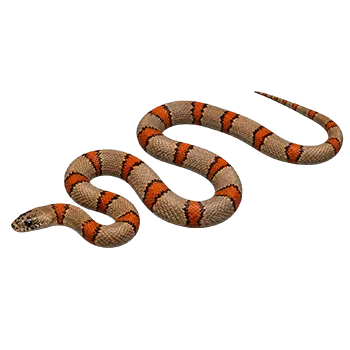

The Gray-Banded Kingsnake (Lampropeltis alterna) is a small, secretive colubrid native to the arid limestone canyons and rocky outcrops of the Trans-Pecos region of western Texas and adjacent areas of northern Mexico, principally the states of Coahuila, Nuevo Leon, and Durango. The species inhabits a harsh and dramatic landscape defined by the Chihuahuan Desert, where rugged mountain ranges rise from vast expanses of desert scrub and deep limestone canyons channel seasonal rains through otherwise parched terrain. Within this environment the Gray-Banded Kingsnake occupies a narrow ecological niche, sheltering by day in rock crevices and emerging at night to hunt lizards and small rodents along canyon floors and roadside cuts through mountainous terrain.
The species was first described by the American herpetologist Arthur Erwin Brown in 1901 from a specimen collected in the Davis Mountains of Jeff Davis County, Texas. Brown assigned it to the genus Lampropeltis, recognizing its kinship with the broader kingsnake group, and gave it the specific epithet alterna in reference to the alternating pattern of bands along the body. The original description was based on limited material, and for decades the species remained poorly understood, with only a handful of specimens available for study in museum collections. Its nocturnal habits, low population densities, and preference for remote and difficult terrain meant that encounters between this snake and human observers were infrequent and largely accidental.
For much of the early twentieth century the Gray-Banded Kingsnake existed at the margins of herpetological knowledge. Few field biologists worked in the Trans-Pecos during this period, and those who did focused primarily on the region's more conspicuous fauna. The snake was occasionally encountered by ranchers, miners, and highway workers, but these observations rarely entered the scientific literature. It was not until the mid-twentieth century, when improved road networks through the Trans-Pecos made the region more accessible and a new generation of field herpetologists began systematic surveys of its reptile fauna, that the Gray-Banded Kingsnake began to emerge from obscurity.
The remoteness of the species' habitat and the difficulty of locating specimens in the wild contributed to an aura of mystery that would prove central to the Gray-Banded Kingsnake's eventual cultural significance within the herpetological community. Unlike common species that could be found in suburban backyards or agricultural fields, this was a snake that demanded effort, patience, and a willingness to spend long nights driving remote desert roads in the hope of an encounter. That combination of scarcity and difficulty of access laid the foundation for the intense interest that would develop around the species in the decades to come.