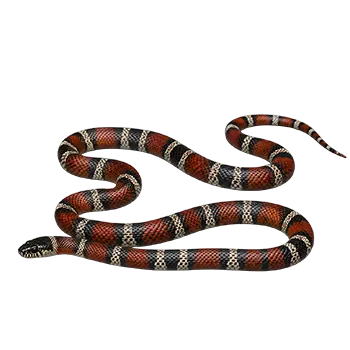

The Eastern Milk Snake is not listed under the United States Endangered Species Act and does not appear on any federal list of threatened or endangered wildlife, a status that reflects the species' broad distribution and generally stable population across most of its range. This absence from federal endangered species protections means that the primary federal statute affecting the Eastern Milk Snake is the Lacey Act, which prohibits the interstate transport of wildlife taken in violation of state or foreign law. The Lacey Act does not independently regulate the collection or possession of milk snakes, but it creates a powerful enforcement mechanism by making it a federal offense to move an animal across state lines if that animal was obtained in a manner that violated the laws of the state where it was collected.
The practical significance of the Lacey Act for Eastern Milk Snake keepers and breeders lies in its amplification of state-level regulations. A person who collects a milk snake from the wild in a state where such collection requires a permit and then transports the animal to another state without having obtained the required permit has potentially committed a federal offense under the Lacey Act, even if the destination state has no restrictions on possession. This layered regulatory structure means that anyone involved in the collection, sale, or interstate transport of Eastern Milk Snakes must be aware of not only federal law but also the specific regulations of every state involved in the transaction.
The Lacey Act's provisions regarding interstate commerce in wildlife also have implications for the commercial reptile trade. Breeders and dealers who sell Eastern Milk Snakes across state lines must ensure that their operations comply with the laws of both the state of origin and the state of destination. While the Lacey Act is most frequently invoked in cases involving high-value wildlife or large-scale commercial operations, its provisions apply equally to individual hobbyists who sell or trade animals through online platforms, reptile expos, or informal networks.
The Convention on International Trade in Endangered Species of Wild Fauna and Flora, commonly known as CITES, does not currently list the Eastern Milk Snake or any member of the Lampropeltis genus in its appendices. This means that international trade in Eastern Milk Snakes is not subject to CITES permitting requirements, a distinction that simplifies cross-border transactions compared to species such as Ball Pythons or Boa Constrictors that are listed under CITES Appendix II. Nevertheless, individual countries may impose their own import and export restrictions on reptiles regardless of CITES status, and anyone contemplating international trade in milk snakes must research the specific requirements of both the exporting and importing nations.