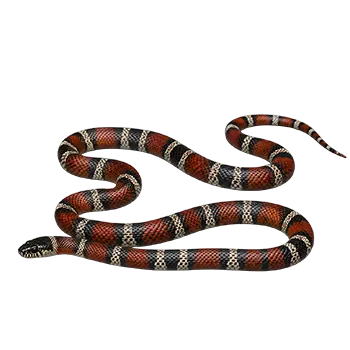

The Eastern Milk Snake (Lampropeltis triangulum triangulum) is a nonvenomous colubrid native to a broad swath of eastern North America, ranging from southern Quebec and Ontario southward through the northeastern and mid-Atlantic United States and into the Appalachian highlands. Its preferred habitats include rocky hillsides, agricultural fields, forest edges, and the margins of barns and outbuildings, a tendency that placed it in close and frequent contact with European settlers from the earliest days of colonial expansion into the interior of the continent. That proximity to human habitation would prove central to the species' cultural identity and its remarkably persistent association with dairy farming.
The species was formally described by the French-American naturalist Bernard Germain de Lacepede in 1788, though earlier naturalists had noted the presence of attractively banded snakes in the farmlands of the American colonies. Lacepede's description drew on specimens collected in the mid-Atlantic region, and the specific epithet triangulum referred to the distinctive dorsal blotches that, in their roughly triangular or saddle-shaped outline, became a key identifying characteristic for generations of field naturalists. The common name milk snake was already in wide colloquial use by the time formal taxonomy caught up with the animal, reflecting the deep roots of folk belief in the rural communities where the snake was most commonly encountered.
The Eastern Milk Snake represents the nominate subspecies of the broader Lampropeltis triangulum complex, a group that at various points in taxonomic history encompassed more than two dozen described subspecies ranging from Canada to Ecuador. The taxonomy of this complex has been extensively revised over the past several decades, with molecular phylogenetic studies prompting the elevation of many former subspecies to full species status. Despite these revisions, the Eastern Milk Snake has retained its place as the foundational member of the group, the population against which all other milk snake forms were historically compared and contrasted.
Early American naturalists recognized the Eastern Milk Snake as one of the most commonly encountered serpents in the rural landscapes of the Northeast and mid-Atlantic. Its habit of sheltering beneath flat rocks, rotting logs, boards, and the stone foundations of barns and springhouses made it a familiar presence to anyone who worked the land. This visibility, combined with its striking banded pattern of reddish-brown blotches bordered in black against a gray or tan ground color, ensured that it was among the first North American snake species to receive sustained attention from both popular culture and the emerging scientific discipline of herpetology.