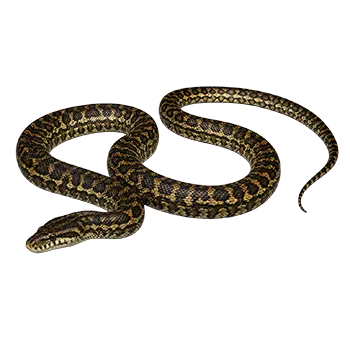

The Coastal Carpet Python's presence in published media began with the natural history accounts produced during the European exploration and colonization of eastern Australia. From the late eighteenth century onward, naturalists, surveyors, and colonial administrators included descriptions of large pythons in their journals, correspondence, and official reports, providing the earliest written accounts of the species for audiences outside Australia. These early texts, while often imprecise in their taxonomic distinctions and colored by the cultural assumptions of their authors, established the Carpet Python as one of the signature animals of the Australian eastern seaboard in the European imagination.
The illustrated natural history volumes of the nineteenth century brought the Carpet Python to a broader readership through detailed lithographic and engraved plates that depicted the snake alongside other elements of the Australian fauna. Publications such as John Gould's monumental works on Australian zoology and the plates produced for the publications of the Australian Museum featured representations of Carpet Pythons that, while sometimes stylized, conveyed the species' bold patterning and impressive proportions to readers who might never encounter the animal in life. These illustrations circulated widely through the scientific and popular libraries of Europe and North America, embedding the image of the patterned Australian python in the visual vocabulary of natural history.
During the early and middle twentieth century, Australian natural history writing matured into a distinctive literary tradition that gave the Carpet Python a more nuanced treatment. Authors such as David Fleay, Eric Worrell, and Vincent Serventy produced popular books and articles on Australian reptiles that combined personal field observation with accessible scientific commentary, introducing generations of Australian readers to the ecology and behavior of the Carpet Pythons they might encounter in their own neighborhoods. Eric Worrell's establishment of the Australian Reptile Park on the New South Wales Central Coast in 1958 created a physical institution dedicated to reptile education and conservation that would become a major source of media content featuring Carpet Pythons for decades to come.
The natural history publishing tradition continues to serve as an important medium for the Coastal Carpet Python today. Contemporary field guides, regional wildlife handbooks, and species-specific monographs provide detailed and scientifically current information on the subspecies, and several Australian publishers maintain active lists of reptile-focused titles that cater to both the general reader and the specialist herpetological audience. These publications, now often complemented by digital resources and online databases, ensure that accurate written and illustrated information about the Coastal Carpet Python remains accessible to a broad public.