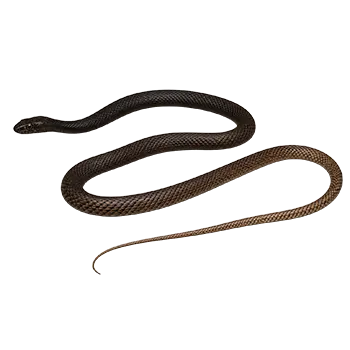

The Coachwhip (Masticophis flagellum) is a large, slender, non-venomous colubrid snake native to the southern half of the United States and extending into northern Mexico. Its range stretches from the coastal plains of the southeastern states westward through Texas and the arid Southwest, reaching into parts of California, Nevada, and Kansas. The species occupies an unusually broad spectrum of habitats, from pine flatwoods and longleaf pine savannas in the East to open desert scrub, grasslands, and rocky hillsides in the western portions of its range. This ecological flexibility has allowed the Coachwhip to maintain viable populations across a vast geographic area even as land use patterns have shifted dramatically over the past two centuries.
The species was formally described by George Shaw in 1802 under the name Coluber flagellum, a Latin epithet meaning whip, inspired by the distinctive braided or plaited appearance of the snake's tail scales. This scale pattern closely resembles the woven leather of a coachman's whip, and it gave the species both its scientific and common names. Shaw worked from specimens that had been collected in the American colonies and shipped to European natural history collections, part of the broader Enlightenment-era effort to catalog the biological diversity of the New World.
The taxonomic placement of the Coachwhip has undergone several revisions since Shaw's original description. For much of the twentieth century, the species was classified under the genus Masticophis, a name derived from the Greek words for whip and snake. More recent phylogenetic analyses have prompted some herpetologists to reclassify the species under the older genus Coluber, though this reassignment has not been universally adopted. Regardless of the genus name applied, the Coachwhip is recognized as a member of the family Colubridae, the largest and most diverse family of snakes in the world.
Several subspecies of the Coachwhip have been described over the years, reflecting the considerable geographic variation in color and pattern across the species' extensive range. The eastern form tends to be dark brown or black on the anterior portion of the body, gradually lightening to tan or cream toward the tail. Western populations may be uniformly tan, reddish, or pinkish, earning them the regional name red racer. The subspecific taxonomy remains a subject of ongoing research, with molecular studies continuing to refine the relationships among regional populations.