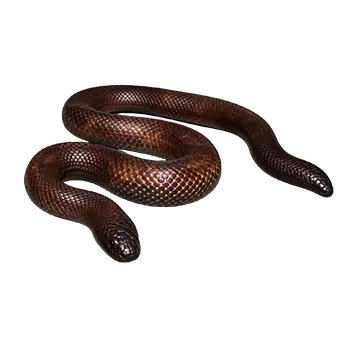

The Calabar Python's first appearances in Western media came through the natural history publications of the nineteenth century, where it featured as a subject of anatomical description and taxonomic debate rather than as a creature of popular fascination. Hermann Schlegel's original 1851 description introduced the species to the European scientific community, and subsequent decades saw the animal discussed in the monographs, museum catalogs, and herpetological journals that constituted the primary media of biological science during that era. These early written accounts focused heavily on morphology and classification, reflecting the priorities of an era in which the cataloging of global biodiversity was the central project of natural history.
By the late nineteenth and early twentieth centuries, the Calabar Python began to appear in broader natural history reference works aimed at educated general audiences. Encyclopedic treatments of the world's reptiles, such as those produced by George Albert Boulenger for the British Museum, included the species alongside hundreds of other snakes, providing basic information about its appearance, range, and habits. These references, while dry by modern standards, served as the primary channels through which knowledge of obscure tropical species reached audiences beyond the small circle of professional herpetologists.
The species' unusual defensive behavior, particularly its habit of curling into a ball and presenting its blunt tail as a false head, attracted specific commentary in several of these early works. Authors noted the resemblance between this strategy and the defensive behaviors of certain boas and other fossorial snakes, sparking comparative discussions that foreshadowed the taxonomic debates that would occupy herpetologists for the next century. The tail-mimicry behavior proved to be one of the Calabar Python's most enduring points of media interest, reappearing as a topic of discussion in virtually every subsequent treatment of the species across every medium.
The limitations of nineteenth- and early twentieth-century media meant that visual representations of the Calabar Python were initially rare. The species appeared in a small number of lithographic illustrations and engraved plates in scientific publications, rendered with varying degrees of accuracy by artists who in many cases worked from preserved specimens rather than living animals. These early illustrations, while scientifically valuable as historical documents, gave only a partial impression of the living animal's appearance, lacking the rich coloration, glossy scalation, and behavioral context that modern photography and videography would later capture.