
Origins & Discovery

The Calabar Python (Calabaria reinhardtii) is a small, fossorial boid snake native to the tropical lowland forests and adjacent habitats of West and Central Africa. Its range extends from Liberia and Sierra Leone in the west through the Guinea Coast nations of Ivory Coast, Ghana, Togo, and Benin, and eastward through Nigeria, Cameroon, Gabon, Equatorial Guinea, the Republic of the Congo, and the Democratic Republic of the Congo. Throughout this range, the species inhabits the leaf litter, loose topsoil, and decaying organic matter of primary and secondary forests, as well as agricultural margins, oil palm plantations, and degraded forest patches where sufficient ground cover and prey remain available.

The species was first described for Western science by the German-British herpetologist Hermann Schlegel in 1851, based on specimens collected in the Calabar region of what is now southeastern Nigeria. Schlegel initially placed the animal in the genus Eryx, reflecting an early impression that it might be allied with the Old World sand boas. The species epithet reinhardtii honors the Danish zoologist Johannes Theodor Reinhardt, who had facilitated the collection and study of West African reptile specimens during the mid-nineteenth century. The choice of the Calabar region as the type locality gave the snake its enduring common name, even though the species' actual range extends far beyond that single city and its hinterlands.

The Calabar Python had, of course, been well known to indigenous communities across West and Central Africa for centuries before its formal scientific description. Forest-dwelling peoples encountered the snake regularly while working the land, clearing undergrowth, or harvesting crops, and accumulated detailed practical knowledge of its habits, diet, and seasonal activity patterns. The species' burrowing lifestyle, small size, and remarkably docile temperament distinguished it clearly from the larger and more conspicuous pythons and vipers that shared its range, and this distinctiveness was reflected in the specific names and cultural associations that various communities developed for the animal.

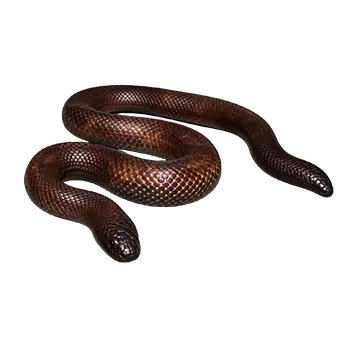
Physically, the Calabar Python is a compact and heavily built snake, typically reaching two to three feet in total length, with a cylindrical body, a short blunt tail that closely resembles its rounded head, smooth glossy scales, and a rich coloration of dark brown to reddish-brown marked with irregular lighter blotches. These features, combined with its unusual defensive behavior of coiling into a tight ball and presenting its tail as a decoy head, make it one of the most morphologically distinctive small snakes in the African herpetofauna.

Indigenous Knowledge & Historical Roles

Throughout the forest belt of West and Central Africa, indigenous communities developed a practical and culturally grounded understanding of the Calabar Python that long predated European scientific engagement with the species. Unlike the large constrictors and venomous snakes that tended to dominate outsiders' perceptions of African serpents, the Calabar Python occupied a quieter and more intimate niche in the daily experience of forest-dwelling peoples. Its habit of emerging from the soil during agricultural clearing, its gentle disposition when handled, and its reliance on small prey like rodents and lizards placed it firmly within the category of animals that rural communities encountered regularly and regarded without significant alarm.

In many communities across the Guinea Coast region, the Calabar Python's docility and burrowing habits associated it with the earth itself and with the agricultural fertility that the earth sustained. Some farming communities regarded the snake as a beneficial presence in gardens and cultivated plots, recognizing its role in controlling populations of small rodents and invertebrates that could damage root crops and seedlings. This practical appreciation for the species' ecological function contributed to a general attitude of tolerance and sometimes active protection toward the snake in areas where its presence coincided with food production.

The Calabar Python's most striking behavioral trait, its tendency to curl into a tight ball and tuck its head beneath its coils when threatened while raising its blunt tail as a false head, attracted particular attention from indigenous observers. This behavior was widely noted across the species' range and incorporated into local knowledge systems as a distinctive identifier for the animal. In some oral traditions, the snake's defensive strategy was interpreted as a form of cleverness or spiritual deception, lending the animal symbolic associations with concealment, self-preservation, and the wisdom of appearing vulnerable while protecting what is most vital.

Among certain communities in southeastern Nigeria, in the broader cultural landscape of the Calabar and Cross River regions where the species was first scientifically described, the burrowing python held a recognized place within the local fauna that reflected the region's rich traditions of ecological knowledge. The peoples of this area, including the Efik, Ibibio, and Ejagham, maintained elaborate systems of natural classification that organized animals according to habitat, behavior, and cultural significance, and the Calabar Python's distinctive habits ensured it a specific and recognized position within these frameworks.

Cultural Symbolism & Folklore

The Calabar Python's symbolic profile in West African cultural traditions is shaped less by the dramatic associations that large constrictors attract and more by the subtler qualities that distinguish this small, secretive species. Where the African Rock Python and other large snakes tend to embody raw power, danger, or divine authority in regional cosmologies, the Calabar Python's associations cluster around themes of concealment, humility, resilience, and the hidden forces that operate beneath the surface of the visible world. Its life beneath the soil and within the leaf litter of the forest floor naturally connected it, in the symbolic logic of many West African traditions, to the subterranean realm and to the processes of growth, decay, and regeneration that take place out of sight.

In the folklore traditions of the Niger Delta and Cross River regions, small ground-dwelling snakes including the Calabar Python appear in stories that emphasize the virtue of modesty and the dangers of arrogance. The snake's defensive ball-curling behavior, in which it sacrifices the use of its head by hiding it and instead offers its tail to potential predators, was read by storytellers as a parable about the willingness to endure minor harm in order to protect what matters most. Such stories served both moral and practical educational purposes, teaching children about the behavior of a commonly encountered animal while also conveying broader lessons about prudence and self-sacrifice.

The snake's association with the soil and with agricultural spaces also connected it to broader West African traditions concerning earth spirits and the spiritual custodianship of the land. In cosmological systems where the earth is regarded as a living spiritual entity with its own agency and custodians, animals that dwell within the ground can be seen as agents or manifestations of these chthonic forces. While the Calabar Python does not appear to have achieved the kind of formalized sacred status that larger pythons hold in traditions like Vodun, its presence in the soil of farms and gardens lent it an aura of quiet spiritual significance in communities where the boundary between the natural and the supernatural was understood as permeable.

In contemporary West African cultural expression, the Calabar Python appears occasionally in the visual arts, poetry, and literary fiction of the region, though it remains far less prominent as a cultural symbol than larger and more dramatic snake species. Where it does appear, it typically serves as a marker of local ecological specificity, grounding a narrative or artistic work in the particular landscape and biodiversity of the West African forest zone. Artists and writers from the Calabar region itself have sometimes invoked the species as a symbol of local identity, a small and unassuming creature that nonetheless carries a distinct name recognized far beyond its home range.

Taxonomic Journey & Scientific Reclassification

Few snakes have experienced as turbulent a taxonomic history as the Calabar Python. Since Schlegel's original 1851 description, the species has been moved between genera and families multiple times as herpetologists have struggled to determine its true phylogenetic relationships. The animal's external morphology presents a puzzle: its heavy cylindrical body, smooth glossy scales, and burrowing habits recall the sand boas of the family Erycidae (now Erycinae), while its geographic range and certain skeletal features have at various times been interpreted as linking it to the true pythons of the family Pythonidae.

For much of the twentieth century, the species was placed in the genus Calabaria and classified within the family Boidae, though its exact position within that family remained uncertain. Some systematists grouped it with the erycine boas, emphasizing the morphological convergences between the Calabar Python and the burrowing boas and sand boas found in other parts of the world. Others maintained that its African origin and certain anatomical features aligned it more closely with the pythons, and proposed placing it in the Pythonidae despite the fact that it lacked some of the defining characteristics of that family, such as heat-sensing labial pits.

The advent of molecular phylogenetics in the late twentieth and early twenty-first centuries brought dramatic new clarity to the Calabar Python's taxonomic position, though the results surprised many herpetologists. DNA-based analyses published from the early 2000s onward consistently recovered Calabaria reinhardtii as the sister taxon to the true pythons rather than to the boas or sand boas, despite the species' superficial resemblance to burrowing boas. This finding supported the interpretation that the Calabar Python represents an ancient and highly specialized lineage that diverged from the ancestors of modern pythons very early in the evolutionary history of the group, retaining a suite of ancestral features while adapting extensively to a fossorial lifestyle.

Some recent taxonomic treatments have placed Calabaria in its own monotypic family, Calabariidae, to reflect the depth of its divergence from both the Pythonidae and the Boidae. This classification emphasizes the species' status as a phylogenetic relic, a sole surviving representative of a lineage that was once presumably more diverse and widespread. Whether the species is ultimately classified within the Pythonidae or maintained in its own family, its taxonomic journey reflects the broader challenges that systematists face when dealing with ancient, morphologically convergent lineages whose true relationships can be revealed only through molecular evidence.

The Calabar Python's shifting taxonomic placement has had practical consequences beyond academic classification. Changes in family-level assignment can affect how the species is treated under wildlife trade regulations, captive-breeding studbooks, and conservation assessments, since these frameworks sometimes apply different rules or protections to different taxonomic families. The ongoing refinement of the species' classification thus intersects with real-world management and conservation decisions in ways that give taxonomic research a concrete applied significance.

The Herpetoculture Movement

The Calabar Python entered the international reptile-keeping hobby gradually, arriving in private collections primarily through the importation of wild-caught specimens from West Africa during the 1970s and 1980s. Unlike the Ball Python, which rapidly became one of the most popular pet reptiles in the world during this same period, the Calabar Python remained a specialist animal appreciated by a relatively small number of experienced keepers. Its cryptic lifestyle, tendency to remain hidden beneath substrate for extended periods, and initially uncertain husbandry requirements meant that the species appealed mainly to herpetologists and advanced hobbyists who valued biological interest over display potential.

Early captive husbandry of the Calabar Python was marked by considerable trial and error. Keepers accustomed to the care of more commonly kept boids often found that the species' requirements differed significantly from those of arboreal or terrestrial pythons. The Calabar Python's need for deep, moisture-retaining substrate, its preference for very small prey items relative to its body size, and its sensitivity to environmental stressors all demanded adjustments to standard snake-keeping practices. The first successful captive breedings were significant milestones within the herpetoculture community, as the species' reproductive biology, including its production of unusually large eggs relative to adult body size and its relatively small clutch size, presented additional challenges.

As captive-breeding techniques improved through the 1990s and 2000s, a small but dedicated community of Calabar Python breeders emerged in North America and Europe. These breeders shared information through specialized online forums, herpetological society meetings, and reptile expos, gradually building a collective knowledge base that made the species more accessible to keepers with intermediate experience. Captive-bred specimens, which tend to be calmer and more predictable in their feeding responses than wild-caught animals, began to appear with increasing regularity at reptile shows and through private breeders, reducing the species' dependence on wild imports for the hobby market.

The Calabar Python's role within herpetoculture today is that of an established but uncommon specialty species. It does not command the commercial attention or the morph-driven market that characterizes the Ball Python trade, but it enjoys a stable and appreciative following among keepers who prize its unique biology, its manageable size, and its gentle temperament. The species has also become something of an ambassador for the broader diversity of African boid snakes, introducing hobbyists to a lineage that most would never encounter through the mainstream pet trade and encouraging a deeper engagement with the evolutionary history and ecology of the snakes they keep.

The Species Today

Today the Calabar Python occupies a position of relative obscurity in the broader landscape of snake conservation, neither critically endangered nor entirely free from the pressures that threaten many tropical forest reptiles. The species' wide distribution across the West and Central African forest belt provides a measure of resilience, as does its ability to persist in degraded habitats, secondary growth, and agricultural landscapes where forest cover has been reduced but ground-level microhabitats remain available. However, the ongoing conversion of tropical forest to farmland, logging concessions, and urban development across the species' range continues to erode the primary habitat on which healthy populations ultimately depend.

In its range countries, the Calabar Python is not typically a target of deliberate persecution by local communities. Its small size, docile nature, and tendency to remain hidden underground mean that it rarely comes into direct conflict with humans in the way that large constrictors or venomous snakes do. Where encounters occur, they are most often incidental to agricultural activity and result in the snake being moved or released rather than killed. This relatively benign relationship with human communities represents a significant advantage for the species' long-term persistence in landscapes that are increasingly dominated by human land use.

The international trade in Calabar Pythons for the pet market, while modest in scale compared to the massive trade in Ball Pythons and other popular species, has raised periodic conservation concerns. Wild-caught specimens continue to enter the market from several West African exporting countries, and the sustainability of harvest levels has been questioned by some researchers and conservation organizations. The species' slow reproductive rate, small clutch sizes, and relatively low population densities compared to more prolific snake species mean that even modest collection pressure could have significant impacts on local populations if not managed carefully.

Scientific interest in the Calabar Python continues to grow, driven in part by the species' unique phylogenetic position and in part by advances in field research technology that make it easier to study secretive, fossorial animals. Radio telemetry studies, environmental DNA sampling, and camera trapping have all been applied or proposed for research on the species, promising to fill significant gaps in knowledge about its ecology, population dynamics, and conservation status. The Calabar Python's story is one of quiet persistence, a small and unassuming animal whose evolutionary distinctiveness and cultural resonance far exceed its modest physical stature, and whose future depends on the continued health of the West African forests that have sheltered it for millions of years.

Always consult a qualified professional before making any health-related decisions. This content is provided for informational reference only and should not replace professional guidance specific to your animal.