
Origins & Taxonomic History

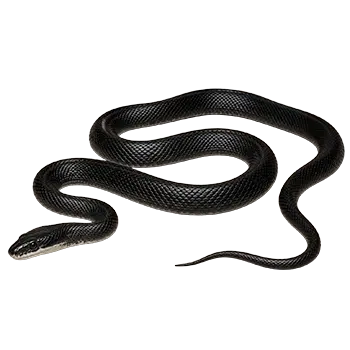
The Black Rat Snake is one of the most recognizable and widely distributed large snakes in eastern North America. Found from southern New England and the Great Lakes region south through the Appalachian Mountains, the Piedmont, and into the upper Gulf Coast states, it occupies a tremendous range of habitats including deciduous forests, rocky hillsides, farmland, old fields, suburban edges, and even the structural interiors of barns and outbuildings. Its adaptability to human-modified landscapes has made it one of the most frequently encountered snakes across much of the eastern United States, and its conspicuous size and striking glossy-black adult coloration have ensured that it has commanded human attention for as long as people have lived within its range.

The species was first formally described to Western science by the naturalist John Edwards Holbrook in the early nineteenth century, though earlier colonial-era observers had recorded detailed accounts of large black snakes in the forests and farmlands of the eastern seaboard. The taxonomic history of the Black Rat Snake is notably complex, reflecting broader debates within herpetology about species boundaries and the relationship between geographic variation and evolutionary divergence. For much of the twentieth century, the Black Rat Snake was classified as Elaphe obsoleta obsoleta, a subspecies within a wide-ranging species complex of North American rat snakes that included the Yellow Rat Snake, Gray Rat Snake, Texas Rat Snake, and Everglades Rat Snake.

A major taxonomic revision in the early 2000s, based on molecular phylogenetic data, transferred the North American rat snakes from the genus Elaphe, which is now restricted to Old World species, into the genus Pantherophis. Subsequent genetic studies further reorganized the species boundaries within this group, and the Black Rat Snake is now recognized as Pantherophis alleghaniensis. This reclassification merged several formerly recognized subspecies into a single species, a move that remains somewhat contentious among herpetologists and hobbyists who had long recognized the distinct regional forms as separate entities. The ongoing taxonomic discussion reflects the broader challenge of reconciling traditional morphology-based classification with modern molecular data.

Regardless of the taxonomic name applied, the animal itself has been a constant and conspicuous presence throughout the forests and farmlands of the eastern United States. Its large size, with adults commonly reaching five to six feet and exceptional individuals exceeding seven or even eight feet, makes it one of the longest native snake species in North America. This imposing stature, combined with a bold willingness to enter human structures in pursuit of rodents and birds, has placed the Black Rat Snake at the center of countless human encounters across hundreds of years of recorded American natural history.

Indigenous Knowledge & Early American Encounters

Long before European colonists arrived on the eastern seaboard, the indigenous peoples of the region possessed detailed and practical knowledge of the Black Rat Snake and its relatives. Native American communities across the eastern woodlands recognized the large black snakes that inhabited forest clearings, rocky outcrops, and riverine corridors, and incorporated them into ecological understanding systems that had been refined over thousands of years of direct observation. The Cherokee, Iroquois, Shawnee, and other nations of the region had specific names and cultural roles for large non-venomous snakes, distinguishing them clearly from the venomous species such as Timber Rattlesnakes and Copperheads that shared their range.

In many eastern woodland cultures, non-venomous snakes including the Black Rat Snake were regarded with a degree of pragmatic tolerance and sometimes active appreciation. Their role as consumers of rodents that could damage stored food supplies was well understood, and some communities permitted or even encouraged the presence of large rat snakes near granaries and food caches. This utilitarian relationship existed alongside more symbolic and spiritual associations, as serpents of various kinds figured prominently in the cosmologies and oral traditions of many eastern indigenous nations.

The arrival of European settlers in the sixteenth and seventeenth centuries brought a dramatically different set of cultural attitudes toward snakes. Drawing on Judeo-Christian symbolic traditions that associated serpents with evil and deception, many colonists viewed all snakes with suspicion and hostility, making little distinction between harmless species and dangerous ones. Colonial-era journals and correspondence frequently describe encounters with large black snakes in terms of alarm and revulsion, and the deliberate killing of any snake encountered near homesteads was a widespread practice that persisted for centuries.

Despite this prevailing hostility, some early American observers took a more measured and curious approach. Naturalists such as Mark Catesby, who produced his landmark Natural History of Carolina, Florida and the Bahama Islands in the 1730s and 1740s, documented the large black snakes of the eastern forests with careful illustrations and descriptions. John and William Bartram, the father-and-son naturalist team who explored the colonial Southeast in the eighteenth century, similarly recorded observations of large rat snakes and noted their ecological role as predators of rodents and birds. These early natural history records provide some of the earliest written documentation of the species that would eventually be formally classified as the Black Rat Snake.

Cultural Symbolism & Rural Folklore

The Black Rat Snake occupies a unique position in the folklore and cultural memory of rural communities across the eastern United States, particularly in the Appalachian region and the upper South. Unlike venomous species, which were universally feared and killed on sight, the Black Rat Snake inspired a more ambivalent and complex set of attitudes that reflected the practical realities of coexistence between farming communities and a large, conspicuous, rodent-eating predator. In many rural households, the Black Rat Snake was grudgingly tolerated or even quietly welcomed in barns and corncribs, where its appetite for mice, rats, and other grain-destroying pests provided a tangible economic benefit.

This functional relationship gave rise to a rich body of folk names that illuminate how different communities perceived the species. The name "black snake" itself was universally understood across the rural East, though it was sometimes applied loosely to both the Black Rat Snake and the Black Racer, two distinct species that superficially resemble each other. Other regional folk names included "pilot snake," a term rooted in the persistent folk belief that Black Rat Snakes guided or "piloted" venomous Timber Rattlesnakes to denning sites. While this belief has no basis in herpetological fact, it reflected a genuine ecological observation: both species do frequently share winter hibernation sites, a behavior known as communal brumation, and encountering both species near the same rocky outcrop or crevice was common enough to sustain the legend across generations.

Appalachian folklore in particular abounds with Black Rat Snake stories and superstitions. The snake's impressive climbing ability, which allows it to ascend vertical tree trunks, barn walls, and even the interiors of houses, gave rise to numerous tales of snakes discovered in rafters, attics, and other elevated locations where they had pursued rodents or birds. These encounters, which could be genuinely startling for the human occupants of the building, became the basis for community anecdotes that were retold and elaborated over decades. The discovery of a large rat snake coiled in a chicken coop, helping itself to eggs, was a near-universal experience in rural poultry-keeping communities and inspired both frustration and a grudging admiration for the snake's resourcefulness.

The cultural symbolism of the Black Rat Snake also intersected with broader American attitudes toward wilderness and rural self-reliance. In the agricultural communities of the nineteenth and early twentieth centuries, a farmer's willingness to tolerate a barn snake rather than kill it was sometimes seen as a mark of practical wisdom and ecological awareness, even before those concepts were articulated in scientific terms. Conversely, the killing of a Black Rat Snake by someone unfamiliar with its beneficial role was sometimes met with disapproval from more experienced neighbors who understood the value of natural rodent control.

Scientific Study & Classification

The scientific study of the Black Rat Snake accelerated significantly during the nineteenth and twentieth centuries as American herpetology matured into a rigorous academic discipline. Early systematic work by Holbrook, Spencer Fullerton Baird, and other pioneering American herpetologists established the species within the broader framework of North American snake taxonomy, though the precise boundaries of the species and its relationships to other rat snakes would remain subjects of debate for well over a century. The geographic variation exhibited by rat snakes across the eastern United States, with populations ranging from solid black in the north to blotched yellow, gray, or orange in the south, presented a particularly challenging problem for taxonomists attempting to determine where one species ended and another began.

For most of the twentieth century, the prevailing taxonomic arrangement treated the various color forms of eastern rat snakes as subspecies within the single species Elaphe obsoleta. Under this framework, the Black Rat Snake was classified as Elaphe obsoleta obsoleta, with the Yellow Rat Snake as E. o. quadrivittata, the Gray Rat Snake as E. o. spiloides, and several other regional forms receiving their own subspecific designations. This arrangement reflected the biological reality that the different color forms intergrade extensively in zones of geographic contact, producing populations of intermediate appearance that defied clean taxonomic separation.

The molecular revolution in systematics, which gathered momentum in the 1990s and 2000s, fundamentally reshaped the understanding of rat snake taxonomy. Phylogenetic analyses based on mitochondrial and nuclear DNA sequences revealed that the North American rat snakes were not closely related to the Eurasian species that constituted the core of the genus Elaphe, necessitating their transfer to the resurrected genus Pantherophis. Further genetic work by Burbrink and colleagues in 2000 proposed splitting the old Elaphe obsoleta complex into three species based on molecular divergence patterns that did not correspond neatly to the traditional subspecies boundaries drawn from color pattern alone.

Under the revised taxonomy, the Black Rat Snake became Pantherophis alleghaniensis, encompassing populations across the northern and central portions of the former species range. This reclassification generated significant discussion within both the scientific community and the herpetoculture world, where hobbyists and breeders had long used the traditional subspecies names to describe and market captive-bred animals. The taxonomic debate remains active, with some researchers advocating for further splitting based on additional genetic data and others arguing that the available evidence does not support the recognition of as many species as have been proposed. Regardless of the outcome of these ongoing discussions, the Black Rat Snake's journey through successive rounds of taxonomic revision illustrates the dynamic and sometimes contentious process by which scientific understanding of biodiversity is refined over time.

The Herpetoculture Movement

The Black Rat Snake was among the first North American snake species to be widely kept in captivity, and its history within the herpetoculture hobby mirrors the broader evolution of reptile keeping in the United States. In the early and mid-twentieth century, before the development of a commercial reptile industry, Black Rat Snakes were commonly kept by amateur naturalists, biology teachers, and curious rural children who captured them from local populations. The species' relative hardiness, willingness to feed in captivity, and generally tractable disposition after a period of acclimation made it a natural entry point into snake keeping for generations of aspiring herpetologists.

As the herpetoculture hobby professionalized during the 1970s and 1980s, the Black Rat Snake and its relatives became subjects of more systematic captive breeding efforts. Breeders worked to establish and refine various color and pattern mutations, including leucistic, albino, and other genetic variants that commanded premium prices in the growing reptile marketplace. The accessibility of wild-caught founder stock across a wide geographic range facilitated these breeding projects, and the species' relatively straightforward reproductive biology made it an attractive subject for both amateur and professional breeders.

The herpetoculture community's engagement with the Black Rat Snake also contributed to scientific knowledge in ways that extended beyond the hobby itself. Captive breeding records provided data on reproductive parameters such as clutch size, incubation temperature and duration, and growth rates that supplemented field-based research. Observations of feeding behavior, thermoregulatory preferences, and individual variation in temperament added to the understanding of the species' biology, and some hobbyist-breeders published their findings in herpetological journals or collaborated with academic researchers on studies of genetics and reproductive physiology.

In the contemporary herpetoculture landscape, the Black Rat Snake occupies a somewhat paradoxical position. It remains widely available and relatively affordable compared to many exotic species, which makes it an excellent choice for beginning keepers seeking a large, impressive, and manageable first snake. At the same time, the proliferation of more colorful and morphologically diverse species in the market has somewhat diminished the commercial prominence of the Black Rat Snake, and dedicated breeders working with the species often emphasize the beauty of well-maintained, naturally colored specimens and the satisfaction of working with a native species whose history is deeply intertwined with the American landscape.

The Species Today

The Black Rat Snake today occupies a position of relative security compared to many reptile species worldwide, though its status is not without concerns. Across much of its extensive range, it remains common and frequently encountered, benefiting from its adaptability to agricultural and suburban landscapes where rodent prey is abundant. Unlike many reptile species that require undisturbed wilderness habitat, the Black Rat Snake has demonstrated a remarkable capacity to persist and even thrive in fragmented and human-modified environments, provided that suitable shelter sites and prey populations remain available.

However, the species does face localized threats that warrant attention. Road mortality represents a significant source of adult mortality in many areas, as Black Rat Snakes frequently cross roads during seasonal movements between foraging areas, hibernation sites, and egg-laying locations. Their large size and relatively slow crossing speed make them particularly vulnerable to vehicular strikes, and the cumulative impact of road mortality on local populations can be substantial, especially in areas where road density is high and wildlife crossing structures are absent. Persecution by humans who mistake them for venomous species or simply kill any snake on sight also continues to take a toll, particularly in rural areas where negative attitudes toward snakes remain deeply entrenched.

The cultural status of the Black Rat Snake has undergone a notable shift in recent decades, driven by growing public awareness of ecological principles and the increasing influence of wildlife education and outreach programs. State wildlife agencies, nature centers, zoos, and herpetological societies across the eastern United States have invested significant effort in educating the public about the ecological value of non-venomous snakes in general and the Black Rat Snake in particular. These educational initiatives emphasize the species' role as a natural pest control agent, its harmlessness to humans and pets, and the importance of tolerating or relocating snakes rather than killing them.

The Black Rat Snake's integration into the broader narrative of North American wildlife conservation reflects a maturation in public attitudes toward reptiles that would have been difficult to imagine a generation ago. While negative perceptions of snakes persist in many communities, the growing visibility of reptile conservation organizations, the popularity of nature documentaries and social media content featuring snakes, and the expanding herpetoculture community have collectively contributed to a more nuanced and informed public discourse about the role of snakes in healthy ecosystems. The Black Rat Snake, as one of the most familiar and frequently encountered large snakes across the populated eastern United States, serves as a key ambassador species in this ongoing cultural transformation.

Always consult a qualified professional before making any health-related decisions. This content is provided for informational reference only and should not replace professional guidance specific to your animal.