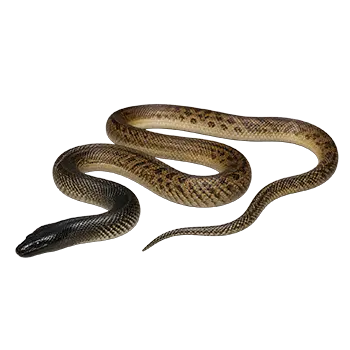

The Black-Headed Python (Aspidites melanocephalus) is one of two species in the genus Aspidites, a lineage considered among the most primitive of all living pythons. The genus name derives from the Greek word for "shield-bearer," a reference to the enlarged symmetrical head scales that distinguish these snakes from most other pythons. The species was first formally described by German naturalist Hermann Schlegel in 1837, based on specimens collected from northern Australia during early European expeditions into the continent's tropical interior.
Aspidites is unique among pythons in that its members lack the heat-sensing labial pits found in nearly all other python genera. This absence, along with other anatomical features such as a relatively small head and robust body, suggests that the genus represents a basal branch of the python family tree. Molecular phylogenetic studies conducted in the late twentieth and early twenty-first centuries have confirmed this positioning, placing Aspidites as a sister group to all remaining Australasian pythons.
The evolutionary history of the Black-Headed Python is tied intimately to the geological and climatic transformations of the Australian continent over millions of years. As Australia drifted northward and its interior became increasingly arid, the ancestors of Aspidites adapted to savanna and semi-arid environments. The Black-Headed Python's current range across the tropical and subtropical north reflects a long history of specialization in warm, seasonally dry habitats where it shelters in animal burrows, rock crevices, and hollow logs.
Early European naturalists were fascinated by the species' striking appearance, particularly the jet-black head and neck that contrast sharply with the banded or striped body. Nineteenth-century herpetological texts frequently remarked on this unusual coloration, speculating about its function. Modern researchers believe the dark head serves a thermoregulatory purpose, allowing the snake to absorb solar heat while the rest of its body remains concealed in shelter.