
The Viral Sensation

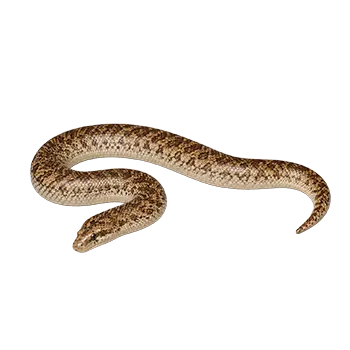
Few snake species have achieved the kind of spontaneous internet celebrity that the Arabian Sand Boa enjoys. The species first entered the broader public consciousness through a series of photographs and short video clips that circulated on social media platforms beginning around 2015 and 2016. These images, typically showing a close-up of the snake's face with its small, beadlike eyes positioned on top of its flattened head, struck viewers as unexpectedly endearing. Comments comparing the snake's expression to a hastily drawn cartoon or a child's first attempt at sketching a serpent proliferated across platforms, and the Arabian Sand Boa rapidly became one of the most widely shared reptile images online.

The appeal of the Arabian Sand Boa's face lies in its departure from the conventional image of a snake. Most people associate snakes with sleek, forward-facing profiles and piercing, laterally positioned eyes. The sand boa, by contrast, presents a blunt, rounded head with tiny eyes perched dorsally, giving it an almost comically startled expression when viewed head-on. This visual incongruity, combined with the species' small and nonthreatening size, made it accessible to audiences who might otherwise have no interest in or even an active aversion to snakes.

The viral spread of Arabian Sand Boa imagery had measurable effects on public engagement with reptile content online. Reptile-focused social media accounts reported significant spikes in followers and engagement when they shared sand boa content, and the species became a reliable source of high-performing posts across platforms including Instagram, Twitter, Reddit, and TikTok. While viral animal content is often fleeting, the Arabian Sand Boa has demonstrated unusual staying power, with new waves of attention recurring as each generation of social media users encounters the species for the first time.

Wildlife Documentaries & Television

The Arabian Sand Boa has appeared in a number of wildlife documentaries and nature television programs, though its coverage has typically been briefer and less prominent than that afforded to larger or more behaviorally dramatic snake species. Its most notable documentary appearances have come in programs focused on Arabian and Middle Eastern desert ecosystems, where it serves as a representative of the specialized fauna that has adapted to one of the planet's most extreme environments.

British and American nature documentary productions have featured the species in segments exploring desert survival strategies. The sand boa's ambush hunting technique, in which it lies buried in sand with only its eyes exposed and strikes at passing lizards with explosive speed, provides compelling footage that translates well to the screen. High-speed camera work has been used to capture the strike in slow motion, revealing the biomechanics of a predatory event that occurs too quickly for the naked eye to fully appreciate. These sequences have appeared in multi-episode series covering global desert habitats as well as in shorter-format nature programming.

Regional broadcasters in the Gulf states have also produced content featuring the Arabian Sand Boa as part of broader programming on national wildlife heritage. Documentaries produced for audiences in the UAE, Oman, and Saudi Arabia have positioned the species within narratives about desert ecology and conservation, often linking the snake's survival strategies to broader themes about resilience and adaptation that resonate culturally in the region. These regional productions, while reaching smaller international audiences than major Western documentary series, have played an important role in shaping local attitudes toward native reptile species.

The species has occasionally appeared in educational programming aimed at younger audiences, where its small size and nonthreatening demeanor make it an effective tool for introducing children to the diversity of snake species and challenging the assumption that all snakes are dangerous. Such appearances, while individually modest, contribute cumulatively to a more nuanced public understanding of reptile diversity.

Photography & Visual Arts

The Arabian Sand Boa has become a favored subject among wildlife and macro photographers, particularly those working in the desert environments of the Arabian Peninsula. The technical challenge of photographing a small, cryptically colored animal in its sandy habitat has attracted skilled photographers seeking to capture images that reveal both the species' remarkable camouflage and its distinctive facial features. Award-winning macro photographs of the sand boa, often showing the animal partially buried with sand grains adhering to its scales, have appeared in regional and international photography competitions.

The species' unusual morphology has also attracted attention from photographers and visual artists interested in the aesthetic qualities of reptile form. The smooth, polished texture of the sand boa's scales, the geometric arrangement of its head scales, and the contrast between its pale ventral coloring and darker dorsal pattern provide rich visual material that lends itself to both documentary and artistic photographic treatment. Some photographers have produced series specifically devoted to the species, exploring its form from multiple angles and in varying lighting conditions to reveal aspects of its appearance not immediately apparent in casual observation.

Beyond traditional photography, the Arabian Sand Boa has inspired illustrative and graphic art within both the reptile enthusiast community and the broader art world. Digital artists have created stylized renderings of the species that exaggerate its most distinctive features, particularly the wide-set dorsal eyes and blunt snout, for use as social media avatars, stickers, and print merchandise. This artistic engagement, while lighthearted in tone, has contributed to making the Arabian Sand Boa one of the most visually recognizable snake species among general audiences who may have limited familiarity with herpetology.

Museums and nature centers in the Gulf states have incorporated photographic and artistic representations of the Arabian Sand Boa into exhibits on regional biodiversity. These installations place the species within the broader context of Arabian desert wildlife, using high-quality imagery to engage visitors with an animal that is rarely encountered in person due to its secretive, subterranean habits.

Social Media & Online Communities

The Arabian Sand Boa's presence on social media extends well beyond its initial viral moments into a sustained and multifaceted online engagement. Dedicated reptile-keeping communities on platforms such as Reddit, Facebook, and specialized herpetological forums maintain active discussions about the species, covering topics from husbandry advice and breeding reports to field observations and conservation news. These communities serve as repositories of practical knowledge that complement the more casual appreciation of the species found on mainstream social media.

On visually oriented platforms like Instagram and TikTok, the Arabian Sand Boa generates a distinctive category of content that bridges the gap between reptile enthusiasm and mainstream animal appreciation. Keepers share short videos showing the snake's burrowing behavior, feeding responses, and interactions with its environment, often set to music or accompanied by humorous commentary. The species' tendency to bury itself and then peek out from beneath the sand with its characteristically wide-eyed expression has proven to be an almost inexhaustible source of engaging content.

The online visibility of the Arabian Sand Boa has had practical consequences for the species' standing in the pet trade and conservation discourse. Increased public awareness generated through social media has driven demand for captive-bred specimens, prompting breeders to expand their programs and making the species more widely available than it was a decade ago. Simultaneously, the heightened visibility has drawn attention to the importance of sourcing animals responsibly and supporting captive breeding over wild collection, with online communities often serving as informal enforcement mechanisms for ethical standards within the hobby.

Science communicators and herpetologists have also leveraged the Arabian Sand Boa's popularity to engage broader audiences with topics in evolutionary biology, desert ecology, and conservation. Popular science accounts on social media use the species as a hook to introduce concepts such as convergent evolution among burrowing reptiles, the physiological demands of desert life, and the ecological roles of small predators in arid ecosystems. This educational dimension adds substance to the species' online presence and demonstrates how viral animal content can serve as a gateway to deeper scientific literacy.

Print Media & Scientific Publications

The Arabian Sand Boa has been the subject of coverage in both popular print media and peer-reviewed scientific literature, though the volume and nature of this coverage differ significantly between the two domains. In popular print, the species has appeared in magazine features on unusual pets, desert wildlife roundups, and articles exploring the phenomenon of viral animal content. Publications ranging from general-interest science magazines to niche reptile hobbyist journals have profiled the species, typically emphasizing its distinctive appearance, manageable care requirements, and unexpected internet fame.

Regional newspapers and lifestyle magazines in the Gulf states have given the Arabian Sand Boa periodic coverage as part of broader reporting on native wildlife and environmental conservation. Feature articles in English-language and Arabic-language publications in the UAE, Oman, and Saudi Arabia have profiled the species in contexts ranging from outdoor recreation guides, advising readers on wildlife they might encounter during desert excursions, to more in-depth environmental journalism examining the conservation challenges facing Arabian desert fauna.

In the scientific literature, the Arabian Sand Boa appears across several research domains. Taxonomic and phylogenetic studies have examined its evolutionary relationships within the sand boa family, contributing to ongoing efforts to resolve the classification of Old World boas. Ecological studies conducted in Oman and the UAE have documented aspects of the species' habitat use, diet, and population density, providing baseline data that informs conservation planning. Physiological research has investigated the sand boa's adaptations for subterranean life, including the structural properties of its scales that facilitate efficient burrowing through loose sand.

Field guides and regional herpetological references covering the reptile fauna of the Arabian Peninsula consistently include the Arabian Sand Boa, and several of these publications have featured the species prominently on their covers or in introductory sections. The snake's photogenic qualities and its status as an Arabian endemic make it a natural choice for visual representation of the region's reptile diversity, ensuring its continued presence in both popular and scientific print media.

Broader Cultural Impact

The Arabian Sand Boa's cultural impact extends beyond its specific media appearances into a broader influence on how the public perceives snakes and desert wildlife. The species has become something of an ambassador for the idea that snakes can be charming, approachable, and even endearing, qualities that run counter to the deeply entrenched cultural aversion that many people feel toward serpents. By presenting a snake that elicits smiles and affection rather than fear and revulsion, the Arabian Sand Boa has played a small but meaningful role in shifting popular attitudes toward a taxonomic group that is often unfairly maligned.

This attitudinal shift is particularly notable in the context of snake conservation, where negative public perception remains one of the most significant barriers to effective protection of threatened species. Conservation organizations have recognized the value of charismatic species in building public support for broader habitat protection efforts, and the Arabian Sand Boa's popularity has provided an opening for messaging about desert conservation that might otherwise struggle to gain traction with general audiences. The species' appeal demonstrates that charisma in wildlife conservation need not be limited to large mammals or colorful birds.

Within the Gulf states, the Arabian Sand Boa has become a minor cultural icon that intersects with national identity and environmental stewardship. As countries in the region invest in conservation infrastructure and environmental education, native species with strong public recognition serve as valuable assets. The sand boa's combination of endemic status, distinctive appearance, and broad public appeal positions it as an effective focal species for engaging citizens in the environmental dimensions of national heritage.

The species' journey from obscure desert specialist to globally recognized internet sensation and conservation talking point illustrates the unpredictable ways in which human cultural engagement with wildlife can develop in the digital age. No marketing campaign or deliberate media strategy elevated the Arabian Sand Boa to its current level of visibility. Instead, the species' inherent visual distinctiveness, amplified by the mechanics of social media sharing, created a cultural phenomenon that continues to generate interest, affection, and meaningful engagement with the natural world.

Always consult a qualified professional before making any health-related decisions. This content is provided for informational reference only and should not replace professional guidance specific to your animal.