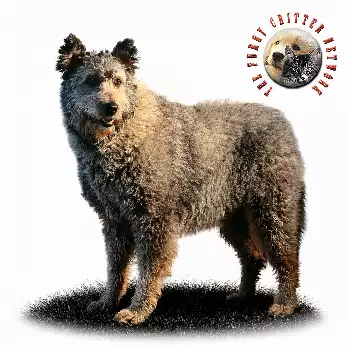

The Pumi emerged in Hungary during the seventeenth and eighteenth centuries, evolving from crosses between the older Puli and various terrier-type herding dogs brought into the region by French and German traders. While the Puli had been an established fixture on the Hungarian plains for centuries, the introduction of these foreign bloodlines produced a lighter, more agile dog with semi-erect ears and a distinctive curly coat. Over several generations of selective breeding by Hungarian shepherds, the Pumi developed into a recognizably distinct type, well suited to the mixed-terrain farmlands of western Hungary.
For much of its early history, the Pumi was not formally distinguished from the Puli or the Mudi, and all three were often grouped together under a loose umbrella of Hungarian sheepdogs. It was not until the early twentieth century that Dr. Emil Raitsits, a professor at the Budapest Veterinary College, undertook a careful study of Hungary's native herding breeds and argued for their classification as separate breeds. His work laid the groundwork for the Pumi to be recognized as its own breed by the 1920s, with a formal standard following soon after.
The breed's development was shaped almost entirely by function. Hungarian farmers valued the Pumi for its ability to drive livestock along narrow paths, work semi-independently in hilly terrain, and alert its handler to intruders or predators. This working emphasis meant that appearance was secondary to performance, and the Pumi's look varied considerably from region to region well into the twentieth century. The modern breed standard, while now more uniform, still reflects this heritage of practicality over aesthetics.
World War II and the political upheaval that followed nearly devastated Hungary's native breeds. Breeding stock was scattered, records were lost, and many rural farming traditions were disrupted by collectivization. Dedicated Hungarian breeders worked through the latter half of the twentieth century to rebuild the Pumi population, relying on surviving dogs in rural areas and careful linebreeding to stabilize the type once more.