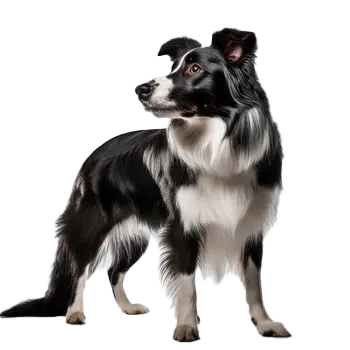

The Border Collie traces its ancestry to the rugged borderlands between England and Scotland, a region where sheep farming was central to daily life for centuries. The terrain itself — steep hillsides, open moorland, and unpredictable weather — demanded a dog that was not only physically resilient but capable of independent decision-making at great distances from its handler. Landrace sheepdogs had worked these hills for generations, but it was through selective breeding in the late nineteenth century that the Border Collie began to emerge as a distinct type.
The breed's defining moment came in 1893 with the birth of a tricolor dog named Old Hemp, bred by Adam Telfer in Northumberland. Old Hemp's working style was revolutionary: quiet, controlled, and intensely focused, using a characteristic crouching posture and hypnotic gaze — known as "eye" — to move sheep with minimal force. He was so effective that he became the most sought-after stud dog in the region and is widely regarded as the progenitor of the modern Border Collie. Virtually every pedigreed Border Collie alive today can trace its lineage back to Old Hemp.
Throughout the early twentieth century, the breed was refined almost exclusively on working ability rather than physical appearance. The International Sheep Dog Society, founded in 1906, maintained a registry based on merit rather than conformation. This emphasis on function over form gave the Border Collie an extraordinarily deep working instinct and an intelligence that consistently ranks at the top of canine cognitive studies. The name "Border Collie" itself was not formally adopted until 1915, when Secretary of the ISDS, James Reid, used it to distinguish these dogs from other collie types.
The breed's development was shaped by practical shepherding needs rather than show-ring aesthetics. This is why Border Collies today display a wider range of coat types, colors, and physical builds than many other purebred dogs. Smooth coats, rough coats, black and white, red and white, tricolor, merle, and other patterns are all accepted because breeders historically selected for brains, stamina, and herding instinct above all else.