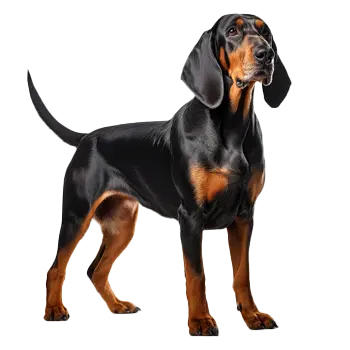

The Black and Tan Coonhound is widely regarded as one of the first truly American dog breeds, with roots that stretch back to the colonial era. Its ancestry traces primarily to the Talbot Hound, a now-extinct scent hound brought to England by William the Conqueror in the eleventh century. Over the centuries, the Talbot line gave rise to the Bloodhound and the Foxhound, both of which contributed heavily to the genetic foundation of the Black and Tan Coonhound as we know it today.
Early American settlers in the Appalachian and Ozark regions needed a dog capable of tracking raccoons through dense, rugged terrain at night. They selectively bred their imported hounds for an exceptional nose, a loud and carrying voice, and the stamina to pursue game over long distances and difficult ground. The distinctive black and tan coloring became a hallmark of the breed, setting it apart from other developing coonhound varieties.
By the late eighteenth and early nineteenth centuries, the Black and Tan Coonhound had emerged as a distinct type, prized by frontier hunters and backwoods families who depended on raccoon pelts for trade income and meat for sustenance. The breed's development was shaped almost entirely by working performance rather than appearance, making it one of the most functionally refined scent hounds in the Americas.
The American Kennel Club officially recognized the Black and Tan Coonhound in 1945, making it the first of the six coonhound breeds to receive AKC recognition. This milestone reflected the breed's long-established identity and its importance within American sporting culture. The breed standard codified the traits that hunters had valued for generations, including the deep chest, long ears, and powerful nose that define the Black and Tan Coonhound.